
1.1 Overview of Digital Logistics

Lesson 1: Introduction to Digital Logistics
Lesson Objective:
This lesson provides a foundational understanding of digital logistics within the European Union regulatory framework, its key principles, the critical importance of digital transformation in the logistics industry, and essential terminology aligned with EU standards. By the end of this lesson, participants will understand the fundamental concepts underlying digital logistics, recognize the EU regulatory requirements shaping the industry (including the eFTI Regulation, AI Act, and Data Act), and be prepared to engage with advanced topics in subsequent lessons. This module is specifically contextualized for logistics professionals operating in Portugal, including the Aveiro region.
1.1 Digital Logistics Overview
Historical Context of Logistics: From Traditional to Digital
a. The Origins and Evolution of Logistics:
Logistics has been a cornerstone of human civilization and trade for millennia. The historical development of logistics can be classified into distinct evolutionary stages, each marked by technological advancement:
- Antiquity (3000 BCE – 500 CE): Primitive logistics involved the transportation of goods and supplies over long distances using animals such as horses, camels, and oxen, supplemented by simple maritime vessels. Ancient civilizations—the Egyptians, Greeks, and Romans—developed rudimentary organizational methods to manage trade routes and supply chains. The Romans, in particular, established sophisticated logistics networks to support military operations and commercial trade across their vast empire.
- Medieval Period (500 – 1450 CE): Medieval logistics saw the emergence of more organized trade routes, including the famous Silk Road connecting Asia to Europe. The establishment of trade fairs and markets in Europe facilitated commercial exchange. Caravans and larger merchant vessels enabled expanded trade across Europe, Asia, and Africa, though logistics remained labor-intensive and slow.
- Industrial Revolution (1760 – 1840): This transformative era introduced steam engines, railroads, and steamships, fundamentally revolutionizing logistics. These innovations dramatically increased both the speed and volume of freight transportation, enabling the movement of goods at unprecedented scales. The Industrial Revolution laid the foundation for modern logistics practices and supply chain management concepts.
- 20th Century – Rise of Modern Logistics (1900 – 1990): The introduction of containerization in the 1950s (pioneered by Malcolm McLean) revolutionized global trade by standardizing the transportation and handling of goods. This era witnessed the development of automated systems, including barcode scanning, computerized inventory management, and warehouse automation. These advances created the infrastructure for increasingly complex and efficient supply chains.

b. The Digital Transformation of Logistics (1990 – Present):
The transition from traditional to digital logistics represents a fundamental paradigm shift in how logistics operations are managed, optimized, and governed. This transformation is driven by multiple convergent factors:
- Technological Advancement: The emergence of Artificial Intelligence (AI), Machine Learning (ML), Internet of Things (IoT), Cloud Computing, and Blockchain technology has introduced unprecedented capabilities for data collection, real-time analysis, and autonomous decision-making in logistics operations.
- Data Integration and Real-Time Visibility: Digital technologies enable the seamless integration of data from multiple sources across the supply chain, providing stakeholders with real-time visibility into inventory levels, shipment status, equipment performance, and environmental conditions. This visibility is now regulated under EU frameworks such as the eFTI Regulation (EU 2020/1056), which mandates electronic freight transport information exchange.
- Supply Chain Complexity: As global commerce has expanded exponentially, supply chains have become increasingly intricate, spanning multiple countries, regulatory jurisdictions, and stakeholders. Digital solutions provide the necessary tools to manage these complex networks efficiently while ensuring compliance with varying regulatory requirements.
- Customer and Regulatory Expectations: Modern consumers demand faster, more reliable deliveries with complete transparency. Simultaneously, regulatory bodies—particularly in the European Union—now mandate digital reporting, data security, and environmental compliance. The EU Data Act (applicable September 12, 2026) and AI Act (applicable August 2, 2026) exemplify this regulatory shift.

Defining Digital Logistics
Digital logistics represents a comprehensive transformation in the management and execution of logistics and supply chain operations, leveraging integrated advanced digital technologies to achieve superior efficiency, transparency, real-time visibility, and regulatory compliance. This transformation goes beyond simply adopting isolated technologies; it involves creating an interconnected ecosystem where data flows seamlessly, systems communicate intelligently, and decisions are informed by real-time, predictive, and prescriptive analytics—all within the framework of EU regulatory requirements.
Core Components of the Digital Logistics Ecosystem

a. Artificial Intelligence (AI)
Artificial Intelligence encompasses computational systems designed to perform tasks requiring human-like cognitive abilities, including pattern recognition, decision-making, and learning from experience. In the logistics context, AI analyzes vast datasets, generates predictive forecasts, and automates complex operational processes.
Key Applications in Digital Logistics:
| Application | Description | EU Regulatory Relevance |
|---|---|---|
| Demand Forecasting | AI algorithms analyze historical sales data, market trends, external economic factors, and seasonal patterns to predict future demand with high accuracy. | Supports compliance with EU Data Act requirements for transparent data use. AI systems must document data sources and processing methods. |
| Route Optimization | AI-powered tools calculate optimal transportation routes by analyzing traffic patterns, weather conditions, fuel costs, delivery time windows, and vehicle capacity. Results in reduced fuel consumption and emissions. | Directly supports EU Green Deal logistics objectives and carbon footprint tracking under emerging sustainability regulations. |
| Disruption Prediction | AI models identify potential supply chain disruptions—supplier delays, port congestion, equipment failures—by analyzing multi-source data, enabling proactive contingency planning. | Enhances supply chain resilience, critical for cross-border EU operations under regulatory scrutiny. |
| Predictive Maintenance | AI predicts equipment failures and maintenance needs before they occur, reducing unplanned downtime and extending asset lifespan. | Supports cost efficiency and operational reliability in EU-regulated transport operations. |
| Personalized Customer Experience | AI enables dynamic, customer-specific service recommendations, delivery options, and communications based on individual preferences and historical behavior. | Subject to GDPR compliance requirements for personal data processing and user consent. |
EU Regulatory Context: The AI Act (EU 2024/1689), fully applicable from August 2, 2026, classifies certain logistics AI applications (particularly those affecting safety or fundamental rights) as “high-risk.” Companies must ensure AI systems used in route optimization, demand forecasting, and customer data processing include explainability features, risk management protocols, and compliance documentation.

b. Machine Learning (ML)
Machine Learning is a specialized subset of AI that trains computational algorithms using historical data to identify patterns, establish relationships, and make increasingly accurate predictions without explicit programming. ML systems continuously refine their accuracy as they process additional data, making them ideally suited for dynamic logistics environments.
Key Applications in Digital Logistics:
| Application | Description | EU Regulatory Relevance |
|---|---|---|
| Inventory Management | ML models analyze historical sales, seasonal trends, supplier lead times, and inventory holding costs to optimize stock levels dynamically. Reduces overstocking and stockout risks. | Complies with Data Act transparency requirements—data sources and processing logic must be documented. |
| Advanced Demand Forecasting | ML algorithms learn from multi-year demand patterns combined with external variables (economic indices, competitor activity, regulatory changes) to generate highly accurate forecasts. | Supports efficient resource allocation and reduces waste, aligning with EU Circular Economy Action Plan objectives. |
| Automated Task Processing | ML automates routine, high-volume tasks: order processing, shipment sorting, invoice matching, label generation. Reduces manual errors and labor costs while improving processing speed. | Automation must comply with worker protection regulations—companies must assess impact on employment and provide training programs. |
| Anomaly Detection | ML systems identify unusual patterns deviating from normal operations: unexpected delivery delays, temperature excursions, inventory discrepancies, fraudulent orders. Enables rapid intervention. | Critical for food safety compliance (temperature-sensitive goods), pharmaceutical traceability (GDPR-regulated data), and fraud prevention. |
| Supplier Performance Analysis | ML evaluates supplier reliability, quality consistency, pricing trends, and compliance with contractual terms over time. Informs procurement decisions. | Supports due diligence requirements under EU Corporate Sustainability Due Diligence Directive (CSDDD). |
EU Regulatory Context: ML systems processing personal data (customer information, employee data) fall under GDPR obligations, including the right to explanation (Articles 13-15). Under the AI Act, ML-based decision systems affecting significant logistics outcomes require documented risk assessments and human oversight mechanisms.

c. Internet of Things (IoT)
The Internet of Things refers to the interconnected network of physical devices, sensors, and equipment embedded with computational capabilities that collect, exchange, and communicate data continuously over the internet. In logistics, IoT provides unprecedented granular, real-time visibility into asset location, condition, and performance.
Key Applications in Digital Logistics:
| Application | Description | EU Regulatory Relevance |
|---|---|---|
| Real-Time Tracking and Location Services | IoT devices including GPS trackers, RFID tags, and cellular beacons enable continuous real-time monitoring of shipment location and movement throughout the supply chain. Provides accurate delivery estimates and customer transparency. | Central requirement of eFTI Regulation (EU 2020/1056)—mandates electronic freight information exchange, including location data, with full implementation by July 9, 2027. |
| Environmental Condition Monitoring | IoT sensors (temperature, humidity, pressure, light, acceleration) continuously monitor conditions during transportation and storage, ensuring goods remain within specified parameters. Critical for food, pharmaceutical, and chemical products. | Mandatory for food safety compliance (FSMA, HACCP principles) and pharmaceutical supply chain integrity (Good Distribution Practice—GDP). Temperature deviations must be automatically logged and reportable. |
| Asset and Container Management | IoT tracking on containers, pallets, and logistics equipment monitors their location, utilization rates, and condition. Reduces asset loss, optimizes container repositioning, and improves asset utilization rates. | Supports circular economy objectives—tracking container reuse and lifecycle. Data must be managed under Data Act transparency requirements. |
| Predictive Equipment Maintenance | IoT sensors on vehicles, warehouse equipment, and material handling systems collect real-time performance and wear data. Algorithms predict maintenance needs before failure. Reduces downtime and extends asset lifespan. | Supports operational continuity for cross-border EU road transport operations. Maintenance records may be required for regulatory audits. |
| Supply Chain Security and Cargo Monitoring | IoT devices detect unauthorized access, tampering, or theft of shipments. Enables rapid response to security incidents. | Critical for high-value goods, pharmaceutical tracking, and compliance with EU anti-counterfeiting regulations. |
EU Regulatory Context: IoT data collection and transmission must comply with GDPR (where location or personal data is involved), NIS2 Directive (cybersecurity requirements for critical transport infrastructure), and the ePrivacy Directive (for electronic communications). The eFTI Regulation specifically mandates standardized electronic data formats for freight information, requiring IoT systems to integrate with eFTI-compliant platforms.

d. Blockchain Technology
Blockchain is a distributed, decentralized digital ledger that cryptographically records transactions and data across a network of computers. Each transaction is grouped into a “block” and linked chronologically in an immutable “chain,” creating a tamper-proof, transparent, and auditable record accessible to authorized parties.
Key Applications in Digital Logistics:
| Application | Description | EU Regulatory Relevance |
|---|---|---|
| Transparency and Supply Chain Traceability | Blockchain creates an immutable, chronological record of every transaction, transfer, and location change throughout the supply chain. All authorized stakeholders (shippers, carriers, customs, recipients) can verify the complete provenance and journey of goods. | Directly supports eFTI Regulation objectives for transparent, verifiable freight information. Blockchain can serve as a secure backend for eFTI data exchange platforms. |
| Product Authentication and Anti-Counterfeiting | Blockchain records every verification step and transaction. High-value or counterfeit-prone items (pharmaceuticals, luxury goods, electronics) can be verified as authentic by checking the blockchain record against manufacturer records. | Essential for pharmaceutical supply chain integrity (EU Good Distribution Practice), luxury goods authentication, and compliance with EU anti-counterfeiting directives. |
| Regulatory Compliance and Audit Trails | Blockchain maintains a secure, immutable record of all documentation, certifications, inspections, and transactions. This facilitates regulatory audits and demonstrates compliance with industry standards and legal requirements. | Supports compliance with GDPR audit requirements, customs documentation (Single Window environment), and export/import regulations. Blockchain-based audit trails are increasingly accepted by regulatory authorities. |
| Smart Contracts for Automated Transactions | Smart contracts are self-executing digital agreements with predefined conditions encoded into the blockchain. When conditions are met (e.g., goods arrive at destination, quality checks pass, payment terms satisfied), the contract automatically executes agreed actions (payment transfer, documentation release, license transfer). | Reduces administrative overhead and potential disputes. Particularly valuable for cross-border EU transactions where smart contracts can automate customs clearance, VAT documentation, and payment settlement in compliance with relevant regulations. |
| Data Integrity in Cross-Border Operations | Blockchain ensures that data cannot be altered retroactively, providing absolute certainty about the chain of custody, especially critical in international trade disputes. | Critical for international commercial disputes, regulatory investigations, and establishing liability in multi-party supply chains spanning multiple EU jurisdictions. |
EU Regulatory Context: While blockchain offers significant regulatory benefits, its implementation must still comply with GDPR (particularly regarding data erasure rights—”right to be forgotten”—which conflicts with blockchain immutability; solutions include encrypting personal data on-chain), eIDAS Regulation (for digital signatures and trust services), and Data Act requirements for data portability and access rights. The eFTI Regulation explicitly recognizes blockchain-based platforms as potential technology infrastructure for compliant freight information exchange.

e. Cloud Computing and Data Integration Platforms
Cloud Computing provides on-demand access to shared computational resources—servers, storage, databases, software applications—delivered over the internet. In logistics, cloud platforms serve as the central nervous system integrating data from IoT devices, AI/ML systems, enterprise software, and external partners.
Key Applications in Digital Logistics:
- Centralized Data Management: Cloud platforms collect, standardize, and store data from all supply chain sources, providing a single source of truth for enterprise-wide decision-making.
- Real-Time Data Integration: Cloud infrastructure enables seamless, instantaneous data flow between warehouse management systems (WMS), transportation management systems (TMS), enterprise resource planning (ERP) systems, and customer platforms.
- Scalability and Flexibility: Cloud infrastructure scales automatically to accommodate peak demand periods (holiday seasons, promotional campaigns) without requiring investment in physical infrastructure.
- Disaster Recovery and Business Continuity: Cloud-based redundancy and backup systems ensure logistics operations can continue even during unexpected disruptions.
EU Regulatory Context: Cloud service providers must comply with GDPR data protection requirements, including Data Processing Agreements (DPAs). The Data Act (applicable September 12, 2026) includes provisions affecting how logistics companies can access and port data stored on cloud platforms. The NIS2 Directive requires critical infrastructure operators (including major logistics providers) to implement robust cybersecurity measures for cloud-based systems.

Key Components of Digital Logistics:
Digital logistics integrates multiple interconnected components that collectively enhance efficiency, transparency, and operational effectiveness. Understanding these components is essential for companies seeking to leverage technology to optimize supply chain performance while maintaining regulatory compliance.
a. Data-Driven Decision Making
Real-time Analytics:
Real-time analytics represents the continuous, instantaneous collection, processing, and analysis of data as it is generated throughout logistics operations. This capability enables companies to gain immediate operational insights and make decisions based on current, accurate information rather than historical trends.
Applications of Real-Time Analytics
| Application | Implementation | EU Compliance Considerations |
|---|---|---|
| Dynamic Inventory Management | Systems monitor inventory levels continuously across all warehouses and distribution centers. When stock falls below predetermined thresholds or demand spikes unexpectedly, the system automatically triggers replenishment orders or alerts managers to adjust stock allocation across locations. | Must comply with Data Act requirements—companies must document how real-time data is collected, used, and shared with supply chain partners. |
| Adaptive Shipment Scheduling | Real-time visibility of shipment status, transit conditions (temperature, humidity, security), and vehicle location enables dynamic adjustment of delivery schedules. Systems can reroute shipments to avoid congestion or environmental excursions (e.g., temperature deviations for perishable goods). | eFTI Regulation mandates real-time electronic freight information availability to authorized parties. Real-time systems must integrate with eFTI-compliant platforms by July 9, 2027. |
| Dynamic Route Optimization | Real-time traffic, weather, and road condition data are continuously analyzed. AI systems recalculate delivery routes in real-time, adjusting for congestion, accidents, or adverse weather. Drivers receive updated navigation instructions to minimize delivery delays and fuel consumption. | Supports EU Green Deal emissions reduction objectives. Companies should track and report route optimization savings as part of sustainability compliance initiatives. Data collection from traffic systems must comply with ePrivacy Directive. |
| Warehouse Operations Monitoring | Real-time dashboards display warehouse activity: throughput rates, labor utilization, equipment status, picking accuracy, packing speed. Managers identify bottlenecks immediately and reallocate resources or call in additional staff. | Supports operational efficiency. Labor monitoring must respect GDPR and worker privacy rights—companies cannot conduct excessive surveillance. |
| Customer Communication and Transparency | Real-time shipment tracking data is transmitted to customers, providing delivery status, estimated arrival times, and any exceptions or delays. Notifications are automatically generated and delivered through multiple channels (SMS, email, app notifications). | GDPR applies—customer contact information and delivery data are personal data. Companies must obtain explicit consent for tracking communications and provide transparent privacy notices. |
Predictive Analytics:
Predictive analytics employs statistical algorithms, machine learning models, and historical data analysis to forecast future trends, behaviors, and events. Unlike real-time analytics (which responds to current conditions), predictive analytics enables proactive planning and risk mitigation by anticipating future challenges.
Applications of Predictive Analytics:
| Application | Implementation | EU Compliance Considerations |
|---|---|---|
| Demand Forecasting and Inventory Planning | Historical sales data, seasonal patterns, promotional calendars, economic indicators, and competitor activity are analyzed to forecast future demand. Inventory levels are optimized in advance to match predicted demand, reducing overstocking (storage costs) and understocking (stockouts, lost sales). | Improves resource efficiency, supporting EU Circular Economy Action Plan objectives. If AI/ML systems make significant business decisions based on forecasts, they may fall under AI Act “high-risk” classification, requiring documented risk assessments and human oversight. |
| Supply Chain Disruption Prediction | ML models analyze supplier performance histories, geopolitical events, weather patterns, and port congestion data to identify risks of disruptions. Early warning enables procurement teams to identify alternate suppliers, increase safety stock, or adjust production schedules before disruptions occur. | Critical for supply chain resilience. The EU Corporate Sustainability Due Diligence Directive (CSDDD) requires companies to assess and mitigate supply chain risks—predictive systems support this compliance obligation. |
| Equipment and Vehicle Failure Prediction | IoT sensors collect continuous performance and wear data from trucks, warehouse equipment, conveyor systems, and handling devices. Predictive models forecast likely failure times, enabling maintenance scheduling before failures occur. Prevents unplanned downtime and extends asset lifespan. | Improves operational continuity for EU road transport operations. Maintenance records may be required for regulatory audits and insurance claims. |
| Demand Variability and Risk Management | Predictive models quantify demand uncertainty and supply chain variability. This enables companies to calculate optimal safety stock levels and supplier backup arrangements, balancing service level targets with inventory holding costs. | Supports financial risk management. Companies can better estimate working capital requirements and communicate supply chain risks to investors and financial stakeholders. |
| Customer Churn and Retention Prediction | Models identify at-risk customer relationships by analyzing order frequency trends, complaint patterns, and service failures. Enables proactive customer retention initiatives—outreach, service improvements, loyalty incentives—before customers switch to competitors. | Involves processing customer personal data. Subject to GDPR restrictions—customer profiles and behavior analysis constitute special category data processing, requiring explicit consent and transparent privacy practices. |
| Pricing and Revenue Optimization | Predictive models forecast demand elasticity and competitive pricing, enabling dynamic pricing strategies that maximize revenue. AI systems can adjust pricing automatically based on demand signals, competitor actions, and inventory levels. | AI Act may classify dynamic pricing systems as “high-risk” if they significantly impact consumer transactions. Companies must ensure pricing algorithms are explainable and not discriminatory. |

b. Automation and Robotics
Automated Warehousing and Material Handling
Automation in warehousing involves deploying robotics, conveyor systems, and computerized control systems to execute tasks traditionally performed by human workers. Modern automated warehouses combine vision systems, artificial intelligence, advanced sensors, and mechanical systems to achieve unprecedented speed, accuracy, and scalability.
Applications of Warehouse Automation:
| Application | Technology & Implementation | EU Compliance & Impact |
|---|---|---|
| Automated Picking and Packing Systems | Robots equipped with computer vision, gripper technology, and tactile sensors navigate warehouse aisles, identify target items, retrieve products, and place them into orders. Systems learn product configurations and adjust gripper pressure automatically. Pick accuracy exceeds 99.9%; picking speeds reach 300+ picks per hour per robot. | Labor considerations: Automation reduces labor requirements. Under EU Employment Directives, companies must provide training and redeployment support for displaced workers. Worker safety regulations apply—automated systems must include emergency stop mechanisms and safety guards. GDPR: Camera systems and tracking systems for workers must respect privacy rights. |
| Automated Sorting and Routing Systems | Conveyor networks integrated with barcode/RFID scanning and AI-based sorting logic automatically route packages to their destination zones. Packages are sorted by delivery area, customer, or service level without human intervention. Throughput can exceed 20,000 parcels per hour. | Dramatically improves operational efficiency. Supports EU Green Deal by consolidating shipments and optimizing routes. Energy consumption of warehouses must be tracked for compliance with Energy Efficiency Directive. |
| Inventory Counting and Stock Management Automation | Robots equipped with RFID readers or cameras conduct autonomous inventory counts, verifying stock levels without shutting down warehouse operations. Systems update inventory records in real-time, eliminating manual counting errors and reducing inventory shrinkage. | Data accuracy: Automated inventory records are more reliable for regulatory reporting and financial statements. GDPR: If systems include worker location tracking, privacy protections apply. |
| Goods-to-Person (GTP) Systems | Rather than workers traveling to retrieve products, automated carousel or mobile robot systems bring product shelves to workers’ stations. Workers pick items from shelves brought to them, dramatically reducing walking distances and fatigue. | Ergonomics and worker health: GTP systems reduce repetitive strain injuries and musculoskeletal disorders. Improves worker satisfaction and retention. Labor safety regulations apply. |
| Autonomous Mobile Robots (AMRs) in Warehouses | Mobile robots navigate warehouse floors using simultaneous localization and mapping (SLAM), identifying obstacles and optimizing paths in real-time. AMRs transport bins, containers, and pallets between work stations, eliminating manual material handling. | Safety requirements: AMRs must comply with ISO/IEC 61508 (functional safety) and ISO/IEC 61511 standards. They must detect human workers and stop or slow down to prevent collisions. Operators must receive training. |
Autonomous Vehicles for Freight Transport
Autonomous vehicles (AVs)—including autonomous trucks, delivery vans, and drones—use integrated systems of sensors, artificial intelligence, and real-time communication to navigate and operate without human driver intervention.
Applications of Autonomous Freight Vehicles:
| Vehicle Type | Capabilities & Current Status | EU Regulatory Framework |
|---|---|---|
| Autonomous Trucks (Long-Haul and Regional Transport) | Heavy-duty trucks equipped with LiDAR, radar, camera arrays, and advanced computing systems navigate highways and regional routes autonomously. Current implementations (2024-2026) are primarily on dedicated routes with limited conditions. Full autonomous capability is emerging but not yet widely deployed in EU. Advantages: continuous operation (no driver fatigue), optimized routes and fuel consumption, potential safety improvements. | EU Automated and Connected Driving Regulation (under development): The EU is establishing regulatory frameworks for autonomous vehicles. Current status (as of September 2026): Autonomous truck operations require dedicated testing corridors and operator oversight protocols. Full Level 5 autonomy (no human intervention required) is not yet permitted for heavy goods vehicles on public roads. Driver regulations: Even partially autonomous vehicles must comply with EU Mobility Package regulations (driver rest periods, working time limits). |
| Autonomous Delivery Vehicles (Last-Mile) | Smaller autonomous vehicles (electric vans) operate in urban and suburban areas for last-mile delivery. These vehicles navigate streets, avoid obstacles, and deliver packages to customer locations. Some implementations include lockboxes where customers retrieve packages. | Urban mobility regulations: Autonomous delivery vehicles must comply with local traffic laws and municipal regulations. Cities are establishing autonomous vehicle zones where operation is permitted. Vehicle certification: Vehicles must meet European Type Approval requirements. Insurance requirements: Autonomous vehicle operators must carry liability insurance—regulatory frameworks are still evolving. |
| Delivery Drones and Aerial Vehicles | Unmanned aerial vehicles (UAVs/drones) deliver small packages (typically <5 kg) for quick delivery in urban and remote areas. Drones reduce delivery times to hours rather than days for time-sensitive items. | EU Drone Regulation (EASA Part 4): Drones fall under EASA regulations, which define operational categories (Open, Specific, Certified) based on risk levels. Delivery drones currently operate in Specific and Certified categories, requiring special authorizations, pilot licensing, and airspace coordination. Privacy and safety: Drones carrying cameras must comply with GDPR (no photography of people without consent) and ePrivacy Directive. Insurance: Operators must carry liability insurance and comply with air traffic control requirements. Current status (2026): Autonomous drone delivery is permitted in designated pilot zones in several EU countries; full commercial deployment is conditional on operator certification and airspace management. |

c. Real-Time Visibility and Supply Chain Transparency
Tracking Systems and IoT Infrastructure
Real-time visibility provides stakeholders across the supply chain with continuous, accurate information about shipment location, status, and condition. This transparency is no longer optional—it is increasingly mandated by EU regulations, particularly the eFTI Regulation (EU 2020/1056).
Tracking Technologies and Applications:
| Technology | Application | EU Regulatory Integration |
|---|---|---|
| GPS and Global Navigation Satellite Systems (GNSS) | Vehicles and mobile assets are equipped with GPS receivers that transmit location coordinates at regular intervals (every 30 seconds to 5 minutes, depending on system configuration). Location data is displayed on management dashboards and customer-facing tracking interfaces. Accuracy is typically 5-15 meters in urban areas. | eFTI Regulation mandates electronic freight information exchange, including vehicle location. By July 9, 2027, all freight operations crossing EU borders or on designated routes must provide location data through eFTI-compliant platforms. Privacy: Location data is personal data under GDPR—companies must obtain consent and provide transparent privacy notices. |
| RFID (Radio Frequency Identification) Tags | Passive or active RFID tags are attached to shipments, containers, or pallets. RFID readers at warehouse doors, loading bays, and distribution centers automatically detect tagged items as they move through facilities. RFID provides precise location within buildings and does not require line-of-sight like barcodes. | Supply chain traceability: RFID is the foundation of GS1 EPCIS (Electronic Product Code Information Services) standards, which enable real-time supply chain event tracking. EU companies increasingly use RFID to comply with food traceability regulations (FSMA), pharmaceutical supply chain integrity (Good Distribution Practice), and EU product safety directives. |
| Cellular and Internet Connectivity Trackers | IoT devices with cellular connectivity (4G/LTE, emerging 5G) provide real-time tracking updates even in areas without Wi-Fi. These “smart trackers” continuously transmit location, altitude, speed, and sensor data to cloud platforms. | Requires ePrivacy Directive compliance—cellular data transmission must be secure and encrypted. Companies must document data retention policies and provide users with transparency regarding data collection. |
| Blockchain-Based Location Verification | Location data from GPS, RFID, and cellular trackers is recorded in blockchain systems, creating an immutable, verifiable record of shipment movements. This provides absolute proof of location history for regulatory audits or legal disputes. | Supports eFTI Regulation transparency objectives. Blockchain records can serve as legal evidence in cross-border disputes, particularly valuable for high-value goods or regulated items (pharmaceuticals, hazardous materials). |
Condition Monitoring and Environmental Sensors
Condition monitoring involves continuous measurement of environmental and operational parameters during shipment transit and storage. This is critical for goods sensitive to temperature, humidity, pressure, light, or vibration.
Condition Monitoring Applications:
| Parameter | Monitoring Technology | Industry Applications | EU Regulatory Requirements |
|---|---|---|---|
| Temperature and Humidity | Wireless IoT sensors record temperature and humidity at 5-15 minute intervals during transit and storage. Data is transmitted to cloud platforms where algorithms detect excursions (deviations from specified ranges). Alerts are generated immediately if limits are exceeded. | Food safety: Fresh produce, dairy, and prepared foods must maintain specific temperature ranges to prevent spoilage and pathogen growth. Pharmaceuticals: Temperature-sensitive medicines (vaccines, biologics) require precise temperature control (+2°C to +8°C or specific ranges). Chemicals: Hazardous materials may be sensitive to temperature-induced reactions. | Food Safety: EU Regulation (EC) 852/2004 (Hygiene of Foodstuffs) requires temperature monitoring for high-risk foods. Pharmaceuticals: Good Distribution Practice (GDP) for pharmaceutical products mandates temperature monitoring and documentation. Temperature deviations must trigger investigation and corrective action. Hazardous materials: IMDG Code (for maritime) and ADR (for road transport) require monitoring of temperature-sensitive hazardous goods. |
| Pressure and Altitude | Barometric sensors detect pressure changes, indicating altitude variations during air transport or vehicle elevation changes. Sudden pressure drops may trigger opening of containers or equipment activation. | Air cargo: Critical for detecting cabin pressure anomalies during aircraft transport. High-altitude transport: Mountain routes may have pressure variations affecting goods. | Not specifically regulated but relevant for aviation safety and cargo security. |
| Vibration and Shock Detection | Accelerometers measure vibration magnitude and shock impacts during transport. Excessive vibration can damage fragile goods (electronics, glass, precision instruments). Shock detection indicates rough handling or collisions. | Electronics: Prevents damage to sensitive components. Glass and ceramics: Detects impacts that may cause hidden fractures. Precision instruments: Ensures goods arrive undamaged. | Product safety regulations (e.g., General Product Safety Regulation—GPSR, applicable December 2024) require manufacturers to ensure goods reach consumers in safe condition. Vibration monitoring provides evidence of proper handling. |
| Light Exposure | Light sensors (photosensitivity detectors) record exposure to light, which can degrade light-sensitive products (photographs, certain chemicals, pharmaceuticals, wines). | Photography and sensitive chemicals: Light exposure can render products unusable. Wine and spirits: Light exposure affects product quality. Pharmaceuticals: Some medications degrade rapidly with light exposure. | Pharmaceutical regulations and food quality standards implicitly require protection from light degradation. Product quality documentation often references light protection measures. |
| Geofencing and Location-Based Alerts | Geofencing uses GPS data to define virtual boundaries (e.g., authorized delivery zones, restricted areas, customs borders). When shipments enter or exit geofenced areas, automated alerts are generated, enabling verification of proper routing. | Cross-border operations: Verifies shipments cross borders at designated customs checkpoints. Theft prevention: Alerts if shipments deviate from expected routes. Compliance verification: Ensures hazardous materials don’t enter restricted areas. | eFTI Regulation includes provisions for route verification and border crossing documentation. Geofencing supports compliance with customs regulations and trade security requirements. GDPR: Geofencing data is location tracking—subject to privacy regulations and user consent requirements. |
Proactive Problem Resolution and Issue Management
Real-time visibility enables supply chain teams to identify and resolve issues before they impact customers.
Proactive Management Applications:
- Exception Management: When sensors detect deviations (temperature excursion, schedule delay, geofencing violation), automated systems generate alerts. Supply chain managers review exceptions and initiate corrective actions—reroute shipment, contact carrier, notify customer, escalate to quality assurance.
- Performance Trending and Predictive Intervention: Rather than reacting to individual exceptions, systems analyze patterns. If a carrier consistently experiences delays, systems may proactively reroute future shipments through alternate carriers before delays occur.
- Supplier Quality Collaboration: Real-time visibility identifies patterns indicating supplier quality issues (repeated temperature excursions from cold storage suppliers, frequent damage reports from specific carriers). This enables targeted improvement initiatives and negotiation of service level improvements.
- Customer Proactive Communication: Rather than customers discovering delayed shipments, logistics providers proactively notify customers of delays and provide updated delivery estimates, reducing frustration and improving satisfaction.

d. Collaboration Platforms and Ecosystem Integration
Integrated Platforms and Digital Freight Information Exchange
Digital collaboration platforms connect all supply chain participants—suppliers, manufacturers, logistics providers, distributors, customers, and regulatory authorities—enabling seamless communication, real-time data exchange, and coordinated decision-making. These platforms represent a fundamental shift from isolated, point-to-point systems to harmonized, interoperable ecosystems mandated by EU regulations.
Integrated Platform Applications and EU Regulatory Integration:
| Platform Component | Functionality | EU Regulatory Integration |
|---|---|---|
| Centralized Communication Hub | Digital platforms provide a single point of contact for all supply chain communications: purchase orders, shipping instructions, tracking requests, exception notifications, delivery confirmations, and regulatory documentation. Reduces miscommunication and ensures all stakeholders have access to the same standardized information in real-time. | eFTI Regulation (EU 2020/1056): Platforms must function as certified eFTI repositories where economic operators upload freight documents (consignment notes, dangerous goods declarations, cargo manifests) electronically. Member State authorities must accept electronically submitted information via these platforms by 9 July 2027. Platforms must comply with UN/CEFACT data modeling standards to ensure machine-to-machine automation of data exchange. |
| Electronic Consignment Notes (e-CMR/eWaybill) | Digital versions of the Convention on the Contract for the International Carriage of Goods by Road (CMR) consignment notes. These replace paper documents and contain standardized data fields: shipper details, consignee, cargo description, hazard classifications, routing instructions, and certification marks. Data is structured according to harmonized EU data models. | eFTI Common Data Set: The EU has established a harmonized eFTI common data set derived from UN/CEFACT standards and adapted to national requirements. All eFTI platforms must support the complete eFTI data set and designated data subsets (e.g., for dangerous goods, waste shipments, air cargo). This ensures interoperability across all EU Member States and compliance with cross-border transport regulations. The eCMR (electronic CMR) is central to this framework. |
| Multi-Modal Transport Integration | Platforms facilitate seamless coordination across multiple transport modes (road, rail, air, inland waterway, maritime) by translating data between mode-specific formats. A single shipment may require different documentation for each leg: road transport uses eCMR, rail uses telematics protocols, air cargo uses air waybills, and maritime uses bill of lading standards. | EU Interoperability Requirements: Per Directive 2010/40/EU (Intelligent Transport Systems) and Regulation 2017/1926 (Multimodal Travel Information), platforms must integrate data from multiple transport modes and provide real-time information to competent authorities. For rail freight, TSI Telematics standards (applicable from 2026) require digital data sharing between operators and regulatory bodies. Platforms serving multimodal routes must integrate with National Access Points (NAPs) established by member states. |
| eFTI Platform Access & Data Retrieval | Certified eFTI platforms enable secure, authorized access by competent authorities (customs, police, tax authorities, safety inspectors) through an eFTI gate. Authorities can query and retrieve freight information for specific shipments in real-time without manual document inspection. Access is role-based: only authorized officials with appropriate credentials can retrieve data relevant to their jurisdiction. | 4-Corners Model Compliance: The eFTI Regulation mandates a “4-corners” model: the economic operator uploads data to a certified platform, competent authorities access data via an eFTI gate, and communication flows between economic operators and authorities. Platforms must implement GDPR-compliant access controls and audit trails documenting all data access. Cross-border authority access is enabled by interconnected eFTI gates following EU Single Window Environment for Customs standards. |
| Blockchain-Based Document Verification | Digital freight documents (eCMR, waybills, dangerous goods declarations) are recorded in blockchain systems, creating immutable, cryptographically secured records. Each transaction (document creation, modification, authority review) generates a unique hash linked to previous records, enabling verification of document authenticity and tracking of all modifications. | EU Data Integrity Requirements: While blockchain is not mandated by eFTI Regulation, it supports compliance objectives by ensuring non-repudiation (parties cannot deny submitting or approving documents). For high-value goods, pharmaceuticals, and hazardous materials, blockchain-verified documents serve as legal evidence in disputes. Blockchain records must comply with eIDAS Regulation (EU 910/2014) on electronic signatures and advanced electronic signature requirements for cross-border legal recognition. |
| Geofencing and Border Crossing Verification | Digital borders and customs checkpoints are defined as geofenced areas in platform databases. When a shipment equipped with GPS tracking crosses a border or enters a designated control zone, the system automatically triggers notifications and may require real-time status updates or document verification from competent authorities. | eFTI Border Compliance: The eFTI Regulation specifically mandates electronic verification of cross-border transport. Geofencing integrates with eFTI platforms to ensure that authorities automatically detect when shipments cross borders and can request or retrieve eFTI documentation. For dangerous goods transport, this is critical: ADR (European Agreement Concerning the International Carriage of Dangerous Goods by Road) and IMDG Code (International Maritime Dangerous Goods Code) compliance is verified through automatic geofencing and platform alerts when shipments approach restricted areas or require special handling during border transit. |
| Sustainability & Compliance Reporting | Platforms consolidate environmental and compliance data: fuel consumption, carbon emissions, vehicle type (electric/hybrid/diesel), loading efficiency, waste management compliance. Real-time dashboards provide visibility into supply chain sustainability metrics and support reporting against EU green logistics mandates. | EU Green Logistics & Sustainability: Platforms must support compliance with the EU Sustainable and Smart Mobility Strategy, which mandates reduction of transport carbon emissions. eFTI platforms increasingly include sustainability metrics required by the Corporate Sustainability Reporting Directive (CSRD) and supply chain transparency standards. Platforms serving pharmaceutical, food, or regulated-goods industries must document compliance with temperature, humidity, and environmental monitoring data—a requirement explicitly tied to GDP (Good Distribution Practice) guidelines for pharmaceuticals. |
Data Exchange Standards and Interoperability Framework
Standardized data exchange is fundamental to digital logistics collaboration. The EU has established harmonized data models and technical protocols to ensure that information can flow seamlessly between economic operators, logistics platforms, and competent authorities across member states.
Key Data Exchange Standards:
UN/CEFACT and eFTI Common Data Set:
The eFTI Regulation mandates that all platforms use a harmonized eFTI common data set based on UN/CEFACT (United Nations Centre for Trade Facilitation and e-Business) standards and the Multimodal Transport Reference Data Model. This ensures that freight information is structured identically across all EU Member States, enabling automated machine-to-machine (M2M) data exchange. The common data set includes:
- Consignment identifiers and references (unique consignment note numbers compatible across borders).
- Party identification (shipper, consignee, carrier, forwarder—standardized using Global Legal Entity Identifier (LEI) system where applicable).
- Cargo data (commodity codes, weights, dimensions, hazard classes per UN GHS – Global Harmonized System).
- Transport routing and mode details.
- Regulatory compliance fields (customs declarations, dangerous goods certifications, food safety traceability data).
- Timestamp and signature fields for document authenticity.
eFreight and eDelivery Architecture:
The eFreight standard (developed under EU Digital Building Blocks initiative) establishes the minimum set of electronic documents needed for freight transport across modes: eWaybills (electronic waybills), itineraries, and transport service descriptions. These documents are exchanged securely through the eDelivery network, which provides a reliable, standardized messaging infrastructure. Portugal has adopted this approach through its Logistics Single Window (Janela Única Logística – JUL), which uses eDelivery Access Points to exchange e-Freight messages across all Portuguese ports and (eventually) all transport modes.
DATEX II and Real-Time Transport Information:
For road and multimodal transport, the DATEX II standard (CEN 16157) enables real-time exchange of transport and traffic data between operators, authorities, and service providers. DATEX II supports information on:
- Traffic conditions, congestion, and incidents
- Variable message signs and real-time route guidance
- Parking availability and terminal capacity
- Environmental data (air quality, weather affecting transport)
All platforms integrating with EU National Access Points (NAPs) must support DATEX II compliance to feed multimodal travel and logistics information into the broader EU mobility ecosystem.

Enhanced Coordination and Collaborative Problem Solving
Supply Chain Integration and Real-Time Visibility:
Coordinated Multi-Stakeholder Operations:
Digital platforms enable unprecedented coordination across traditionally siloed functions:
- Shippers and Carriers: Shippers upload booking requests with full cargo specifications; carriers immediately receive structured data and confirm capacity availability. Historical data on carrier performance (on-time delivery, handling quality, cost efficiency) is visible, enabling shippers to optimize carrier selection and negotiate service levels based on real performance metrics rather than assumptions.
- Carriers and Terminal Operators: When a vehicle approaches a port, airport, or inland terminal, the platform transmits cargo manifests, expected arrival times, and special handling requirements in advance. Terminal operators schedule dock labor, prepare equipment, and optimize warehouse space before the vehicle arrives—reducing dwell time (the time a vehicle spends in the terminal awaiting loading/unloading) from hours to minutes.
- Logistics Operators and Customs Authorities: Through eFTI platforms, carriers submit freight information electronically well in advance of border crossing. Customs authorities review documents, conduct risk assessments, and pre-clear shipments before arrival. At the border, vehicle checks are minimal or eliminated for low-risk shipments, reducing crossing time from 2-4 hours to 10-15 minutes.
- Manufacturers and Regulatory Agencies: For regulated goods (pharmaceuticals, food, chemicals), platforms automatically log compliance checkpoints. Quality certifications, temperature logs, hazard classifications, and origin documentation are timestamped and auditable in real-time, enabling regulators to verify compliance without manual inspection.
Proactive Problem Resolution and Performance Optimization:
Collaborative Exception Management:
When real-time data reveals deviations (delayed shipment, temperature excursion, missing documentation), the platform automatically notifies all affected stakeholders simultaneously:
- The carrier is alerted to investigate the delay and provide updated ETA.
- The shipper receives notification and can prepare the consignee for delayed arrival.
- Customs authorities are notified if a pre-cleared shipment will miss its scheduled border crossing and re-plan inspection resources.
- Insurance carriers receive alerts on potential damage risk (temperature, humidity, vibration anomalies) and may adjust claims assessment.
- Competent authorities monitoring dangerous goods shipments are alerted if a hazmat transport deviates from the authorized route.
Performance Analytics and Predictive Collaboration:
Rather than reacting to individual exceptions, platforms analyze historical performance patterns to enable predictive optimization:
- If a specific carrier consistently experiences 10-15% delays on a route, the shipper may proactively reroute future shipments through an alternative carrier or adjust scheduled delivery commitments.
- If a border crossing experiences predictable congestion on certain days and times, shippers can reschedule shipments to cross during lower-congestion windows.
- If temperature monitoring reveals that a particular cold-storage provider allows excursions below safe thresholds, the shipper can demand service level improvements or switch providers before regulatory action is necessary.
Supplier Quality Collaboration:
Real-time logistics data reveals supplier and service provider quality issues in granular detail:
- A food distributor notices that shipments from a specific cold-storage facility consistently experience 30-minute temperature excursions, indicating aging refrigeration equipment. The logistics platform generates a quality report, and the distributor escalates directly to the cold-storage provider with data-backed evidence, triggering equipment replacement.
- A pharmaceutical manufacturer identifies that a particular logistics partner exceeds acceptable vibration thresholds during road transport. The platform recommends suspension pending equipment upgrades and directs future shipments to a certified alternative.

EU Regulatory Compliance Framework for Collaboration Platforms
eFTI4EU Implementation in Portugal:
Portugal’s Strategic Role:
Portugal participates in the eFTI4EU project (2023-2027, EU CEF TEN-T funded), coordinated by Estonia with nine EU Member States including Portugal, France, Germany, Italy, and Austria. The project develops harmonized, interoperable eFTI infrastructure at both national and European levels.
Portugal-Specific Developments:
- National eFTI Gate: Portugal is establishing a national eFTI gate through which Portuguese economic operators can upload freight documents and Portuguese competent authorities (customs, road transport police, environmental agencies) can securely access data.
- Logistics Single Window (JUL): Based on successful pilots at Port of Leixões and Port of Lisbon using eDelivery infrastructure, Portugal is expanding the Logistics Single Window across all national ports and preparing extension to road and rail transport. The JUL consolidates port operations, customs data, and logistics messaging in a single digital environment accessible to all stakeholders.
- Multimodal Integration: As a major port nation with significant road and rail corridors, Portugal’s digital logistics infrastructure must integrate maritime (port systems), road (eFTI platforms), and emerging rail telematics (TSI standards from 2026) to support cross-border transport through the Iberian Peninsula and into France.
Certification and Accreditation of eFTI Platforms:
The eFTI Regulation mandates certification of all platforms and service providers. Key requirements (published January 2025, with certification rules adopted September 2025):
- Security Standards: Platforms must implement TLS 1.2+ encryption for data transmission, role-based access control (RBAC) ensuring users access only authorized documents, and audit logging of all data access by authorities.
- Data Integrity: Documents uploaded to platforms must be digitally signed or hash-verified. Any subsequent modifications must be logged with timestamps and digital signatures, ensuring non-repudiation (economic operators and authorities cannot deny their actions).
- Interoperability Testing: All certified platforms are tested against eFTI technical specifications to ensure they can exchange data with other platforms and eFTI gates without intermediaries. The eFTI Reference Implementation (current version 0.5, released February 2025) provides technical blueprints for platform developers.
- Business Continuity: Platforms must demonstrate redundancy, backup systems, and recovery capability to ensure 99.5%+ uptime. Data loss or system failure cannot result in loss of regulatory documents required for customs clearance or safety compliance.
Benefits of Integrated Digital Collaboration Platforms
Operational Efficiency Gains:
- Document Processing: Manual paper processing takes 24-48 hours per shipment; eFTI platforms enable instantaneous electronic submission and validation, reducing processing time to minutes.
- Border Crossing Speed: Pre-cleared shipments via eFTI platforms reduce border crossing time from 120-240 minutes to 10-30 minutes, increasing transport corridor capacity without road infrastructure investment.
- Labor Reduction: Automated data entry, validation, and exception handling eliminate clerical positions in document-handling centers. Modern logistics operators report 30-40% reduction in administrative headcount after eFTI implementation.
Cost Reduction:
- Paper & Printing: Elimination of physical consignment notes, dangerous goods forms, and customs declarations reduces paper costs and printing infrastructure requirements.
- Dwell Time Reduction: Advance terminal notification reduces vehicle waiting time, lowering driver labor costs, fuel consumption, and vehicle depreciation. A logistics operator reducing dwell time from 3 hours to 30 minutes across 100 daily shipments saves approximately €150,000-200,000 annually in driver and vehicle costs.
- Reduced Non-Compliance Penalties: Electronic documentation ensures regulatory compliance is verifiable at all times. Companies eliminate penalties for missing documents, incorrect declarations, or untracked shipments, saving tens of thousands of euros annually in fines and legal remediation.
Regulatory Compliance and Risk Reduction:
- Audit Trail & Legal Certainty: All platform transactions are timestamped and cryptographically verified, creating an immutable record defensible in legal disputes. In cross-border transport disputes or regulatory enforcement actions, companies with eFTI platform documentation can prove compliance far more credibly than those relying on paper records.
- Customs Risk Assessment: Authorities using eFTI data can apply advanced risk algorithms to identify high-risk shipments before arrival, enabling targeted inspections of genuinely suspicious cargo rather than random sampling. This reduces the inspection burden on compliant operators and accelerates clearance for legitimate trade.
- Dangerous Goods Tracking: For hazmat shipments, eFTI platforms automatically verify that drivers have ADR certifications, vehicles meet technical standards, and routing complies with geofencing restrictions for sensitive areas (populated zones, water protection areas). Non-compliance triggers automatic alerts and blocking of shipment authorization.
- Food Safety & Pharmaceutical Traceability: eFTI platforms integrate temperature, humidity, and handling data for temperature-sensitive goods, creating continuous digital evidence of compliance with EU Food Safety Regulation (EC) 852/2004 and Good Distribution Practice (GDP) guidelines. In case of product recalls, traceability is instantaneous: regulators can identify all affected shipments and consignees within minutes rather than days.
Sustainability and Environmental Benefits:
- Carbon Footprint Visibility: Integrated platforms track fuel consumption, vehicle emissions, and route efficiency across entire supply chains, enabling companies to identify high-emission corridors and transition to electric or multimodal alternatives.
- Load Optimization: Real-time cargo matching and consolidation reduce empty running (vehicles returning with no cargo), a major source of logistics waste. Platforms connecting multiple shippers enable them to share transport capacity, reducing total vehicle kilometers and proportional emissions.
- Multimodal Modal Shift: By visualizing costs and times across different transport modes (road, rail, inland waterway, maritime), logistics platforms enable shippers to shift cargo from high-emission road transport to lower-emission rail or maritime alternatives. Road transport generates ~95 gCO₂/ton-km; rail generates ~20-25 gCO₂/ton-km—a reduction of 75-80%.

Integration with Portugal and Aveiro Context
Aveiro as a Regional Logistics Hub:
Aveiro’s strategic importance in Portuguese and Iberian logistics is growing due to:
- Port of Aveiro: A multipurpose port serving container, breakbulk, and RoRo (Roll-on/Roll-off) traffic, with capacity to serve interior regions of Portugal and Spain via road and rail corridors.
- Rail Corridor: Aveiro connects to the IP (Eixo Atlântico – Atlantic Axis) rail corridor linking Portugal to Spain and central Europe, supporting multimodal transport.
- Road Network: Central location on routes connecting Lisbon, Porto, and Spanish regions.
Digital Logistics Applications in Aveiro:
- Port of Aveiro eFTI Integration: The port is integrating with Portugal’s national eFTI gate and the Logistics Single Window (JUL), enabling electronic submission of:
- Cargo manifests and bill-of-lading data
- Dangerous goods declarations for hazmat containers
- Custom declarations for imported/exported goods
- Terminal operation requests and berth allocation
- Multimodal Coordination: Integrated platforms at Aveiro enable:
- Maritime-to-Rail Handoff: Containers discharged from vessels are automatically logged in rail system platforms, triggering train scheduling and slot allocation.
- Maritime-to-Road Handoff: RoRo cargo discharged at the port is matched with outbound truck routing, optimizing load consolidation for inland destinations.
- Customs Pre-Clearance: EU origin cargo is pre-cleared digitally while still on vessel; non-EU cargo triggers risk assessment protocols ensuring inspection readiness upon discharge.
- Supply Chain Transparency for Regional Exporters: SMEs in northern Portugal (manufacturing, agriculture, technology) using Aveiro for export gain access to integrated platforms enabling them to:
- Obtain real-time visibility of cargo from warehouse to destination
- Meet customer demands for sustainability certifications and carbon footprint data
- Comply with EU export documentation requirements electronically
- Reduce administrative burden through automated document submission
Digital collaboration platforms represent the connective tissue of modern supply chains, harmonizing communication and data exchange across traditionally fragmented stakeholder networks. The EU’s eFTI Regulation (EU 2020/1056) mandates this integration, with full compliance required by 9 July 2027.
Key Takeaways for Digital Logistics Professionals:
- eFTI Platforms Are Mandatory: By 2027, all freight transport operations crossing EU borders or operating on designated routes must use certified eFTI platforms. Early adoption provides competitive advantage in speed, compliance, and cost reduction.
- Standardization Enables Automation: Adherence to UN/CEFACT and eFTI common data set standards enables machine-to-machine automation, reducing human data entry and associated errors.
- Real-Time Authority Access Reduces Friction: Pre-submission of freight data to authorities eliminates border delays and reduces inspection burden on compliant operators.
- Interoperability Requires Technical Investment: Organizations must upgrade systems to support eDelivery Access Points, DATEX II integration, and potentially TSI Telematics (for rail). This is not a one-time cost but ongoing investment in system compatibility.
- Portugal’s eFTI Leadership: Portugal’s participation in eFTI4EU and deployment of the Logistics Single Window (JUL) position the country as a digital logistics innovator, attracting logistics investment and improving regional competitiveness.
- Sustainability Integration: Collaboration platforms that consolidate environmental data support companies in meeting EU Sustainable and Smart Mobility Strategy targets and Corporate Sustainability Reporting Directive (CSRD) transparency requirements.
The four core components of digital logistics—Data-Driven Decision Making, Automation and Robotics, Real-Time Visibility and Supply Chain Transparency, and Collaboration Platforms and Ecosystem Integration—form an integrated system. No single component delivers full benefit in isolation:
- Real-time data (visibility) flows into decision-making engines (AI/ML/analytics)
- Decisions trigger automated actions (robotics, vehicle dispatch, inventory adjustment)
- Automated actions generate new data feeding back into analytics
- Collaboration platforms enable data and decision-sharing across all stakeholders
The EU regulatory framework—particularly the eFTI Regulation, ITS Directive, and emerging sustainability mandates—accelerates this integration by establishing harmonized standards and requiring interoperability across member states.
For organizations in Portugal and the Aveiro region, digital logistics adoption is transitioning from competitive advantage to regulatory requirement. Success requires not only technology investment but also organizational change: upskilling staff, redefining processes, and building partnerships with platform providers and technology vendors who understand both EU regulatory mandates and regional logistics characteristics.

Benefits of Digital Logistics:
Digital logistics is revolutionizing supply chain management by introducing advanced technologies that improve efficiency, reduce costs, optimize customer experience, and ensure regulatory compliance. The adoption of digital logistics is no longer optional—it is increasingly mandated by EU regulations and demanded by customers, competitors, and sustainability initiatives. The following are the main benefits of adopting digital logistics:
a. Greater Efficiency
Optimized Operations Through Automation and Real-Time Data Integration
Overview:
Digital logistics leverages automation, IoT sensors, and real-time data integration to optimize logistics operations across warehouses, distribution centers, and transport networks. This transformation reduces manual labor, eliminates paper-based delays, and enables real-time synchronization of inventory, shipments, and resource allocation. The result is measurable operational performance improvements: reduced processing times, higher throughput, and lower error rates.
Applications of Operational Optimization:
| Application | Implementation | EU Regulatory & Performance Metrics |
|---|---|---|
| Automated Warehousing and Material Handling | Robotics systems (automated guided vehicles (AGVs), robotic arms, conveyor sorting systems) handle repetitive picking, packing, sorting, and loading tasks. Modern warehouses achieve 400-600 picks per hour per worker with robotic systems versus 50-100 picks per hour manually. Goods are automatically routed based on order data, eliminating misrouting. Real-time inventory tracking via RFID or barcode systems maintains 99.5%+ inventory accuracy. | Working Time Directive (2003/88/EC): Automation reduces monotonous, repetitive work, addressing worker safety and fatigue concerns. General Product Safety Regulation (GPSR, Dec 2024): Automated sorting and condition monitoring (vibration, shock detection) ensure goods arrive without damage, meeting strict product safety requirements. Digital Product Passport (DPP) readiness: Automated systems can scan and verify product sustainability credentials and compliance data at scale. |
| Real-Time Data Integration and Synchronization | Cloud-based logistics platforms ingest data from multiple sources simultaneously: warehouse management systems (WMS), transport management systems (TMS), IoT sensors (GPS, RFID, temperature/humidity), customer ordering systems, and supplier systems. Data is unified into a single source of truth, updated in milliseconds. AI algorithms identify conflicts or inefficiencies (e.g., inventory in warehouse A could fulfill an order faster than shipment from warehouse B), and recommend real-time adjustments. | eFTI Regulation (EU 2020/1056): All data integrated into logistics platforms must be compatible with eFTI data standards, ensuring seamless transmission to competent authorities. GDPR (General Data Protection Regulation): Real-time data integration requires robust consent management and data minimization protocols. Companies must document data flows and justify retention periods. eIDAS Regulation (EU 910/2014): Digital signatures must validate all critical data records (inventory counts, shipment certifications). |
| Inventory Synchronization Across Locations | Goods are tracked at the SKU (stock keeping unit) level across multiple warehouses, distribution centers, and retail locations. When a customer places an order, the system automatically identifies the nearest warehouse with available stock, routes the shipment to minimize transit time, and updates inventory across all locations in real-time. This eliminates overselling (customer orders exceeding available stock). | Consumer Rights Directive (2011/83/EU): Accurate, real-time inventory reduces cancellations and returns. Retailers must provide accurate delivery date information at point of sale—real-time inventory visibility enables this. EU Sustainability Reporting Standards (ESRS): Companies report on supply chain sustainability metrics; real-time inventory data demonstrates efficient stock turnover and waste reduction. |
Optimized Processes Through AI and Machine Learning
Overview:
Advanced algorithms continuously analyze logistics data patterns, learning from historical performance to predict future conditions and recommend optimizations. Unlike static rules or one-time optimizations, AI/ML systems adapt to changing circumstances (seasonality, disruptions, market shifts) and improve recommendations as they accumulate more data.
Applications of Process Optimization:
| Application | Implementation | EU Regulatory & Performance Impact |
|---|---|---|
| Route Planning and Optimization | AI-powered route optimization tools analyze multiple variables: road network topology (shortest path, toll roads, restricted areas), real-time traffic conditions (via DATEX II feeds from traffic management centers and GPS fleets), weather forecasts (wind affecting fuel consumption, rain affecting braking and safety), vehicle specifications (fuel tank capacity, axle weight limits), delivery time windows (customer or warehouse availability), and driver rest regulations. Algorithms simultaneously optimize for multiple objectives: minimize distance, minimize time, minimize fuel, minimize emissions. Advanced systems reduce fuel consumption by 10-25% compared to manual routing. A logistics operator with 1,000 daily deliveries can reduce fuel costs by €50,000-100,000 annually through optimization. | EU Intelligent Transport Systems Directive (2010/40/EU, amended 2023/2661): Platforms integrating real-time traffic data must comply with ITS standards. Route optimization must respect ADR (dangerous goods transport) restrictions—hazmat vehicles cannot use certain roads, tunnels, or time windows. Mobility Package I & II (Regulations 1024/2012 & 2020/1054): For international road freight, optimization must respect driver working time and rest requirements (maximum 9-10 hours driving, 45-hour rest periods weekly). Clean Energy Directive (2014/94/EU): Platforms should prioritize electric and alternative-fuel vehicle routing where available, supporting EU decarbonization targets. |
| Dynamic Delivery Route Adjustment | Rather than static route plans, systems continuously adjust routes during the delivery day based on real-time events: traffic accidents, vehicle breakdowns, last-minute order changes, or customer cancellations. Machine learning algorithms predict the optimal sequence of remaining deliveries. Drivers receive updated routing instructions via mobile apps, reducing missed deliveries (attempts to deliver when customer is unavailable). | GDPR/ePrivacy: Real-time vehicle tracking and driver location monitoring requires explicit consent and transparent privacy policies. Driver unions have raised concerns about excessive monitoring; compliant systems balance business needs with worker privacy. Driver Working Time Directive (2006/22/EC): Dynamic routing cannot create excessive driving hours that violate rest requirements. Systems must monitor cumulative driver fatigue risk. |
| Inventory Demand Forecasting | ML models analyze historical sales data (multi-year patterns revealing seasonality), market trends (social media signals, competitor pricing, economic indicators), external factors (weather, holidays, industry-specific events), and supply-side constraints (manufacturing lead times, supplier reliability). Models generate demand forecasts at the SKU, regional, and temporal level (daily, weekly, seasonal). Demand forecasts drive inventory replenishment: instead of fixed stock levels, companies adjust inventory proportional to predicted demand. Forecast accuracy improvements of 10-20% are typical after implementing ML models. For a company with €10 million annual inventory, a 10% improvement in forecast accuracy can reduce inventory carrying costs by €100,000-200,000 annually while reducing stockouts. | Food Safety Regulation (EC 852/2004): For perishable goods, forecast accuracy reduces waste and spoilage. Companies must document their demand planning processes and traceability systems. Pharmaceutical Good Distribution Practice (GDP): Accurate forecasting ensures adequate cold-chain capacity for temperature-sensitive medicines while preventing excess manufacturing and waste. Circular Economy Action Plan (2020): Better demand forecasting reduces overproduction and product waste, supporting circular economy objectives reported in sustainability disclosures. |
| Predictive Inventory Management | Rather than reacting to stockouts or overstocking, ML models predict inventory imbalances before they occur. Models account for manufacturing lead times (it takes 2-3 weeks to replenish slow-moving items), supply chain risk factors (a key supplier’s historical delivery reliability), and demand volatility (seasonal spikes requiring pre-positioning of stock). When a model predicts a future stockout risk, it automatically triggers replenishment orders before stock depletes. Conversely, when models predict excess inventory for slow-moving items, they recommend promotional pricing or halt replenishment to avoid obsolescence. Companies report 15-25% reduction in safety stock while maintaining 98%+ inventory availability. | General Product Safety Regulation (GPSR, Dec 2024): Accurate inventory management ensures goods are not held beyond safe shelf-life limits (particularly critical for food, pharmaceuticals, cosmetics). REACH Regulation (EC 1907/2006): For chemical inventory, predictive management ensures proper storage conditions (temperature, segregation from incompatible materials) and prevents deterioration. Fashion & Textile Sustainability: Inventory optimization reduces unsold goods destined for disposal or incineration, addressing growing EU scrutiny of fast-fashion waste. |

b. Cost Reduction
Lower Operating Costs Through Automation and Optimization
Overview:
Digital logistics transforms cost structure by reducing labor intensity (automation), improving asset utilization (real-time scheduling), and eliminating inefficiencies (data-driven optimization). Cost reductions extend beyond direct logistics expenses to encompass reduced damage claims, lower compliance penalties, and improved cash flow through working capital optimization.
Applications of Cost Reduction:
| Cost Category | Implementation & Metrics | EU Regulatory & Financial Impact |
|---|---|---|
| Labor Cost Reduction | Warehouse automation reduces picking labor by 30-40%; some highly automated facilities achieve 50%+ reduction in headcount per unit of throughput. A logistics operator with 500 warehouse staff can reduce staffing to 300-350 after automation, saving €1.5-2 million annually in wages and benefits (assuming €40,000 average annual cost). However, this transition creates skill-gap challenges: remaining staff require training in robotics maintenance and system operation. Many operators partner with training providers to reskill workers rather than laying them off entirely. | Workers’ Rights & Social Pillar: The European Pillar of Social Rights (2017) emphasizes just transition and worker protection in automation contexts. Companies must provide retraining programs and transition support. Working Time Directive (2003/88/EC): Automation reduces physically demanding warehouse work, supporting worker safety objectives. Skills Agenda for Sustainable Competitiveness: EU emphasizes that automation creates demand for digital and technical skills. Companies investing in automation should parallel-invest in workforce development. |
| Fuel and Transportation Savings | Route optimization, vehicle load optimization, and idle-time reduction collectively reduce fuel consumption by 15-25%. For a fleet of 100 vehicles averaging 120,000 km/year at €0.80/liter (fuel + maintenance) and 6 km/liter efficiency, fuel costs are €1.6 million annually. A 20% savings equals €320,000 annually. Modal optimization (shifting volume from road to rail where viable) reduces costs further: rail freight costs approximately 40-50% less per tonne-km than road transport. | Clean Transport Directive (2020/1887): EU mandates CO2 emission reductions for all transport modes. Companies must report and progressively reduce transport emissions. Digital optimization enables measurable emission reductions (10-20% through route optimization, 25-40% through electrification). Euro VII Emission Standards (pending, 2026 adoption): Vehicles meeting next-generation emission standards cost 10-15% more; digital optimization extends vehicle lifespan and reduces early replacement, offsetting this cost increase. Mobility Package Regulations: International road transport operators face stricter cabotage rules and posting of workers requirements; digital optimization ensures compliance while managing costs. |
| Reduced Non-Compliance Penalties and Fines | Companies operating without digital documentation systems face substantial penalties for non-compliance: customs violations (€200-€5,000+ per infraction), ADR violations (dangerous goods transport infractions: €1,000-€100,000 depending on severity), GDPR data breaches (up to 4% of global revenue or €20 million, whichever is higher), working time violations (penalties for driver hour infractions). Digital systems with automated compliance monitoring detect and prevent violations before they occur. A logistics operator handling 100,000 shipments annually with a 0.1% compliance violation rate would face 100 violations × average €500 penalty = €50,000 in annual fines. Robust digital systems reduce violations to near-zero, saving this cost entirely. Additionally, avoid reputational damage and customer account suspension (major retailers suspend suppliers with compliance violations). | eFTI Regulation (EU 2020/1056): By July 9, 2027, all cross-border and designated-route freight operations must use certified eFTI platforms. Companies non-compliant with this mandate face immediate inability to operate legally. GDPR: Companies lacking privacy compliance face substantial fines and customer litigation. ADR (Dangerous Goods Transport): Non-compliance creates unlimited liability for accidents, environmental damage, or injuries. Digital monitoring ensures hazmat compliance 100% of the time. |
Waste Reduction and Inventory Optimization
Overview:
Improved demand forecasting and inventory management directly reduce waste across the supply chain. Excess inventory represents tied-up capital, storage costs, and product spoilage/obsolescence risk. Digital systems optimize inventory levels to the “sweet spot”: high enough to prevent stockouts, low enough to avoid waste and carrying costs.
Applications of Waste Reduction:
| Application | Implementation | EU Regulatory & Sustainability Impact |
|---|---|---|
| Demand Forecasting Accuracy | Traditional demand forecasting relies on historical averages and manual adjustments, achieving 80-85% accuracy. ML-based forecasting incorporates trend data, seasonality, external signals, and competitive dynamics, achieving 90-95% accuracy. This 10% improvement in forecast accuracy translates directly to 5-10% reduction in excess inventory. For a company with €50 million annual inventory at a carrying cost of 20% annually (warehouse space, capital cost, spoilage), a 7% reduction in excess inventory saves €700,000 annually. For perishable goods (food, pharmaceuticals), excess inventory directly translates to expiration and waste; forecast improvements prevent spoilage. | Circular Economy Action Plan: EU explicitly targets waste reduction in production and logistics. Better demand forecasting supports this objective. Food Waste Directive (Directive 2012/19/EU & evolving regulations): EU tracks food waste across supply chains. Companies report waste reduction as a key sustainability metric. Extended Producer Responsibility (EPR): Manufacturers bear responsibility for end-of-life disposal of products they produce. Excess unsold inventory represents producers’ liability. Digital forecasting prevents this by balancing supply and demand. CSRD (Corporate Sustainability Reporting Directive): Companies must report on waste generation and reduction initiatives—digital inventory optimization is a measurable, reportable initiative. |
| Inventory Optimization & Dynamic Stock Positioning | Digital systems optimize inventory across multiple locations (manufacturing plants, regional distribution centers, local warehouses) based on demand patterns and transport lead times. Rather than keeping uniform safety stock at all locations, systems concentrate inventory near high-demand areas and reduce stock in slower regions. This reduces overall inventory while improving delivery speed to customers. Real-time inventory visibility eliminates duplicate safety stock: traditionally, each distribution center kept independent safety stock to protect against demand uncertainty; now, a central algorithm manages all stock globally, reducing redundancy by 20-30%. | Product Safety & Liability: Holding old inventory increases risk of product recalls (outdated versions, safety issues). Dynamic inventory management keeps products fresher and more compliant with current safety standards. GDPR (Data Protection): Customer delivery address data used for demand localization must be handled with privacy compliance. Systems must implement data minimization (use only necessary location data). |
| Reduction of Obsolescence and Product Expiration | For goods with expiration dates (food, pharmaceuticals, cosmetics), excess inventory increases spoilage and waste. ML forecasting reduces excess inventory, ensuring goods sell before expiration. RFID tracking and blockchain records enable first-in-first-out (FIFO) handling: goods with nearest expiration dates are automatically prioritized for picking and shipment, reducing waste. For a food distributor, waste reduction of 10% (from improved forecasting) can save €500,000+ annually in spoilage and disposal costs. | Food Safety Regulations (EC 852/2004, 853/2004): FIFO tracking and expiration monitoring are now regulatory expectations, not just best practices. Pharmaceutical GDP: Temperature-controlled transport and condition monitoring ensure medications maintain efficacy; expired or degraded medications must be documented and properly disposed of (not resold). Digital tracking prevents accidental sale of expired drugs. Cosmetics Regulation (EC 1223/2009): Cosmetics with expired “use-by” dates cannot be sold; digital tracking prevents non-compliance. |
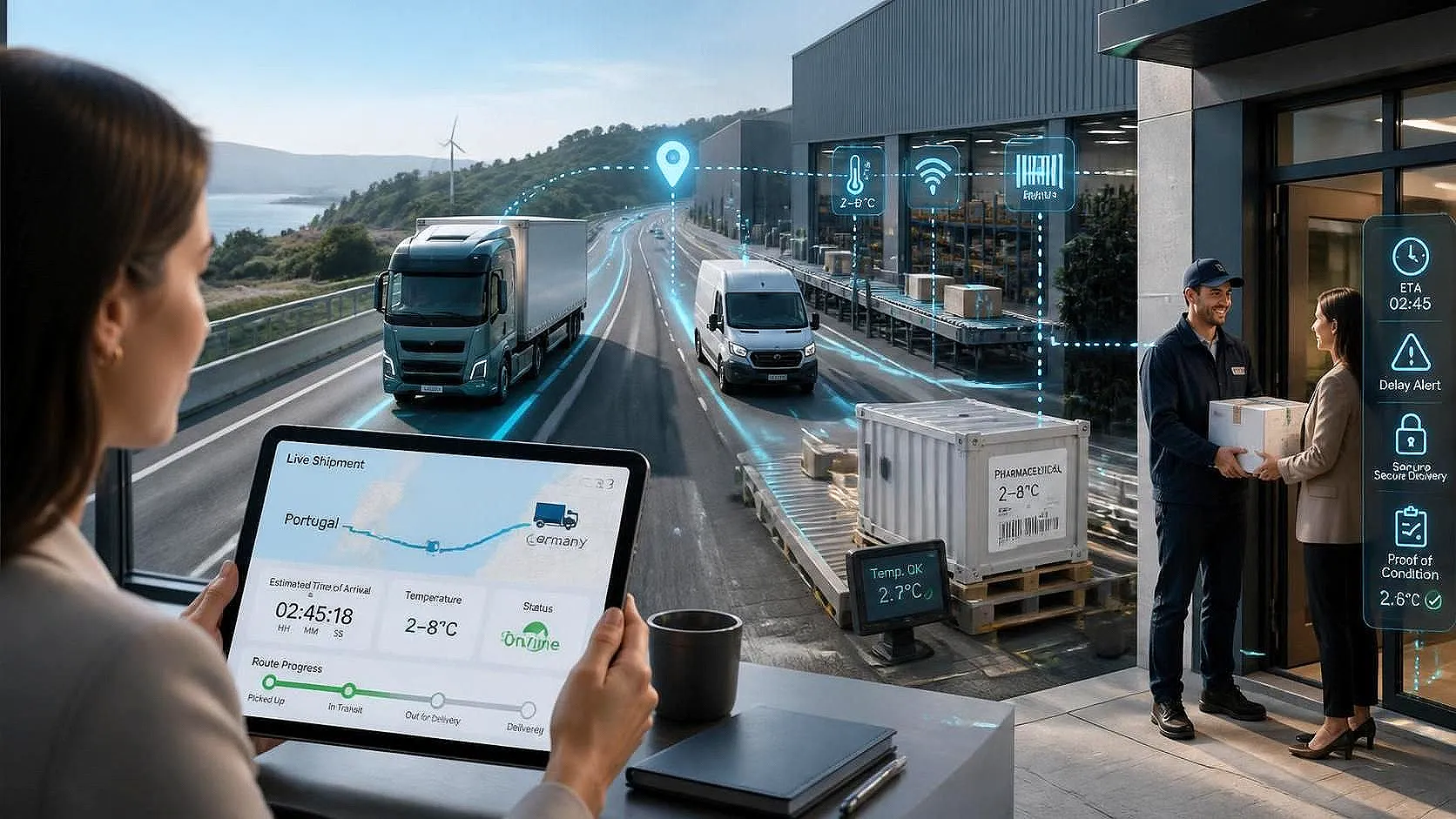
c. Enhanced Customer Experience
Real-Time Visibility and Transparency Throughout the Supply Chain
Overview:
Digital logistics fundamentally transforms customer experience by providing unprecedented transparency, speed, and reliability. Modern customers expect to know exactly where their shipments are, when they will arrive, and what condition goods are in during transit. Digital systems provide this visibility while simultaneously reducing delivery times and improving service reliability. This enhanced experience builds customer loyalty, reduces customer service inquiries, and increases repeat purchase rates.
Applications of Enhanced Customer Experience:
| Application | Implementation | EU Regulatory & Customer Impact |
|---|---|---|
| Real-Time Order Tracking and Visibility | Digital logistics platforms integrate GPS tracking (via fleet management systems), IoT sensors (RFID tags, temperature/humidity sensors), and barcode scanning systems that create a continuous digital record of shipment location and condition. Customers access this information through web portals or mobile applications updated every 15-30 minutes. For cross-border EU shipments, eFTI platforms (EU Regulation 2020/1056) create standardized, interoperable tracking accessible to all logistics stakeholders. A customer shipping goods from Portugal to Germany can view real-time location, customs clearance status, and estimated delivery time throughout the 2-3 day journey. This eliminates the “black hole” period (typically 3-5 days in traditional logistics) where shippers have no visibility into shipment status. | eFTI Regulation (EU 2020/1056): Mandates that from July 9, 2027, all cross-border road transport and specified transport corridors must use certified eFTI platforms. These platforms must provide standardized data exchange enabling shippers, carriers, and consignees to access shipment status information. Non-compliance results in inability to legally operate on regulated routes. Consumer Rights Directive (2011/83/EU): Traders must provide accurate information about delivery dates; real-time tracking systems enable compliance with this requirement. GDPR (General Data Protection Regulation): Tracking systems must implement data minimization (collect only necessary location data) and secure data handling. Customer location data must be encrypted and accessible only to authorized parties. |
| Accurate Delivery Time Windows and Proactive Notifications | Traditional logistics provides delivery windows of 4-6 hours (“sometime between 8 AM and 2 PM”); customers must wait home all day. Digital logistics uses real-time traffic data (DATEX II feeds), vehicle telematics, and predictive analytics to narrow delivery windows to 1-2 hours. SMS/email notifications alert customers when delivery vehicles are 30 minutes away. For deliveries to businesses, digital appointment scheduling systems allow customers to reserve specific delivery time slots days in advance. A food delivery business using real-time route optimization can guarantee delivery within a 30-minute window; a customer ordering at 11:30 AM receives notification: “Your order will arrive between 12:15 and 12:45 PM.” This precision reduces customer anxiety and enables better planning. | Working Time Directive (2003/88/EC): Predictable delivery windows support driver rest regulations; systems that optimize routes to align with traffic patterns reduce overtime and driver fatigue. E-Commerce Directive (2000/31/EC): Online retailers must provide accurate delivery timing; digital systems enable compliance. Consumer Rights Directive (2011/83/EU): Traders may not charge customers for delivery time uncertainty; precise digital systems reduce disputes and returns due to missed deliveries. |
| Exception Management and Proactive Communication About Delays | When exceptions occur (weather delays, traffic congestion, vehicle breakdowns, customs holds), digital systems automatically detect these conditions and notify customers with revised delivery estimates and explanations. Rather than delivering goods unannounced 2 days late, the customer receives notification within hours of the delay, enabling them to adjust expectations. For cross-border shipments, customs clearance delays are a major source of uncertainty (can range 2 hours to 2 days); digital integration with customs authorities (through the Single Window environment, EU Regulation 952/2013) provides real-time visibility into clearance status. If a shipment is held for inspection, the customer is notified immediately with explanation and revised delivery date. This proactive communication reduces customer support inquiries by 40-50% and improves customer satisfaction scores. | GDPR & ePrivacy: Proactive customer notifications must use contact methods customers have explicitly consented to (email, SMS) and comply with do-not-contact preferences. Consumer Rights Directive (2011/83/EU): Sellers must provide accurate information about delivery delays; failure to communicate delays proactively can be construed as misleading commercial practice. Single Window Environment (Regulation 952/2013): Customs declarations and status must be available through digital systems; integration enables real-time visibility. |
| Quality Assurance and Condition Monitoring During Transit | IoT sensors embedded in shipping containers or pallets continuously monitor temperature, humidity, vibration, and light exposure during transit. This is critical for perishable goods (food, pharmaceuticals), sensitive electronics, and high-value items. For a pharmaceutical shipment from Portugal to a hospital in Germany, temperature sensors maintain a blockchain-verified record that the shipment was kept at exactly 2-8°C throughout the journey. Upon delivery, the customer (hospital) has automated proof of temperature compliance, eliminating risk of temperature excursions that could render medications unsafe. For food shipments, humidity and temperature monitoring prevent spoilage and condensation damage. If sensors detect a breach (e.g., reefer truck refrigeration failure), alerts trigger immediately, enabling emergency rerouting or recall. Customers receive a quality assurance certificate with delivery confirming goods arrived in proper condition. | Good Distribution Practice (GDP) for Pharmaceuticals (EudraLex Volume 4): Requires proof of proper temperature maintenance during transport. Digital sensor records provide this proof; without digital tracking, companies rely on driver attestations (less reliable). Food Safety Regulation (EC 852/2004): Temperature monitoring during transport is mandatory for foods requiring refrigeration. Digital systems automate compliance. Product Liability Directive (85/374/EEC): Companies bear liability for product defects; if a temperature excursion damages product quality, digital sensor records prove whether the damage occurred during logistics or earlier. CSRD (Corporate Sustainability Reporting Directive): Companies must report on product quality and waste; sensor data demonstrates quality assurance efforts. |
| Personalized Customer Service and Delivery Preferences | Digital logistics systems enable customers to specify delivery preferences: time windows, location on premises, signature requirements, photo documentation, contact phone numbers, special handling instructions. For business customers (B2B), systems can route deliveries to preferred receiving departments and automatically notify relevant staff. For residential customers (B2C), delivery can be directed to secure lockers, neighbor addresses, or alternative locations if the primary recipient is unavailable. AI systems learn customer preferences over time: “This customer always accepts delivery to the side garage” or “This business accepts 7 AM early deliveries before business hours.” Machine learning personalizes future delivery logistics without requiring repeated customer input. A logistics company serving 50,000 customers can provide personalized delivery for each one through automated preference tracking and intelligent routing. This reduces failed delivery attempts (a major logistics cost) from 10-15% to 2-3%, improving customer satisfaction and reducing re-delivery costs by €50,000+ annually for a mid-sized logistics operator. | GDPR (Data Protection): Customer delivery preferences constitute personal data; systems must store this securely with explicit customer consent. Customers have rights to access, correct, or delete their preference data. Consumer Rights Directive (2011/83/EU): Delivery terms must be clearly communicated before purchase. Personalized delivery options must be presented as choices, not as hidden defaults. Professional Secrecy & Cybersecurity: If customer preferences include security-sensitive information (e.g., “use back entrance, don’t mention house number”), systems must protect this data with encryption and role-based access control. |
| Post-Delivery Feedback and Continuous Improvement | Digital logistics systems automatically request customer feedback after delivery: rating of service, condition of goods upon receipt, delivery time accuracy, and driver professionalism. Feedback is aggregated and analyzed to identify service gaps, underperforming routes, or logistics partners requiring improvement. For example, if 30% of customers report goods arriving damaged on a specific route, the system flags this route for investigation: Is the issue damage during packing? Harsh handling during loading? Rough driving conditions? Poor road infrastructure? Root cause analysis enables targeted improvement. Companies using feedback loops improve customer satisfaction scores (NPS) by 20-30% annually. Additionally, customer feedback creates a competitive advantage: a logistics provider with 95% on-time delivery and 98% damage-free record can charge premium pricing. | Consumer Rights Directive (2011/83/EU): Feedback mechanisms provide evidence of compliance with delivery obligations and service quality representations. GDPR: Feedback collection must comply with data protection rules; feedback containing personal information (customer location, preferences) must be handled securely. CSRD (Corporate Sustainability Reporting Directive): Customer satisfaction metrics and feedback mechanisms are now reportable as part of corporate sustainability reporting; digital collection provides verifiable data. |

d. Sustainability and Environmental Compliance
Reduction of Carbon Footprint Through Operational Optimization
Overview:
Digital logistics is a core enabler of EU sustainability objectives. The European Green Deal targets climate neutrality by 2050, with interim targets of 55% emissions reduction by 2030. The logistics sector accounts for approximately 29% of EU transport-related CO2 emissions; digital optimization is essential to meet these targets. Digital systems reduce emissions through route optimization, modal shift (shifting cargo from road to rail), vehicle electrification, and idle-time elimination.
Applications of Sustainability:
| Application | Implementation | EU Regulatory & Environmental Impact |
|---|---|---|
| Route Optimization for Emissions Reduction | AI-powered route optimization algorithms minimize total distance, fuel consumption, and idle time by considering real-time traffic, weather (wind direction), vehicle specifications (EV range limitations), and road topology (mountains, toll routes). For a 100-vehicle fleet, this typically reduces fuel consumption by 15–25% annually (50–80 tonnes CO₂ reduction). A 500-vehicle fleet reduces emissions by 250–400 tonnes annually (equivalent to 4,000–6,400 trees). Cost savings: approximately €320,000 annually for a mid-sized fleet (100 vehicles at €0.80/liter ÷ 6 km/liter). | Clean Transport Directive (2020/1887): Mandates 15% CO₂ reduction by 2025, 30% by 2030, 55% by 2035. Eco-driving Regulations: Member states mandate training; digital systems monitor driver behavior in real-time. Mobility Package Regulations (2020/1054 & 2020/1055): International operators must optimize operations. CSRD: Companies report scope 3 emissions (supply chain) with verifiable data from route optimization. |
| Modal Shift and Intermodal Optimization | Digital systems shift freight from high-emission road transport to rail and inland waterway (70–80% fewer emissions per tonne-km than road). A typical shipment from Portugal to Germany (2,000 km) emits 800–900 kg CO₂/tonne via road; road-rail-road combined route emits 200–250 kg CO₂/tonne (75% reduction). Trade-off: rail takes 3–4 days vs. 2 days for road. Digital systems help balance cost, emissions, and time for non-urgent shipments (e.g., inventory replenishment). | TEN-T Regulation (1315/2013): EU invests in rail and inland waterway infrastructure to enable modal shift. Trans-European Transport Network: Focuses on interconnected, efficient networks. Railway Package Directives: Harmonize cross-border rail freight. Carbon Border Adjustment Mechanism (CBAM): Low-emission transport (rail intermodal) reduces tariff exposure and competitiveness risk. |
| Vehicle Electrification and Energy Management | Digital fleet management optimizes EV operations by: (1) charging during off-peak hours (lower cost, reduced grid load), (2) route planning around charging infrastructure, (3) real-time energy consumption monitoring (detects mechanical issues), (4) predictive battery maintenance. EVs produce zero tailpipe emissions; well-to-wheel emissions are 50–70% lower than diesel. Transitioning 100 vehicles reduces annual emissions by 150–200 tonnes CO₂. EV cost: €40,000–€60,000 vs. €30,000 for diesel. Digital optimization shows ROI through reduced fuel (€0.02/km EV vs. €0.13/km diesel), maintenance, and government incentives (€5,000–€15,000/vehicle). Route optimization extends EV range 20–30% by reducing distance and optimizing speed (most efficient at 50–80 km/h). | Euro VII Emission Standards (adopted December 2023, implementation 2026): Near-zero limits accelerate EV/hydrogen transition; delayed adoption prevents vehicle purchases post-2026. Clean Vehicle Directive (2019/1161): Public procurers must buy clean vehicles, influencing private sector. Alternative Fuels Infrastructure Directive (revised 2023): EU mandates charging infrastructure rollout; digital systems integrate real-time availability. Energy Efficiency Directive (revised 2023): Companies >2.5 GWh annually conduct energy audits; digital data demonstrates optimization. CSRD: Fleet emissions and electrification status reported with verifiable data. Carbon Neutrality Objective (2021/1119): EV adoption essential to achieving 2050 climate neutrality. |
| Warehouse Energy Efficiency and Automation | LED lighting with occupancy sensors reduces consumption 40% vs. fluorescent. Smart HVAC reduces 25% vs. manual controls. Automated guided vehicles (AGVs) and conveyors operate 24/7 consistently; night shifts with fewer workers enable “low-occupancy mode” requiring less climate control. Combined reduction: 30–35% (150–200 MWh annually for large warehouses). Cost savings: €22,500–€30,000 per warehouse annually at €0.15/kWh; €225,000–€300,000 for 10-warehouse network. Carbon benefit: 175 MWh reduction (average) at 0.4 tonnes CO₂/MWh = 70 tonnes CO₂ saved annually per warehouse. | Energy Efficiency Directive (revised 2023): Large companies (>250 employees or >€50 million revenue) conduct energy audits every 4 years; digital systems provide detailed consumption data. Building Energy Performance Directive (2010/31/EU, revised 2021): All new buildings from 2028 must be near-zero energy; automated, digitally-controlled warehouses comply. CSRD: Companies report energy consumption and reduction initiatives with verifiable metrics. European Green Deal Objective: Warehouse electrification and efficiency are critical to EU climate targets. |
| Packaging Optimization and Waste Reduction | Digital systems optimize packaging by minimizing volume (reducing material), selecting sustainable materials (recyclable cardboard vs. plastic), and eliminating void-fill using AI. Just-in-time delivery reduces intermediate packaging cycles. Condition monitoring prevents over-protective packaging. For 100,000 units annually, optimization (1 cm size reduction, 30% switch to biodegradable fill) saves €50,000–€100,000 and reduces waste by 200–300 tonnes. Blockchain tracks used packaging (pallets, containers) for reuse instead of disposal. Pallet reuse: €4–€6 per pallet per rotation; 10,000 pallets annually save €40,000–€60,000 while reducing waste. | Circular Economy Action Plan (2020): Targets sustainable design and packaging reduction; digital tracking enables reuse. Single-Use Plastics Directive (2019/904): Restricts single-use packaging; optimization supports compliance. Extended Producer Responsibility Directive (2022/34): Producers responsible for end-of-life management; digital tracking proves compliance. Packaging and Packaging Waste Directive (94/62/EC): Recycling targets mandatory; digital tracking supports composition and end-of-life reporting. CSRD: Packaging waste and reduction initiatives reported with verifiable data. |
| Supply Chain Transparency and Sustainability Certification | Blockchain and IoT create transparent, traceable records of origin, processing, and transportation. Retailers verify “sustainably sourced” claims (geographic coordinates, transport mode, storage temperatures, delivery emissions) via QR codes on products. B2B suppliers automate sustainability reports for multiple retail partners from unified digital data instead of manual compilation. For a supplier serving 50 retailers, one digital system generates reports automatically rather than separately for each customer. | Supply Chain Due Diligence Directive (2024/1760): Manufacturers and importers conduct due diligence on human rights and environmental impacts; digital mapping and monitoring enable compliance. Digital Product Passport (proposed): EU mandates digital records of composition, repairability, and recycling; blockchain records support this. EU Taxonomy Regulation (2020/852): Companies report sustainability alignment; digital supply chain data demonstrates criteria compliance. CSRD: Supply chain sustainability efforts reported with blockchain-enabled verification. Carbon Border Adjustment Mechanism (CBAM): Low-carbon transportation records reduce tariff exposure. |

e. Regulatory Compliance and Data Security
Digital Systems as Compliance Enablers
Overview:
EU regulations increasingly mandate digital documentation and compliance verification. The eFTI Regulation (EU 2020/1056), requiring certified digital freight documents from July 9, 2027, exemplifies this trend. Digital systems automate compliance, reducing human error and enabling real-time violation detection and prevention. Additionally, digital systems improve data security and cybersecurity resilience, protecting sensitive business and customer information.
Applications of Compliance and Security:
| Application | Implementation | EU Regulatory & Compliance Impact |
|---|---|---|
| Automated eFTI Compliance and Digital Freight Documentation | The eFTI Regulation mandates that from July 9, 2027, all cross-border road transport and specified transport corridors must use certified eFTI (electronic Freight Transport Information) platforms. eFTI platforms replace paper freight documents (CMR waybills) with standardized digital equivalents, enabling real-time data exchange between shippers, carriers, customs authorities, and consignees. A logistics company operating in Portugal (Aveiro region) or internationally must implement certified eFTI systems. Digital systems automatically populate eFTI data from shipment information: shipper/consignee details, goods descriptions, hazardous materials classifications, dangerous goods (ADR) certifications, and customs requirements. The eFTI platform certifies this data and makes it accessible to authorities and stakeholders throughout transport. Benefits: (1) Faster customs clearance (automated data submission vs. manual document review), (2) Real-time compliance verification (systems automatically detect non-compliant shipments), (3) Reduced administrative burden (no manual document compilation), (4) Audit trail (all document access is logged, improving accountability). Non-compliance with eFTI from July 2027 results in inability to legally operate on regulated routes. | eFTI Regulation (EU 2020/1056): Mandatory implementation for all cross-border road transport and specified corridors by July 9, 2027. Certified eFTI platforms must comply with technical standards (eDelivery/PEPPOL for data exchange, eIDAS for digital signatures). Single Window Environment (Regulation 952/2013): Customs declarations must be submitted digitally; eFTI platforms integrate with member state Single Window systems. CMR Convention (International Convention on the Contract for the International Carriage of Goods by Road): Digital eFTI documents replace paper CMR waybills; member states recognize digital equivalents with same legal validity. GDPR (Data Protection): eFTI platforms must encrypt sensitive data (shipper addresses, customer information) and comply with data minimization principles. |
| Automated Dangerous Goods (ADR) Compliance and Hazmat Tracking | The European Agreement concerning the International Carriage of Dangerous Goods by Road (ADR) imposes strict requirements on transport of hazardous materials: proper classification, labeling, packaging, driver training, vehicle specification, and documentation. Violations carry heavy penalties (€1,000-€100,000 depending on severity). Digital systems automate ADR compliance: (1) Goods classification: system identifies hazardous substances in shipment against ADR classification rules, (2) Driver qualifications: system verifies driver ADR certification and training currency, (3) Vehicle compliance: system verifies vehicle equipment (fire extinguishers, spill kits, hazard placards) is current and compliant, (4) Documentation: system auto-generates required ADR documents (Shipper’s Declaration, Emergency Contact Cards), (5) Real-time monitoring: IoT sensors monitor temperature, pressure (for pressurized containers), and vibration, alerting operators if conditions exceed safety limits. For a logistics operator handling 100 hazmat shipments monthly, automated compliance reduces violation risk from 1-2% (manual checking) to near-zero, saving €50,000-€200,000 annually in potential fines and avoiding reputational damage (major retailers suspend suppliers with ADR violations). | ADR (European Agreement on the International Carriage of Dangerous Goods by Road): Mandatory for all hazmat transport. Violations result in: operator fines, driver fines, criminal liability for serious violations (injury/environmental damage). REACH Regulation (Regulation 1907/2006): Chemical hazard classifications must be current; digital systems update classifications automatically when REACH data changes. Seveso III Directive (Directive 2012/18/EU): Facilities storing hazardous substances above thresholds face strict requirements; digital tracking prevents accidental storage violations. Environmental Liability Directive (Directive 2004/35/EC): Hazmat accidents creating environmental damage trigger unlimited liability; digital monitoring prevents accidents by detecting system failures early. |
| Working Time Directive and Driver Regulation Compliance | The Working Time Directive (2003/88/EC) and Mobility Package Regulations (2020/1054, 2020/1055) impose strict limits on driver working hours: maximum 4.5 hours consecutive driving, mandatory 45-minute breaks, and maximum 56 hours weekly driving. Violations result in operator penalties (€1,500-€10,000+), driver fines, and vehicle immobilization. Digital tachographs (smart tachographs required in all new vehicles post-2023) automatically record driving time and breaks. Fleet management systems integrate tachograph data with route planning: systems refuse to assign additional routes to drivers who have reached maximum driving hours, automatically trigger break time notifications, and prevent violations by design. For a fleet of 100 drivers, a 2% violation rate (2 drivers) can result in €30,000-€100,000+ in annual penalties. Automated compliance reduces violations to near-zero. Additionally, compliance with working time regulations improves driver safety (well-rested drivers have fewer accidents) and driver satisfaction (predictable schedules, adequate rest). | Working Time Directive (2003/88/EC): Maximum 48 hours average weekly work (driving + on-duty time), maximum 4.5 hours consecutive driving. Violations result in operator fines (€1,500-€10,000) and driver fines. Mobility Package I & II (Regulations 2020/1054, 2020/1055): International road transport operators must ensure driver working time compliance, enforce weekly rest periods, and document compliance. Cabotage restrictions limit third-country operators. Digital systems enable compliance verification. Smart Tachograph Regulation (Regulation 165/2014): All new vehicles from 2023 must have smart tachographs. Fleet management systems must integrate tachograph data for compliance monitoring. Posting of Workers Directive (Directive 96/71/EC, revised 2018): International drivers must follow host country minimum wage, working conditions, and employment terms. Digital systems track driver location, hours, and ensure compliance with local requirements. |
| Data Security, GDPR Compliance, and Cybersecurity | Digital logistics systems handle sensitive data: customer locations, shipment contents, payment information, and business strategy (routes, pricing, suppliers). GDPR imposes strict requirements: data minimization (collect only necessary data), encryption, user access controls, breach notification (within 72 hours), and data subject rights (access, deletion, portability). Logistics companies face fines up to 4% of global revenue or €20 million for GDPR violations. Digital systems implement security controls: (1) Encryption: sensitive data encrypted in transit (TLS/SSL) and at rest (AES-256), (2) Access Control: role-based permissions (driver sees only their assigned routes, not company strategy), (3) Audit Logging: all data access logged and monitored, (4) Backup & Disaster Recovery: regular backups ensure data availability after cyberattacks or system failures, (5) Incident Response: rapid detection and containment of breaches. For a logistics company storing data on 1 million customers, a breach exposing 100,000 customer addresses triggers GDPR fine (€4 million+ potential), legal liability, and reputational damage. Robust security prevents breaches. Additionally, cyber-insurance costs are lower for companies with strong security (ISO 27001 certification), creating financial incentive for investment. | GDPR (General Data Protection Regulation, Regulation 2016/679): Mandatory for all companies processing EU resident data. Fines up to 4% of global revenue or €20 million. Companies must implement data protection by design, conduct Data Protection Impact Assessments (DPIA), and report breaches within 72 hours. NIS2 Directive (Directive 2022/2555): Network and Information Security directive mandates cybersecurity standards for essential services. Large logistics operators (affecting critical infrastructure) must comply with NIS2 requirements: security risk assessments, incident reporting, supplier security audits. eIDAS Regulation (Regulation 910/2014): Digital signatures on eFTI documents and contracts must use qualified signatures; systems must implement eIDAS-compliant signature technology. ISO 27001 Certification: While voluntary, provides baseline for information security; EU procurement increasingly requires ISO 27001 certification for supply chain partners. |
| Supply Chain Audit Trails and Accountability | Blockchain and distributed ledger technology create immutable audit trails of all supply chain transactions: shipment creation, handoffs between parties, customs clearance, delivery, and post-delivery status. Audit trails enable accountability: if goods are damaged, the record shows who had custody at time of damage. If shipments are delayed, records show where delay occurred (shipper, carrier, customs, consignee). This accountability improves operational discipline: parties knowing actions are recorded are more likely to follow procedures correctly. For disputes (customer claims goods were damaged in transit), the audit trail provides definitive proof: If condition sensors show goods were intact at departure and damaged upon arrival, the carrier bears liability. Without audit trails, disputes devolve to “he said, she said,” often resulting in litigation. Audit trails also simplify regulatory audits: tax authorities, customs, and labor inspectors can request digital records providing complete supply chain view, rather than manually reviewing paper documents. | Audit Directive (Directive 2006/43/EC): Large companies must have external audits; digital audit trails simplify auditor access to transaction records. Product Liability Directive (Directive 85/374/EEC): Manufacturers bear liability for product defects. Audit trails distinguish defects occurring during manufacturing (manufacturer liability) vs. defects from logistics damage (carrier liability). Corporate Sustainability Reporting Directive (CSRD): Companies must report on supply chain management and transparency; audit trails provide evidence. Anti-Money Laundering Directive (Directive (EU) 2015/849): Logistics operators must verify customers and monitor for suspicious activity. Audit trails document due diligence and suspicious transaction reporting. |

The Future of Digital Logistics: Emerging Trends and Technologies
Enhanced AI and Machine Learning Capabilities
Artificial intelligence and machine learning will continue to advance, enabling increasingly sophisticated predictive analytics and autonomous decision-making. Future developments include:
- Predictive Supply Chain Analytics: Advanced ML models will predict not only customer demand but also supplier disruptions, regulatory changes, and market shifts months in advance, enabling proactive adaptation rather than reactive crisis management.
- Autonomous Vehicle Integration: Self-driving trucks and delivery robots will reduce labor costs and improve safety. While regulatory frameworks are still developing (EU automated vehicle regulations expected 2025-2027), early deployments in controlled environments (port automation, warehouse distribution) are expanding.
- Real-Time Dynamic Pricing and Revenue Optimization: AI systems will dynamically adjust pricing based on demand, capacity, and operational conditions (similar to airline pricing). This enables logistics providers to maximize revenue and profitability.
Greater IoT Integration and Sensor Networks
The proliferation of IoT devices will enable increasingly granular monitoring of supply chains:
- Micro-Location Tracking: Beyond GPS (accurate to ±10 meters), ultra-wideband (UWB) and 5G networks will enable centimeter-level accuracy for warehouse and port operations, enabling automated warehouse systems to route goods to specific picking locations within seconds.
- Environmental Intelligence: Sensors will monitor not only temperature and humidity but also air quality, vibration, light exposure, and chemical composition, enabling comprehensive quality assurance for sensitive goods (pharmaceuticals, fine chemicals, fresh produce).
- Predictive Maintenance Intelligence: Sensors will predict vehicle and equipment failures with increasing accuracy, enabling maintenance before failures occur, reducing downtime and extending asset lifespan.
Sustainability and Decarbonization Acceleration
Digital logistics will be central to achieving EU climate objectives:
- Carbon Accounting Automation: Digital systems will automatically calculate and report supply chain carbon emissions, enabling companies to identify and optimize highest-emission activities. Carbon accounting will become as routine as financial accounting.
- Renewable Energy Integration: Logistics operations (warehouses, vehicle charging) will increasingly source renewable energy. Digital systems will optimize operations to align with renewable availability (shift operations to times of high wind/solar generation when electricity is cheapest and lowest-carbon).
- Circular Economy Enablement: Digital systems will track materials through multiple lifecycle cycles (product manufacture → use → return → remanufacture), enabling true circular economy operations where waste becomes input for new production.
Enhanced Interoperability and Data Standards
The EU’s digital infrastructure will continue evolving to enable seamless data exchange across borders and systems:
- eFTI Ecosystem Maturation: By 2027-2030, eFTI platforms will become standard, with enhanced capabilities beyond current requirements: real-time visibility, integrated customs pre-clearance, and automated border crossing procedures reducing cross-border transport time from 2-3 days to under 24 hours. The fully operational eFTI network will eliminate paper-based documentation entirely across EU Member States, streamlining compliance and reducing administrative burden by an estimated 30-40%.
- API Standardization and Open Data Standards: The adoption of common APIs (Application Programming Interfaces) and open data standards will enable smaller logistics providers to integrate seamlessly with larger ecosystems, fostering innovation and reducing barriers to entry. Standardized formats for shipment data, tracking information, and customs documentation will become as universal as HTML is for web browsers.
Blockchain Evolution for Supply Chain Transparency
As blockchain technology matures beyond theoretical frameworks, its practical applications will expand significantly:
- Immutable Compliance Records: Blockchain will maintain tamper-proof records of regulatory compliance, certifications, and safety inspections, enabling authorities to verify logistics operator credentials instantly rather than through lengthy audits. This is particularly critical for regulated goods (pharmaceuticals, hazardous materials, food products).
- Smart Contracts Automation: Self-executing contracts will automate payment processes, insurance claims, and liability determination based on real-time data from IoT sensors and GPS tracking. When a delivery is delayed, compensation will be automatically calculated and processed without human intervention, reducing disputes and improving stakeholder relationships.
- Supply Chain Tokenization: Digital tokens representing goods, containers, and transportation capacity will enable peer-to-peer trading of logistics resources, creating dynamic marketplaces where transport capacity can be bought, sold, and optimized in real-time, similar to energy trading markets.
Advanced Analytics and Digital Twins
Digital twin technology—creating virtual replicas of physical logistics systems—will enable unprecedented levels of operational optimization:
- Virtual Warehouse and Port Simulations: Companies will model entire supply chains in digital environments before implementing changes, testing scenarios such as labor strikes, equipment failures, demand spikes, or new product launches without disrupting actual operations. Port of Aveiro and other European ports will increasingly use digital twins to optimize container handling sequences, reducing vessel turnaround time from days to hours.
- Prescriptive Analytics: Moving beyond predictive analytics (forecasting what will happen) to prescriptive analytics (recommending what should happen), AI systems will provide specific, actionable recommendations with quantified impact: “Reroute shipment X via transport mode Y to save €500 and reduce emissions by 40 tons CO₂.”
Cybersecurity and Resilience Enhancement
As logistics systems become increasingly digital and interconnected, cybersecurity will become as critical as physical security:
- Zero-Trust Architecture: Logistics networks will implement zero-trust security models, where every device, user, and transaction is verified before access is granted. This is essential as logistics systems interact with customs authorities, port operators, and multiple international partners.
- Decentralized Identity Management: Digital identity systems (using blockchain or similar technologies) will enable secure, verifiable authentication of logistics operators, drivers, and goods without relying on centralized databases vulnerable to single points of failure.
- Supply Chain Resilience Planning: Digital tools will continuously map supply chain vulnerabilities and automatically trigger alternative routing, supplier activation, or inventory repositioning when threats emerge—whether natural disasters, geopolitical disruptions, or cyberattacks.
In this lesson, we have explored the fundamental concepts of digital logistics, including its historical evolution from traditional methods to modern digital systems, the definition and scope of digital logistics, the core enabling technologies (AI, ML, IoT, and blockchain), and the promising innovations on the horizon. We have examined how the European Union, through initiatives like the eFTI Regulation and the Digital Transport and Logistics Forum, is establishing the standards and infrastructure necessary to support seamless, transparent, and efficient logistics operations across Member States—with Portugal and the Port of Aveiro playing active roles in this transformation.
The transition to digital logistics is not merely a technological upgrade; it represents a fundamental reimagining of how goods move across supply chains, how data flows between stakeholders, and how organizations can balance operational efficiency with sustainability and regulatory compliance. As we progress through this course, we will move beyond these foundational concepts to examine the practical implementation strategies, organizational change management, and specific applications within Portugal’s logistics ecosystem.
In Lesson 1.2: Importance of Digital Transformation in Logistics, we will analyze the strategic business drivers compelling organizations to adopt digital logistics solutions. We will explore how digital transformation enhances operational efficiency, reduces costs, improves customer experience, and enables competitive advantage in an increasingly complex global supply chain. We will also examine how digital logistics adoption aligns with EU sustainability objectives and regulatory mandates, making it not just a competitive advantage but an operational necessity.
Prepare to discover how the adoption of these digital innovations can transform logistics from a cost center into a strategic asset, driving profitability, resilience, and sustainable growth for organizations across Portugal and the broader European economy.