




















Overview
Curriculum
Certificates
Instructor
Cybersecurity Awareness for Trade and Logistics – Foundation is an entry-level course that introduces the basic knowledge, habits, and workplace behaviors needed to reduce common cybersecurity risks in trade, transportation, logistics, warehousing, supply chain, and business operations.
The course explains how cyber incidents can affect shipments, warehouse operations, fleet systems, customer service, payments, inventory records, supplier relationships, transport documentation, and business continuity. Learners will understand that cybersecurity is not only an IT responsibility. Employees, managers, contractors, drivers, warehouse teams, suppliers, and service providers all contribute to the security of digital operations.
The course is designed for beginners and does not require technical or cybersecurity experience. It is suitable for SME employees, business owners, entrepreneurs, logistics professionals, warehouse staff, transport operators, freight forwarders, procurement teams, administrative employees, students, and anyone who uses digital systems in a trade or logistics environment.
Learners will be introduced to common cyber threats, including phishing, spear phishing, business email compromise, ransomware, malware, credential theft, social engineering, fraudulent payment requests, unauthorized access, data theft, denial-of-service attacks, and supply-chain attacks. Transport-sector threat analysis has identified ransomware, data-related threats, malware, denial-of-service attacks, phishing, and supply-chain attacks among the key risks affecting the sector.
The course explains how attackers may target employees through email, messaging applications, phone calls, fake websites, social media, QR codes, shared files, delivery notifications, payment requests, and compromised supplier or customer accounts. Learners will practice identifying warning signs and deciding when to stop, verify, report, or escalate a suspicious activity.
Passwords, authentication, access controls, and device security are covered in practical language. Learners will understand how to create and manage strong passwords, use multifactor authentication when available, protect work devices, avoid unauthorized software, secure mobile phones, and respond appropriately if credentials or devices may have been compromised.
The course also addresses cybersecurity in operational environments. Learners will explore how cyber incidents can affect transportation management systems, warehouse management systems, fleet platforms, route-planning tools, digital freight platforms, port systems, inventory systems, customer portals, e-commerce platforms, and electronic documentation workflows.
Supply-chain cyber risk is a central theme. Businesses often depend on carriers, freight forwarders, software vendors, cloud providers, payment providers, marketplace operators, customs service providers, maintenance contractors, and other external partners. Learners will understand why third-party access, shared accounts, connected systems, outdated software, and weak supplier controls can create risks across the wider supply chain.
Incident reporting and response are also introduced. Learners will learn what to do when they receive a suspicious message, click a harmful link, lose a device, discover unauthorized access, send information to the wrong person, or observe unusual system behavior. The course emphasizes rapid reporting, preserving relevant information, following internal procedures, and avoiding actions that could make an incident worse.
Business continuity and recovery are included at an awareness level. Learners will examine the importance of backups, alternative communication methods, manual fallback procedures, recovery priorities, emergency contacts, and tested continuity plans. The course explains how cybersecurity incidents can become operational disruptions when companies cannot access systems, records, warehouse controls, payment platforms, or transport information.
The course introduces cybersecurity governance and regulatory awareness, including the general purpose of risk management, management responsibility, security policies, incident procedures, supplier controls, and employee awareness. It references NIS2 awareness without determining whether a specific company or individual is legally covered. NIS2 applicability depends on the organization, sector, size, jurisdiction, and other legal criteria. The course does not replace a legal assessment or cybersecurity risk assessment.
The course also introduces data protection and responsible information handling. Learners will consider how to protect personal information, customer records, employee information, payment details, shipment data, commercial documents, access credentials, and confidential business information. The emphasis is on practical data minimization, appropriate access, secure sharing, and prompt reporting of suspected incidents.
Cybersecurity awareness is increasingly important because digital dependencies can allow a disruption in one part of a supply chain to affect other businesses and services. Recent European threat analysis has highlighted the continued importance of phishing, vulnerability exploitation, ransomware, supply-chain dependencies, and the transport sector’s exposure to cyber incidents.
This is an educational awareness course. Completion does not constitute cybersecurity certification, professional competence, legal advice, a penetration test, a security audit, a data-protection assessment, NIS2 compliance, or compliance with any other regulation or standard.
Course metadata
| Field | Course information |
|---|---|
| Pillar | Cybersecurity, Privacy & Digital Resilience |
| Category | Cybersecurity awareness for trade and logistics |
| Subcategories | Phishing, passwords, access controls, malware, social engineering, incident response, business continuity, third-party risk, data protection |
| Course level | Foundation |
| Difficulty | Beginner |
| Estimated study time | 4–5 hours |
| Format | Text-first lessons, micro-video summaries, quizzes, checklists, scenarios, and worksheets |
| Language | English |
| Market relevance | European Union, with examples from Portugal |
| Prerequisites | None |
| Assessment | Knowledge checks and final cybersecurity incident-response exercise |
| Certificate | EDTC Certificate of Completion – Foundation |
| Version | 1.0 |
| Regulatory relevance | General awareness of cybersecurity responsibilities, information security, data handling, operational resilience, and NIS2 concepts |
| Last content review | September 21, 2026 |
| Recommended review cycle | Every 12 months, or sooner if relevant threats, technology, or regulatory requirements change |
| Related courses | Digital Skills for Trade and Logistics, Digital Logistics Fundamentals, Cybersecurity in Supply Chains, Supply Chain Risk and Resilience, Digital Transformation for Transport Operators |
| Related learning pathway | SME Digital Transformation Manager and Digital Logistics Specialist |
Learning outcomes
By the end of the course, learners should be able to:
- Define cybersecurity and explain why it matters in trade and logistics.
- Identify the main elements that organizations need to protect, including systems, devices, data, people, and operations.
- Recognize common cyber threats affecting businesses and logistics operations.
- Identify typical signs of phishing and spear-phishing messages.
- Recognize business email compromise and fraudulent payment requests.
- Explain how malware and ransomware can affect business operations.
- Identify common social-engineering techniques.
- Apply basic password and authentication practices.
- Explain the purpose of multifactor authentication.
- Protect work computers, mobile devices, removable media, and shared equipment.
- Recognize the risks of unauthorized software, unsafe downloads, and unapproved cloud services.
- Explain why access should be limited according to job responsibilities.
- Identify cybersecurity risks associated with fleet, warehouse, transport, port, and freight systems.
- Describe basic third-party and supplier cybersecurity risks.
- Recognize the importance of secure information sharing with customers, carriers, vendors, and service providers.
- Explain what to do after clicking a suspicious link or sharing information incorrectly.
- Identify the appropriate steps for reporting a suspected cybersecurity incident.
- Describe the role of backups, recovery procedures, and manual workarounds.
- Recognize the importance of protecting personal, financial, commercial, and operational data.
- Explain the general purpose of cybersecurity governance and regulatory awareness.
- Describe NIS2 as a European cybersecurity policy framework without assuming legal applicability to a specific organization.
- Complete a basic cybersecurity risk and incident-response exercise.
- Create a personal cybersecurity action plan for a trade or logistics workplace.
Lessons
| Lesson | Title | Main focus |
|---|---|---|
| 1 | Cybersecurity in Trade and Logistics | Cybersecurity principles, digital dependencies, operational impact, and shared security responsibility |
| 2 | Common Cyber Threats and Attack Methods | Phishing, malware, ransomware, credential theft, denial-of-service attacks, data theft, and supply-chain attacks |
| 3 | Phishing, Social Engineering and Fraud | Suspicious messages, fake websites, fraudulent requests, impersonation, QR-code scams, and business email compromise |
| 4 | Passwords, Authentication and Access Control | Strong passwords, password managers, multifactor authentication, shared accounts, permissions, and least-privilege awareness |
| 5 | Securing Devices and Digital Workplaces | Computers, mobile devices, removable media, software updates, downloads, public networks, and physical security |
| 6 | Protecting Business and Operational Data | Customer information, shipment records, payment details, credentials, commercial data, secure sharing, and data minimization |
| 7 | Cybersecurity in Transport, Warehousing and Freight Systems | Fleet systems, TMS, WMS, port systems, freight platforms, tracking tools, electronic documents, and operational technology awareness |
| 8 | Third-Party and Supply-Chain Cyber Risk | Suppliers, carriers, freight forwarders, cloud providers, software vendors, contractors, remote access, and shared dependencies |
| 9 | Reporting and Responding to Cyber Incidents | What to report, who to contact, immediate actions, evidence preservation, escalation, and common reporting mistakes |
| 10 | Business Continuity and Cyber Recovery | Backups, recovery priorities, manual procedures, alternative communication, system outages, and recovery testing awareness |
| 11 | Cybersecurity Governance and Regulatory Awareness | Policies, roles, risk assessment, management responsibility, employee awareness, NIS2 concepts, and security culture |
| 12 | Building a Personal Cybersecurity Action Plan | Practical review of individual habits, workplace risks, reporting procedures, improvement priorities, and next steps |
Included practical resources
- Personal Cybersecurity Awareness Self-Assessment
- Phishing Warning-Signs Checklist
- Suspicious Email and Message Review Worksheet
- Business Email Compromise Response Checklist
- Password and Multifactor Authentication Checklist
- Device Security Checklist
- Mobile Device Security Checklist
- Secure File-Sharing Guide
- Data-Handling and Access-Control Worksheet
- Cybersecurity Incident Reporting Form
- First Response to a Suspected Incident Checklist
- Supplier and Third-Party Cyber-Risk Questions
- Cloud and Software-Service Security Checklist
- Business Continuity Contact List
- Cyber Incident Communication Worksheet
- Basic Cybersecurity Risk Register
- Cybersecurity Improvement Action Plan
- Personal Learning Pathway Planner
Primary learner profile
The primary learner is an employee, business owner, entrepreneur, student, or logistics professional who uses digital tools at work and needs to recognize, prevent, and report common cybersecurity risks.
The course is particularly suitable for employees in SMEs who may use several systems without being cybersecurity specialists. These employees may process orders, communicate with customers, update inventory, arrange transport, prepare documents, manage payments, use mobile applications, or share information with suppliers and carriers.
It is also suitable for managers who need to build a basic security culture, clarify reporting responsibilities, identify common operational weaknesses, and prepare employees for more advanced cybersecurity or business-resilience training.
Recommended next courses
After completing this course, learners can progress to:
- Digital Skills for Trade and Logistics
- Digital Logistics Fundamentals
- Cybersecurity in Supply Chains
- Supply Chain Risk and Resilience
- Digital Logistics Operations
- Data Governance
- API Integration and Interoperability
- Digital Transformation for Transport Operators
- Business Continuity and Disaster Recovery
- Risk Management for Logistics and Supply Chains
- Digital Marketplace Governance
- Project Management for Digital Transformation
Regulatory and content-status box
| Item | Course status |
|---|---|
| Legal and policy areas referenced | General awareness of cybersecurity responsibilities, information security, data protection, incident reporting, operational resilience, supplier risk, and NIS2 concepts |
| Jurisdiction | European Union, with Portugal-related examples |
| Purpose | Foundational cybersecurity awareness and cyber-hygiene education |
| Regulatory status | The course does not provide legal, technical, cybersecurity, data-protection, or regulatory certification |
| Current status | Introductory and non-certifying |
| Last content review | September 21, 2026 |
| Next planned review | September 21, 2027 |
| Operational relevance | Helps learners recognize common threats, protect accounts and information, report incidents, understand supply-chain dependencies, and support business continuity |
| Content owner | EDTC Curriculum and Cybersecurity, Privacy & Digital Resilience Content Owner |
| Important limitation | Course completion does not establish professional competence, NIS2 compliance, cybersecurity compliance, data-protection compliance, or compliance with any regulation or standard |
| Regulatory maintenance note | References to NIS2, cybersecurity requirements, incident reporting, and sector obligations must be reviewed against current EU and Portuguese requirements before each scheduled content update |
Certificate
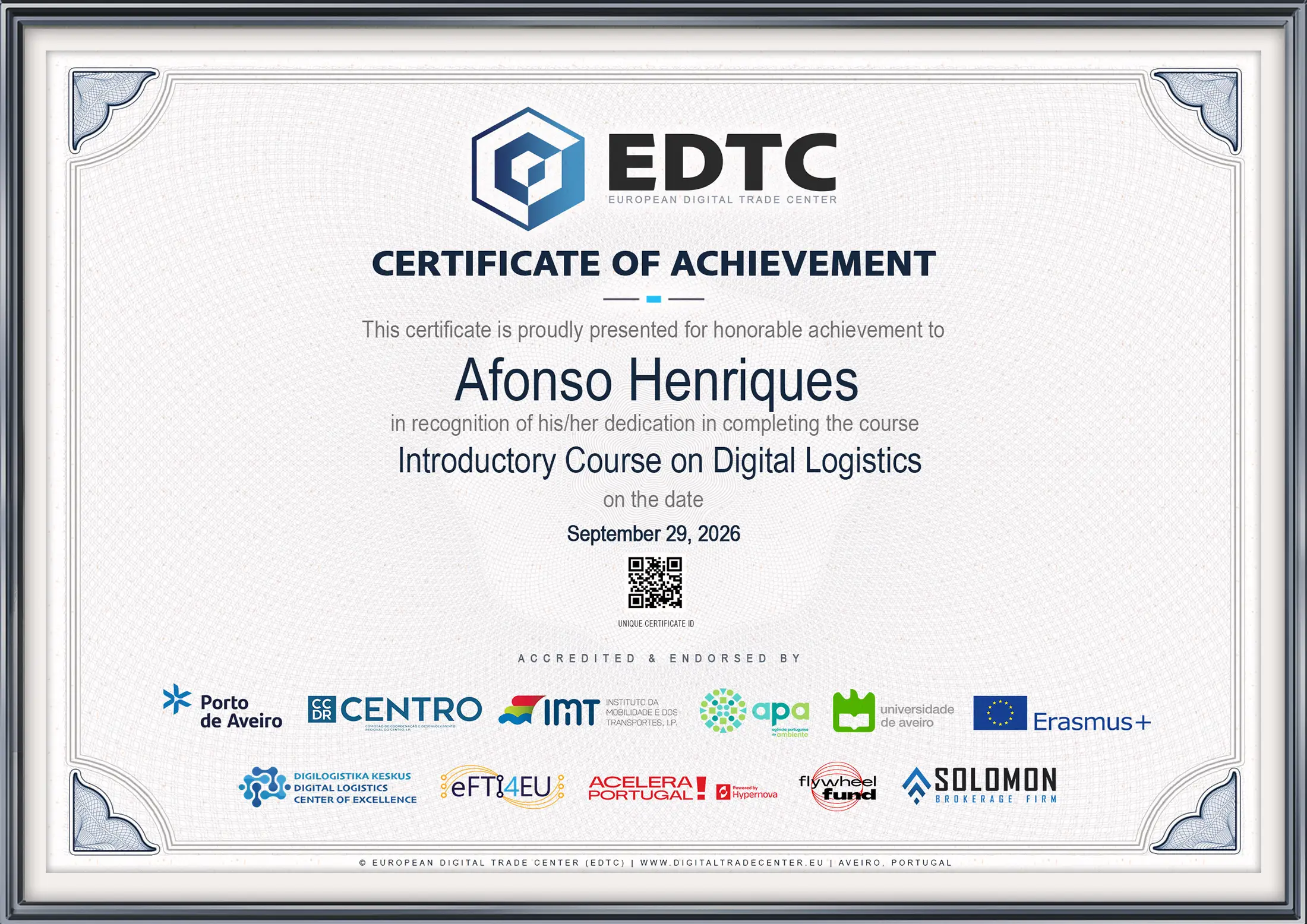
Earn a Certificate & Showcase Your Skills
Complete this course and earn a verified certificate to showcase your new skills. Share it on LinkedIn, add it to your resume, or download it for your records.

Instructor
European Digital Trade Center (EDTC)
2552 Students10 Courses
The European Digital Trade Center (EDTC) helps businesses and professionals participate in sustainable, technology-enabled international trade. Through its membership-based platform, EDTC offers practical training, assessments, and certifications in digital trade, logistics, transportation, trade finance, and compliance. Qualified members can access a digital brokerage marketplace to connect with relevant buyers and sellers, while organizations can receive support in implementing eLogistics, paperless trade, and digital transportation solutions.
Reviews