


















Overview
Curriculum
Certificates
FAQs
Instructor
Overview
Introduction to European Digital Trade – Foundation is an entry-level course that explains how businesses, professionals, entrepreneurs, logistics operators, educators, and public-sector stakeholders participate in Europe’s increasingly digital economy.
The course introduces the main concepts, participants, processes, technologies, opportunities, and risks connected with digital trade. Learners explore how goods, services, payments, documents, data, and business relationships move through European and international trade networks.
The course connects digital trade with logistics, supply chains, customs, finance, cybersecurity, sustainability, data, digital identity, and digital marketplaces. It is designed for beginners and does not require previous knowledge of international trade, logistics, technology, or European regulation.
Learners will develop a practical overview of how a modern cross-border transaction works—from identifying a business opportunity and selecting a supplier or customer to arranging transport, exchanging documents, managing payments, protecting data, and monitoring delivery.
The course also introduces the shift from paper-based processes to electronic information exchange. For example, the European eFTI framework is intended to support standardized electronic freight information and is scheduled to apply fully from 9 July 2027, when Member State authorities must accept information shared electronically through certified eFTI platforms. This course presents eFTI as an awareness topic rather than providing technical implementation or legal certification.
The course includes practical examples relevant to Portugal, the European Union, SMEs, exporters, importers, freight forwarders, carriers, warehouses, technology providers, and marketplace participants. It also introduces key concepts relating to GDPR, electronic identification and trust services, cybersecurity, digital documentation, sustainability, and business resilience. EU data-protection guidance identifies the GDPR as a central part of the EU data-protection framework, while eIDAS provides the framework for electronic identification, authentication, and trust services.
This is an educational foundation course. Completion does not constitute legal, customs, tax, cybersecurity, professional, or regulatory certification and does not by itself make an organization compliant with any law or standard.
Course metadata
| Field | Course information |
|---|---|
| Pillar | Pillar 1: Cross-pillar foundation course |
| Main pillars | Business, Entrepreneurship & Management; International Trade, Customs & Market Access; Logistics, Transportation & Distribution; Information Technology, Data & Interoperability |
| Related pillars | Cybersecurity, Privacy & Digital Resilience; Sustainability, Climate & Circular Economy; Standards, Regulations & Digital Trade Compliance; E-Commerce, Digital Marketplace & Strategic Negotiation |
| Category | European Digital Trade Overview |
| Level | Foundation (EQF 3–4) |
| Difficulty | Beginner |
| Estimated study time | 12–14 hours (approx. 4 weeks @ 3 hours/week) |
| Format | Text-first lessons, micro-video summaries, quizzes, practical activities |
| Language | English |
| Market relevance | European Union, with examples from Portugal |
| Prerequisites | None; assumes basic business knowledge |
| Assessment | Knowledge checks and final practical exercise |
| Certificate | EDTC Certificate of Completion – Foundation |
| Version | 1.0 |
| Regulatory content review | September 28, 2026 |
| Recommended review cycle | Every 12 months, or sooner when relevant rules change |
Learning outcomes
Upon completion, learners will be able to:
- Explain the evolution of digital trade in Europe and current market drivers (LO1.1.01).
- Identify the 12 pillars of EDTC and their operational relevance (LO2.3.17).
- Recognize regulatory frameworks governing digital trade (EQAVET, DigComp 3.0, EQF, ESG) (LO4.1.04).
- Distinguish between Foundation, Applied, and Advanced learning pathways (LO5.4.05).
- Assess which learning pathway aligns with their organizational role (LO5.4.09).
- Evaluate the business case for digital transformation in logistics and trade (LO5.3.02).
- Identify key stakeholders and support channels in the EDTC ecosystem (LO2.1.05).
- Formulate a preliminary organizational action plan for digital trade engagement (LO3.1.15).
Lessons
| Lesson | Title | Main focus |
|---|---|---|
| 1 | What Is European Digital Trade? | Definitions, scope, benefits, and the digital European business environment |
| 2 | The European Trade and Logistics Ecosystem | Businesses, customers, suppliers, carriers, ports, platforms, authorities, banks, and technology providers |
| 3 | How a Cross-Border Transaction Works | From opportunity and quotation to order, transport, delivery, payment, and records |
| 4 | Digital Documents, Data and Interoperability | Electronic records, data exchange, APIs, platforms, e-signatures, and eFTI awareness |
| 5 | Customs, Compliance and Market Access | Import/export concepts, trade documents, tariffs, origin, VAT awareness, and regulatory responsibilities |
| 6 | Payments, Finance and Commercial Risk | Payment methods, foreign exchange, credit risk, insurance, fraud awareness, and working capital |
| 7 | Cybersecurity, Data Protection and Digital Trust | Passwords, phishing, access control, personal data, suppliers, incidents, and digital identity |
| 8 | Sustainable and Resilient Digital Trade | Sustainable logistics, carbon awareness, circular economy, continuity, and disruption planning |
| 9 | Digital Marketplaces and Business Relationships | Marketplace models, onboarding, listings, ratings, service quality, negotiation, and customer trust |
| 10 | Building a Digital Trade Readiness Plan | Practical assessment of people, processes, technology, data, compliance, and improvement priorities |
Primary learner profile
The primary learner is a professional, entrepreneur, or SME representative who understands that digital tools are becoming essential for trade and logistics but needs a clear, practical introduction before studying specialist subjects such as customs, eFTI, digital logistics, trade finance, cybersecurity, or sustainable supply chains.
Recommended next courses
After completing this course, learners can progress to:
- Digital Logistics Fundamentals
- International Trade Fundamentals
- Digital Skills for Trade and Logistics
- Cybersecurity Awareness for Trade and Logistics
- Sustainability Fundamentals
- Introduction to Customs and Compliance
- Supply Chain Fundamentals
- Business Fundamentals for SMEs
Regulatory status box
| Item | Course status |
|---|---|
| Legal and policy areas referenced | eFTI, electronic identification and trust services, data protection, cybersecurity awareness, digital documentation |
| Jurisdiction | European Union, with Portugal-related context |
| Purpose | General awareness and operational orientation |
| Application dates | Subject to the specific instrument and current official guidance |
| Current status | Introductory and non-certifying |
| Last content review | 20 September 2026 |
| Next planned review | 20 March 2027 |
| Operational relevance | Helps learners identify digital trade processes, risks, responsibilities, and further training needs |
| Content owner | EDTC Curriculum and Regulatory Content Owner |
| Important limitation | Course completion does not establish legal compliance, professional competence, or regulatory certification |
Curriculum
- 4 Sections
- 8 Lessons
- 14 Hours
Expand all sectionsCollapse all sections
- SECTION 1: WHAT IS DIGITAL TRADE? (Lessons 1–2, ~3 hours)Purpose: Establish foundational understanding of digital trade in Europe, its evolution, and market drivers that affect SMEs and logistics businesses.4
- 1.1Lesson 1: The Evolution of Digital Trade in Europe90 Minutes
- 1.2Quiz: Lesson 1: Foundations of European Digital Trade & Market Drivers30 Minutes10 Questions
- 1.3Lesson 2: Market Drivers and Business Opportunity90 Minutes
- 1.4Quiz: Lesson 2: Market Drivers and Business Opportunity30 Minutes10 Questions
- SECTION 2: THE EDTC ECOSYSTEM (Lessons 3–4, ~3 hours)Purpose: Introduce learners to the EDTC's 12-pillar framework, stakeholder roles, and available resources for digital trade development.4
- 2.1Lesson 3: The 12 Pillars of EDTC — Overview and Relevance90 Minutes
- 2.2Quiz: Lesson 3: The 12 Pillars of EDTC — Overview and Relevance30 Minutes10 Questions
- 2.3Lesson 4: Stakeholders, Resources, and Pathways to Support
- 2.4Quiz: Lesson 4: Stakeholders, Resources, and Pathways to Support30 Minutes10 Questions
- SECTION 3: EUROPEAN QUALITY, QUALIFICATION & DIGITAL STANDARDS (Lessons 5–6, ~2.5 hours)Purpose: Equips learners to understand European quality, qualification, digital competency standards, and select an appropriate EDTC learning pathway.4
- SECTION 4: STRATEGIC UPSKILLING PATHWAYS & ACTION PLANNING (Lessons 7–8, ~3 hours)Purpose: Guide learners to develop a preliminary digital trade strategy and identify next steps aligned with EDTC learning resources.6
- 4.1Lesson 7: Digital Transformation Readiness Assessment90 Minutes
- 4.2Quiz: Lesson 7: Digital Transformation Readiness Assessment30 Minutes10 Questions
- 4.3Lesson 8: Building Your Digital Trade Strategy and Action Plan
- 4.4Quiz: Lesson 8: Building Your Digital Trade Strategy and Action Plan30 Minutes0 Questions
- 4.5Assignment 1: Organizational Digital Readiness Self-Asssessment3 Days
- 4.6Assignment 2: Capstone Project: SME Digital Trade Transformation Action Plan3 Days
Certificate
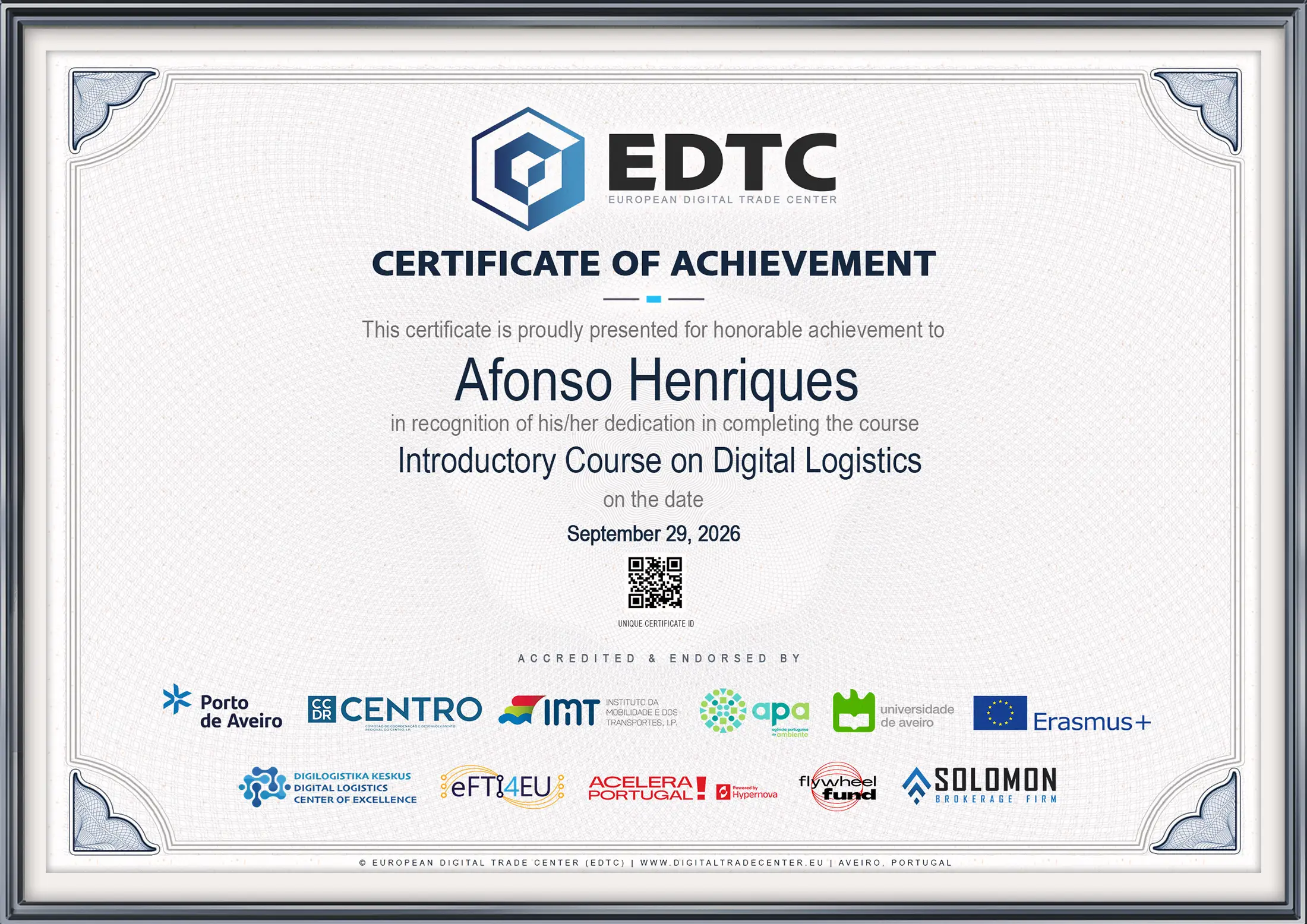
Earn a Certificate & Showcase Your Skills
Complete this course and earn a verified certificate to showcase your new skills. Share it on LinkedIn, add it to your resume, or download it for your records.
This course is designed for SME owners, business managers, trade association advisors, public-sector trade officers, and professionals involved in import, export, logistics, retail, manufacturing, and digital business operations. It is also suitable for learners who want to understand the European digital trade ecosystem and identify suitable professional development pathways.
No, prior experience in digital trade, international trade, logistics, technology, or European regulation is required. This foundation-level course provides a structured, non-technical introduction for beginners and professionals seeking to build their digital trade knowledge.
The course requires approximately 12–14 hours of study and is designed to be completed over four weeks, with around three hours of learning per week. It is delivered online, allowing participants to access the lessons, quizzes, and learning resources from any location with an Internet connection.
You will learn how digital trade is developing in Europe, how the European Digital Single Market supports businesses, and how digital tools affect trade, logistics, customs, documentation, compliance, and business relationships. You will also explore the 12 EDTC pillars, digital transformation opportunities, stakeholder networks, and appropriate learning pathways.
Each of the eight lessons includes a five-question quiz to assess your understanding of the key concepts. At the end of the course, you will complete a final organizational self-assessment. The final self-assessment is designed to support reflection and planning and is not a pass-or-fail examination.
There are no prerequisites for enrolling in this entry-level course. Basic English proficiency and a general interest in business, trade, logistics, or digital transformation are recommended, since the course materials and terminology are provided in English.
Yes, the course includes operational examples relating to Portugal, including the Port of Sines, the Portuguese customs authority and ACE Portal, and AICEP trade-support resources. It also includes broader European examples from countries such as Germany and France.
Participants complete an interactive organizational digital-trade readiness self-assessment and review a case study about an SME’s digital transformation journey. These activities help learners identify current capabilities, improvement priorities, and suitable next steps.
Participants will have access to eight lessons, lesson quizzes, a digital-trade pillar overview cheat sheet, a learning-pathway selector tool, a terminology glossary, practical examples, and a final organizational self-assessment.
This course is a foundation-level awareness course and does not provide professional, regulatory, or compliance certification. Completion may be recorded by EDTC according to the applicable course and settings. Any completion recognition does not confirm that an individual or organization complies with European law or regulations.
The course helps learners identify the digital trade knowledge and skills relevant to their role or organization. After completing it, participants can select suitable Foundation, Applied, or Advanced EDTC courses in areas such as logistics, customs, cybersecurity, digital skills, sustainability, and international trade.
To enroll, participants can click the “Add to Cart” button on the course webpage. For broader access to the full course catalog, select a Membership Plan. For enrollment details, access instructions, or guidance on the appropriate learning pathway, please contact EDTC through our Contact Page.

FAQs
This course is designed for SME owners, business managers, trade association advisors, public-sector trade officers, and professionals involved in import, export, logistics, retail, manufacturing, and digital business operations. It is also suitable for learners who want to understand the European digital trade ecosystem and identify suitable professional development pathways.
No, prior experience in digital trade, international trade, logistics, technology, or European regulation is required. This foundation-level course provides a structured, non-technical introduction for beginners and professionals seeking to build their digital trade knowledge.
The course requires approximately 12–14 hours of study and is designed to be completed over four weeks, with around three hours of learning per week. It is delivered online, allowing participants to access the lessons, quizzes, and learning resources from any location with an Internet connection.
You will learn how digital trade is developing in Europe, how the European Digital Single Market supports businesses, and how digital tools affect trade, logistics, customs, documentation, compliance, and business relationships. You will also explore the 12 EDTC pillars, digital transformation opportunities, stakeholder networks, and appropriate learning pathways.
Each of the eight lessons includes a five-question quiz to assess your understanding of the key concepts. At the end of the course, you will complete a final organizational self-assessment. The final self-assessment is designed to support reflection and planning and is not a pass-or-fail examination.
There are no prerequisites for enrolling in this entry-level course. Basic English proficiency and a general interest in business, trade, logistics, or digital transformation are recommended, since the course materials and terminology are provided in English.
Yes, the course includes operational examples relating to Portugal, including the Port of Sines, the Portuguese customs authority and ACE Portal, and AICEP trade-support resources. It also includes broader European examples from countries such as Germany and France.
Participants complete an interactive organizational digital-trade readiness self-assessment and review a case study about an SME’s digital transformation journey. These activities help learners identify current capabilities, improvement priorities, and suitable next steps.
Participants will have access to eight lessons, lesson quizzes, a digital-trade pillar overview cheat sheet, a learning-pathway selector tool, a terminology glossary, practical examples, and a final organizational self-assessment.
This course is a foundation-level awareness course and does not provide professional, regulatory, or compliance certification. Completion may be recorded by EDTC according to the applicable course and settings. Any completion recognition does not confirm that an individual or organization complies with European law or regulations.
The course helps learners identify the digital trade knowledge and skills relevant to their role or organization. After completing it, participants can select suitable Foundation, Applied, or Advanced EDTC courses in areas such as logistics, customs, cybersecurity, digital skills, sustainability, and international trade.
To enroll, participants can click the “Add to Cart” button on the course webpage. For broader access to the full course catalog, select a Membership Plan. For enrollment details, access instructions, or guidance on the appropriate learning pathway, please contact EDTC through our Contact Page.
Instructor
European Digital Trade Center (EDTC)
2552 Students10 Courses
The European Digital Trade Center (EDTC) helps businesses and professionals participate in sustainable, technology-enabled international trade. Through its membership-based platform, EDTC offers practical training, assessments, and certifications in digital trade, logistics, transportation, trade finance, and compliance. Qualified members can access a digital brokerage marketplace to connect with relevant buyers and sellers, while organizations can receive support in implementing eLogistics, paperless trade, and digital transportation solutions.
Reviews