















Overview
Curriculum
Certificates
Instructor
Supply Chain Fundamentals – Foundation is an entry-level course that explains how products, materials, information, money, and services move from suppliers to customers.
The course introduces the structure and purpose of modern supply chains, including sourcing, procurement, production, inventory, warehousing, transportation, distribution, customer service, returns, and performance management. Learners will understand how these activities connect and how decisions in one part of the supply chain can affect cost, service, quality, cash flow, sustainability, and business continuity.
The course is designed for beginners, SME employees, entrepreneurs, logistics professionals, procurement staff, warehouse teams, transport operators, and anyone who needs a practical understanding of supply chain management.
Using examples from Portugal, the European Union, and international trade, learners will examine how companies plan demand, select suppliers, manage inventory, coordinate logistics, monitor performance, and respond to disruptions.
The course also introduces digital supply chain tools, including enterprise resource planning systems, transportation management systems, warehouse management systems, barcode and RFID technologies, tracking systems, dashboards, and data exchange. It explains these technologies at an awareness level and does not require technical experience.
Supply chain resilience is a central theme. European businesses are increasingly focusing on supplier diversification, preparedness, early-warning systems, and longer-term resilience strategies as geopolitical risks, tariffs, regulatory requirements, and market uncertainty affect international trade.
Sustainability is also included as a fundamental supply chain responsibility. Learners are introduced to resource efficiency, sustainable procurement, transportation efficiency, packaging, reverse logistics, recycling, repair, and circular supply chains. The European transition toward a circular economy emphasizes keeping products and materials in use for longer, reducing waste, and improving resource efficiency.
This is an educational foundation course. Completion does not constitute professional certification, legal advice, customs certification, procurement accreditation, or compliance with any regulation or standard.
Course metadata
| Field | Course information |
|---|---|
| Pillar | Logistics, Supply Chain & Procurement |
| Category | Supply chain management fundamentals |
| Subcategories | Supply chain planning, inventory, procurement, logistics, warehousing, performance, risk, sustainability |
| Course level | Foundation |
| Difficulty | Beginner |
| Estimated study time | 4–5 hours |
| Format | Text-first lessons, micro-video summaries, quizzes, worksheets, and scenarios |
| Language | English |
| Market relevance | European Union, with examples from Portugal |
| Prerequisites | None |
| Assessment | Knowledge checks and final supply chain mapping exercise |
| Certificate | EDTC Certificate of Completion – Foundation |
| Version | 1.0 |
| Regulatory relevance | General awareness of supply chain responsibilities and operational risks |
| Last content review | September 20, 2026 |
| Recommended review cycle | Every 12 months, or sooner if relevant business or regulatory requirements change |
| Related courses | Digital Logistics Fundamentals, Inventory Management, Strategic Procurement, Supply Chain Risk and Resilience |
Learning outcomes
By the end of the course, learners should be able to:
- Define a supply chain and explain how it differs from logistics.
- Identify the main participants and activities in a supply chain.
- Describe the flow of products, information, money, and services.
- Explain the relationship between suppliers, manufacturers, distributors, logistics providers, retailers, and customers.
- Describe the basic procurement and supplier-selection process.
- Explain demand, supply, capacity, inventory, and replenishment concepts.
- Identify the main warehouse and transportation activities.
- Recognize common supply chain performance indicators.
- Explain the relationship between cost, speed, quality, inventory, and customer service.
- Identify common supply chain risks and disruption points.
- Describe basic approaches to supplier diversification and resilience.
- Explain how digital systems improve supply chain visibility and coordination.
- Recognize the role of sustainable procurement, efficient transportation, and reverse logistics.
- Create a basic supply chain map and identify improvement opportunities.
Lessons
| Lesson | Title | Main focus |
|---|---|---|
| 1 | What Is a Supply Chain? | Definitions, purpose, structure, and the difference between supply chain management and logistics |
| 2 | Supply Chain Participants and Flows | Suppliers, manufacturers, distributors, carriers, customers, information, products, money, and services |
| 3 | Demand, Supply and Supply Chain Planning | Demand forecasting, capacity, supply planning, lead times, and sales and operations planning awareness |
| 4 | Procurement and Supplier Management | Sourcing, supplier selection, evaluation, communication, contracts, and supplier relationships |
| 5 | Inventory and Materials Management | Stock levels, safety stock, reorder points, inventory accuracy, carrying costs, and stockouts |
| 6 | Warehousing, Transportation and Distribution | Receiving, storage, picking, packing, shipping, delivery, freight modes, and distribution networks |
| 7 | Supply Chain Technology and Visibility | ERP, TMS, WMS, barcodes, RFID, tracking, dashboards, data quality, and visibility |
| 8 | Supply Chain Performance and Improvement | Cost, service, quality, delivery, inventory, productivity, KPIs, process mapping, and continuous improvement |
| 9 | Supply Chain Risk, Resilience and Business Continuity | Disruptions, supplier dependency, geopolitical risks, capacity shortages, contingency planning, and recovery |
| 10 | Sustainable and Circular Supply Chains | Sustainable procurement, efficient transportation, packaging, reverse logistics, reuse, repair, and recycling |
| 11 | Building a Basic Supply Chain Map | Practical mapping of suppliers, processes, inventory points, logistics activities, risks, and improvement priorities |
Primary learner profile
The primary learner is a professional, business owner, or student who needs a practical understanding of how supply chains operate but does not yet have specialist training in procurement, logistics, inventory, planning, warehousing, or transportation.
The course is particularly suitable for employees in SMEs who perform supply chain tasks as part of a broader role and need a complete view of how their work affects suppliers, operations, customers, costs, and business performance.
Recommended next courses
After completing this course, learners can progress to:
- Digital Logistics Fundamentals
- Inventory Management
- Strategic Procurement
- Digital Logistics Operations
- Warehouse Management Systems
- International Logistics
- Sustainable Logistics
- Supply Chain Risk and Resilience
- Data Analytics for Logistics
- Quality Management in Logistics and Supply Chains
Regulatory and content-status box
| Item | Course status |
|---|---|
| Legal and policy areas referenced | General awareness of procurement responsibilities, product movement, sustainability, data, operational risk, and business continuity |
| Jurisdiction | European Union, with Portugal-related examples |
| Purpose | Foundational operational education |
| Regulatory status | The course does not provide legal or regulatory certification |
| Current status | Introductory and non-certifying |
| Last content review | September 20, 2026 |
| Next planned review | September 20, 2027 |
| Operational relevance | Helps learners understand supply chain activities, dependencies, performance, risks, and improvement opportunities |
| Content owner | EDTC Curriculum and Supply Chain Content Owner |
| Important limitation | Course completion does not establish professional competence, legal compliance, or certification |
Certificate
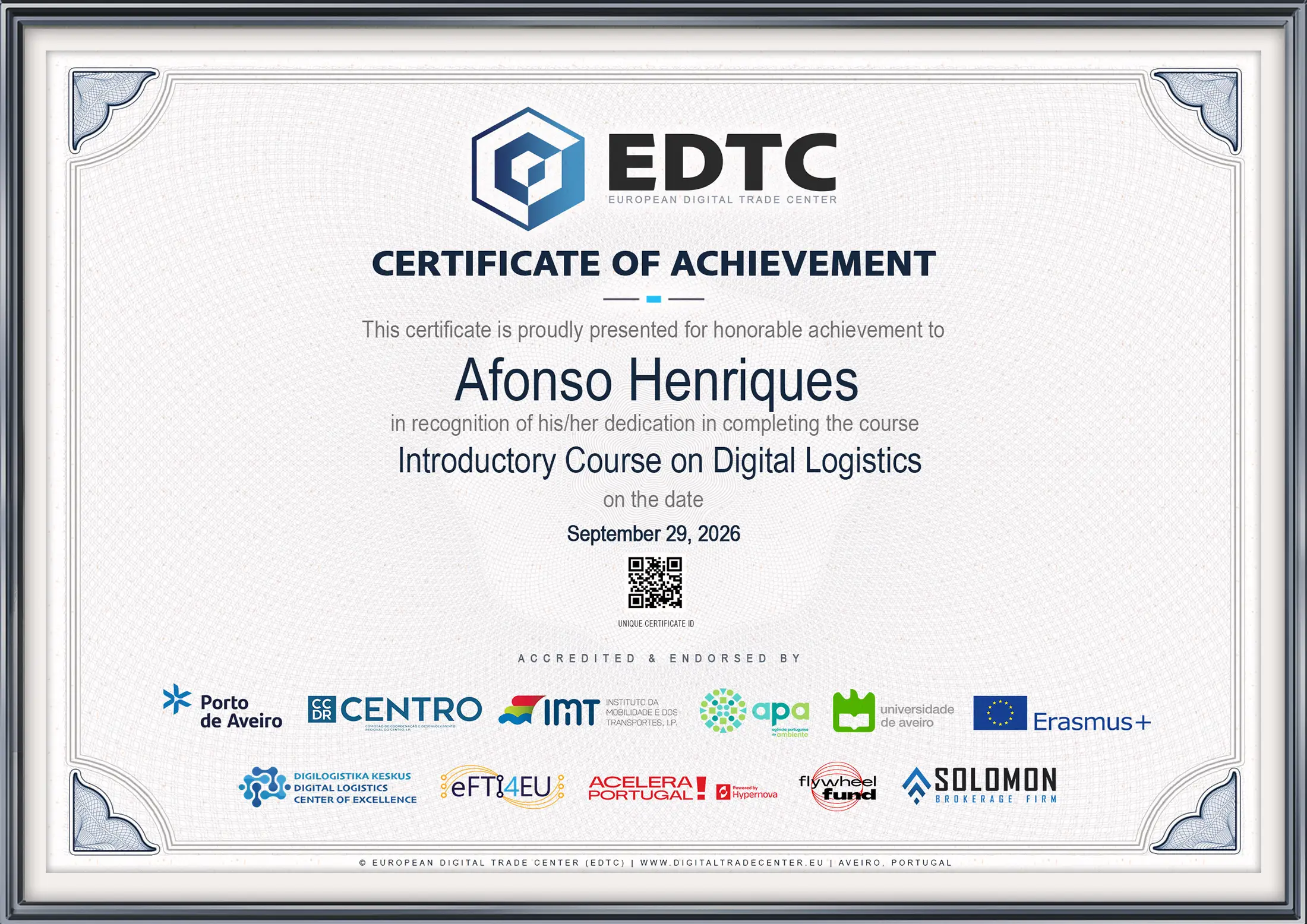
Earn a Certificate & Showcase Your Skills
Complete this course and earn a verified certificate to showcase your new skills. Share it on LinkedIn, add it to your resume, or download it for your records.

Instructor
European Digital Trade Center (EDTC)
2552 Students10 Courses
The European Digital Trade Center (EDTC) helps businesses and professionals participate in sustainable, technology-enabled international trade. Through its membership-based platform, EDTC offers practical training, assessments, and certifications in digital trade, logistics, transportation, trade finance, and compliance. Qualified members can access a digital brokerage marketplace to connect with relevant buyers and sellers, while organizations can receive support in implementing eLogistics, paperless trade, and digital transportation solutions.
Reviews