Lesson 1: The EDTC Vision — Bridging Education & Digital Trade
Unit Information & Metadata
- Lesson ID: EDTC-0-F100_L01
- Estimated Study Duration: 90 Minutes (60 min core instructional reading + 30 min practical workflow & assessment)
- Target EQF Level: EQF Level 3–4 (Vocational Awareness / Entry Prerequisite Micro-Credential)

1. Lesson Opening
1.1 Learning Objectives
Upon completing this lesson, learners will be able to:
- Explain how the European Digital Trade Center (EDTC) bridges the European digital trade maturity gap by unifying vocational education, micro-credentials, and operational B2B marketplace tools [LO0.1.01].
- Identify the core drivers of the European “digital productivity paradox” in cross-border logistics and analyze how paperless administrative workflows lower transaction costs [LO0.1.02].
- Differentiate between Higher Education degree mechanisms (ESG 2015) and Vocational Education and Training quality frameworks (EQAVET, EQF Levels 3–6 micro-credentials, DigComp 3.0) within EDTC course production [LO0.1.03].
- Map the EDTC Tri-Pillar Ecosystem (Curriculum, B2B Marketplace, and 4-Gate Quality Assurance Model) to real-world Atlantic trade corridors, including the Portuguese Tax and Customs Authority ACE Portal and the Port of Sines Janela Única Logística (JUL) [LO0.1.04].
1.2 Business Relevance
For small and medium-sized enterprises (SMEs), logistics operators, freight forwarders, and trade compliance officers across Europe, international commerce is undergoing an unprecedented transition from paper-dependent manual operations to fully digitized, interoperable, and automated data exchanges [1]. While multinational corporations leverage enterprise resource planning (ERP) platforms and direct customs API connections, regional SMEs frequently face severe administrative friction, manual data re-entry errors, and costly cargo detention at maritime ports and border terminals [2].
Understanding the foundational vision of the European Digital Trade Center (EDTC) equips enterprise leaders and operational personnel with the strategic orientation required to navigate European Union digital trade legislation—such as the Union Customs Code (UCC), Regulation (EU) 2020/1056 on Electronic Freight Transport Information (eFTI), the Carbon Border Adjustment Mechanism (CBAM), and the Corporate Sustainability Reporting Directive (CSRD) [3]. By connecting outcomes-based vocational training directly with digital marketplace tools and statutory compliance workflows, EDTC enables organizations to eliminate administrative delays, lower landed supply chain costs, and achieve verifiable digital maturity [4].
1.3 Key Concepts Preview
- The European Digital Productivity Paradox: The operational disconnect where advanced European digital infrastructure exists alongside legacy paper-based enterprise workflows, creating administrative bottlenecks [1, 2].
- Vocational Micro-Credentials vs. Academic Degrees: Short, outcomes-based qualification units (12–32 study hours) mapped to EQF Levels 3–6 and DigComp 3.0, governed by EQAVET quality assurance standards rather than university degree accreditation [5, 6].
- The EDTC Tri-Pillar Ecosystem: The integrated architecture comprising the 12-Pillar / 44-Course Curriculum, the B2B Digital Trade Marketplace, and the 4-Gate Quality Assurance Review Model [4].
- Atlantic Digital Logistics Corridors: Real-world Member State digital trade interfaces, focusing on Portugal’s Action Plan for Digital Transition (Resolution 30/2020), the Tax and Customs Authority (AT) ACE Portal, the Port of Sines Janela Única Logística (JUL), and the Port of Aveiro logistics platform (PLASS) [7, 8].
2. Core Instructional Content
2.1 The European Digital Trade Imperative & The Productivity Paradox
The modern European economy operates within a profound structural contradiction known as the digital productivity paradox [1]. On one hand, the European Union possesses some of the world’s most sophisticated cross-border digital infrastructure, backed by multi-billion-euro legislative programs such as Regulation (EU) 2021/694 establishing the Digital Europe Programme [3]. European customs authorities, maritime port community systems, and road haulage networks have established advanced digital single-window platforms—such as the Janela Única Logística (JUL) connecting maritime terminals in Sines, Leixões, Aveiro, and Lisbon, and the Portuguese Tax and Customs Authority (AT) ACE Portal [7, 8].
On the other hand, small and medium-sized enterprises (SMEs)—which represent 99% of all businesses and employ over two-thirds of the private sector workforce in Europe—continue to rely overwhelmingly on paper-dependent manual processes [2, 9]. International commercial transactions across EU Member States remain burdened by physical paper commercial invoices, printed packing lists, couriered certificates of origin (such as Form EUR.1), and physical paper consignment notes (CMR) [10].
This reliance on paper documentation creates severe operational friction. In cross-border supply chains, physical documents travel separately from the physical freight. When paper documents are delayed, contain manual clerical errors, or fail to reach customs declarants prior to vessel or truck arrival, physical goods are held in port container yards or border inspection terminals [2, 7]. This holding time generates substantial financial penalties in the form of port demurrage, container detention, and vehicle standing charges, which can quickly exceed thousands of euros per shipment and erode the narrow profit margins of exporting SMEs [8].
The Digital Productivity Paradox in EU Trade
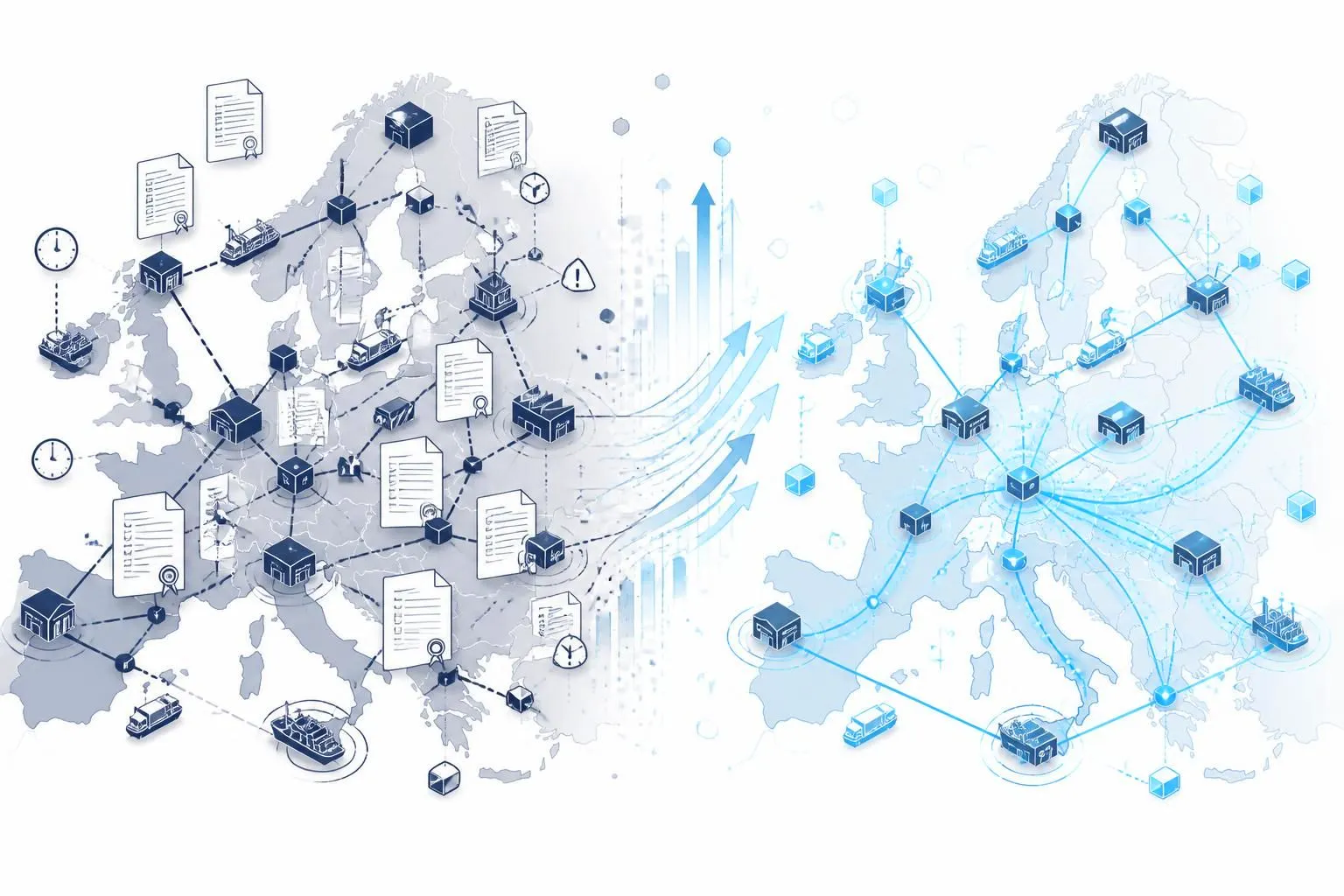
2.1.1 Infrastructure vs. Operational Reality
| Advanced EU Digital Infrastructure | Legacy Paper-Based SME Workflows |
|---|---|
| Digital Europe Programme (€7.5B+) | Physical Paper Invoices & Packing Lists |
| eFTI Freight Platforms (EU 2020/1056) | Couriered Form EUR.1 Certificates |
| National Single Windows (ACE / JUL) | Paper CMR Truck Consignment Notes |
2.1.2 Supply Chain Friction Impact
| Impact Category | Consequence |
|---|---|
| Administrative Delay | Processing times expanded from minutes to 3–5 days |
| Financial Penalties | €2,000–€5,000/day port demurrage & detention charges |
| Error Rates | 15–20% manual re-keying errors in customs data entry fields |
The European Digital Trade Center (EDTC) was established to solve this productivity paradox [4]. The primary obstacle to digital transformation in European trade is not a lack of software or technology; rather, it is a acute digital skills and capability gap among enterprise personnel [5, 9]. Operational staff—such as export managers, customs clerks, warehouse supervisors, and commercial directors—frequently lack the specific procedural competencies needed to operate digital single-window portals, structure electronic trade data schemas (such as UN/CEFACT XML or GS1 standards), execute electronic freight transport information (eFTI) exchanges, or verify digital origin rules [3, 10].
By deploying a standardized, outcomes-based educational model integrated directly with an operational B2B trade marketplace, EDTC systematically upskills workforce personnel while guiding enterprises through step-by-step digital transition pathways [4, 6]. This dual approach ensures that learning is immediately applied to real-world commercial workflows, transforming regulatory compliance from a cost burden into a strategic competitive advantage for European businesses [7].
2.2 Vocational Education vs. Academic Training: The Micro-Credential Revolution
To understand the instructional architecture of the European Digital Trade Center, one must distinguish between traditional Higher Education (HE) academic degree structures and Vocational Education and Training (VET) micro-credential frameworks [5, 6]. Historically, professional development in international trade relied either on multi-year university degree programs (such as Master’s degrees in International Trade or Supply Chain Management) or ad-hoc, unaccredited corporate training seminars [6].
While academic university programs provide valuable theoretical knowledge, they suffer from two major operational limitations in the fast-evolving digital trade landscape: long development cycles and lack of immediate procedural application [5]. A university curriculum often takes 2 to 3 years to accredit and launch, by which time binding European regulations—such as amendments to the Union Customs Code, new eFTI platform interface specifications, or updated CBAM reporting schemas—have already changed [3, 11]. Furthermore, academic programs operate under the Standards and Guidelines for Quality Assurance in the European Higher Education Area (ESG 2015), which evaluate institutional governance, academic research output, and degree awarding powers rather than workplace-specific procedural execution [6].
In contrast, EDTC operates strictly within the European Vocational Education and Training (VET) framework, utilizing short, outcomes-based micro-credentials designed for rapid workforce upskilling [5, 12]. A micro-credential, as defined by Council Recommendation 2022/C 243/02, is a certified record of learning outcomes achieved through a small, focused learning volume (typically 12 to 32 study hours) [12].

2.2.1 Academic Degree Frameworks vs. EDTC VET Micro-Credentials
| Dimension | Academic Degrees (ESG 2015) | EDTC VET Micro-Credentials |
|---|---|---|
| Primary Objective | Theoretical Knowledge & Research | Procedural Workplace Mastery |
| Quality Baseline | ESG 2015 Standards | EQAVET (PDCA Quality Cycle) |
| Time Commitment | 1 to 4 Years (60–240 ECTS) | 12 to 32 Hours (1–2.5 ECTS) |
| Target EQF Level | EQF Levels 6, 7, and 8 | EQF Levels 3, 4, 5, and 6 |
| Digital Competency | General Academic Literacy | DigComp 3.0 Mapped Skills |
| Updating Cycle | 3 to 5 Year Curriculum Review | Annual PDCA Regulatory Audit |
All EDTC courses follow the European Guidelines for the Development and Writing of Short, Learning-Outcomes-Based Descriptions of Qualifications published by CEDEFOP [5]. Every learning objective is expressed using active, measurable verbs from Bloom’s Revised Taxonomy (e.g., classify, calculate, execute, audit, formulate) and mapped directly to the European Digital Competence Framework for Citizens (DigComp 3.0) [13].
DigComp 3.0 defines 21 digital competences structured across 5 thematic areas:
- Information and Data Literacy: Browsing, searching, filtering, evaluating, and managing trade data schemas [13].
- Communication and Collaboration: Interacting, sharing, and engaging through digital trade technologies (e.g., eFTI platforms, ACE Portal, e-CMR networks) [3, 13].
- Digital Content Creation: Developing, editing, and integrating electronic trade documents, e-signatures, and structured datasets [10, 13].
- Safety and Cybersecurity: Protecting devices, trade secrets, personal data (GDPR), and operational networks from cyber threats [13, 14].
- Problem Solving: Identifying technical gaps, selecting appropriate digital tools, and resolving e-customs submission errors [13].
2.2.2 Mandatory Statutory Boundary & Non-Automation Disclaimer
It is a fundamental principle of EDTC governance that short VET micro-credentials provide vocational awareness, procedural knowledge, and operational execution competence, but do NOT independently confer university degrees, academic titles, or statutory licenses (such as licensed customs broker status, certified public auditor credentials, or official customs authority appointment) [4, 6]. Final customs declarations submitted to national tax and customs authorities (such as the Portuguese Autoridade Tributária e Aduaneira) remain subject to statutory verification by licensed customs brokers or authorized economic operators (AEO) [7].
2.3 The EDTC Tri-Pillar Ecosystem: Curriculum, Marketplace & Quality Assurance
The European Digital Trade Center operates as an integrated ecosystem built upon three mutually reinforcing pillars: The 12-Pillar / 44-Course Curriculum, The B2B Digital Trade Marketplace, and The 4-Gate Quality Assurance Framework [4]. This tri-pillar architecture ensures that educational content is not consumed in isolation, but serves as the direct engine for commercial execution and organizational transformation [4, 7].

2.3.1 The EDTC Tri-Pillar Ecosystem Model
| Pillar | Component | Description |
|---|---|---|
| Pillar 1: Curriculum Architecture | Specialized Trade Pillars | 12 specialized trade domains |
| Tiered Courses | 44 courses across Foundational (F), Advanced Practitioner (AP), and Advanced Designer (AD) levels | |
| Professional Pathways | 8 credential pathways for targeted upskilling | |
| Pillar 2: B2B Digital Marketplace | Accredited SME Directory | Vetted service provider business directory |
| eFTI & Logistics Providers | Electronic Freight Transport Information and logistics service integration | |
| Support Services | Custom brokerage and legal advisory helpdesks | |
| Pillar 3: Quality Assurance | Gate 1 | Instructional Design & WCAG 2.1 AA Accessibility Verification |
| Gate 2 | Subject-Matter Expert (SME) Operational Rigor Sign-off | |
| Gate 3 | Statutory Regulatory Verification (EUR-Lex / TARIC Matching) | |
| Gate 4 | LMS Technical Deployment & Metadata Completeness |
1. The Curriculum Architecture (12 Pillars, 44 Courses, 8 Pathways)
The educational baseline comprises 12 specialized domains covering the full spectrum of modern digital trade [4]:
- Pillar 1: Business & Entrepreneurship: SME strategy, digital business models, cross-border expansion [4].
- Pillar 2: International Trade & Customs: Union Customs Code, tariff classification (HS 2026), origin rules, BTI procedures [7].
- Pillar 3: Logistics & Supply Chain Management: Freight forwarding, multimodal transport, port community systems (Sines JUL, Aveiro PLASS) [8].
- Pillar 4: E-Commerce & Digital Marketing: Cross-border B2B/B2C platforms, consumer rights, international SEO [4].
- Pillar 5: Trade Finance & Payments: Letters of credit (UCP 600), supply chain factoring, FX risk management [4].
- Pillar 6: Information Technology & Data Management: B2B data exchange (EDIFACT/XML), master data quality, eFTI architecture [3].
- Pillar 7: Cybersecurity & Operational Resilience: NIS2 Directive compliance, GDPR data protection, phishing defense [14].
- Pillar 8: Sustainability & Circular Economy: Scope 1-3 carbon accounting, CSRD reporting, CBAM emissions calculations [15, 16].
- Pillar 9: Legal, Compliance & Governance: International sales contracts, dual-use export controls, sanctions screening [7].
- Pillar 10: Human Capital & Digital Skills: DigComp 3.0 upskilling, workforce change management [13].
- Pillar 11: Project Management & Innovation: Agile trade projects, Horizon Europe / Digital Europe grant governance [3].
- Pillar 12: Global Market Negotiation: Cross-border agency contracts, joint ventures, international arbitration [4].
Courses are structured across three progressive tiers:
- Foundation Tier (EQF Levels 3–4): Entry-level vocational awareness, introducing core regulatory frameworks and basic administrative workflows [4].
- Applied Tier (EQF Level 5): Operational execution, focusing on hands-on document assembly, data mapping on customs portals, and practical case studies [7].
- Advanced Tier (EQF Levels 5–6): Strategic compliance mastery, legal tariff classification, RVC mathematical modeling, BTI application dossier preparation, and customs audit defense [7].
Learners can combine individual courses into 8 Professional Credential Pathways (e.g., Digital Trade Compliance Officer, Atlantic Supply Chain Specialist, Green Trade & CBAM Lead), concluding with a comprehensive Capstone Action Plan [4].
2. The B2B Digital Trade Marketplace
Unlike static e-learning platforms, EDTC incorporates a live B2B Digital Marketplace that connects upskilled learners and certified SMEs directly with digital trade service providers [4]. Enterprise graduates gain access to:
- Accredited Service Directory: Verified digital freight forwarders, eFTI service providers, and cloud ERP vendors [3, 8].
- Customs Broker Helpdesk: Direct escalation channels to licensed customs brokers for complex tariff classification and BTI rulings [7].
- Digital Readiness Matchmaking: A platform connecting exporting SMEs with EU digital transition grant opportunities (such as AICEP and IAPMEI co-funding in Portugal) [1, 9].
3. The 4-Gate Quality Assurance Framework
Every course module deployed on the EDTC platform must pass through a strict 4-Gate Quality Assurance Review before publication [4]:
2.3.2 The EDTC 4-Gate Quality Assurance Review Model
| Gate | Stage | Key Requirements |
|---|---|---|
| 1 | Instructional Design | • 7,800-word depth & structure • WCAG 2.1 AA accessibility compliance |
| 2 | Subject-Matter Expertise (SME) | • Operational rigor & technical accuracy • 15+ numeric footnote citations & APA references |
| 3 | Statutory Legal Audit | • EUR-Lex / TARIC article match verification • Non-automation boundary verification |
| 4 | LMS Technical Deployment | • 5 native LMS quiz format checks • Metadata completeness & URL slug validation |
2.4 Alignment with Binding European Union Quality & Policy Frameworks
The EDTC educational ecosystem is built upon full alignment with binding European Union policy frameworks, national administrative transition strategies, and vocational quality standards [3, 4]. Every course module undergoes continuous annual quality evaluation under the EQAVET Plan-Do-Check-Act (PDCA) Quality Assurance Cycle [17].
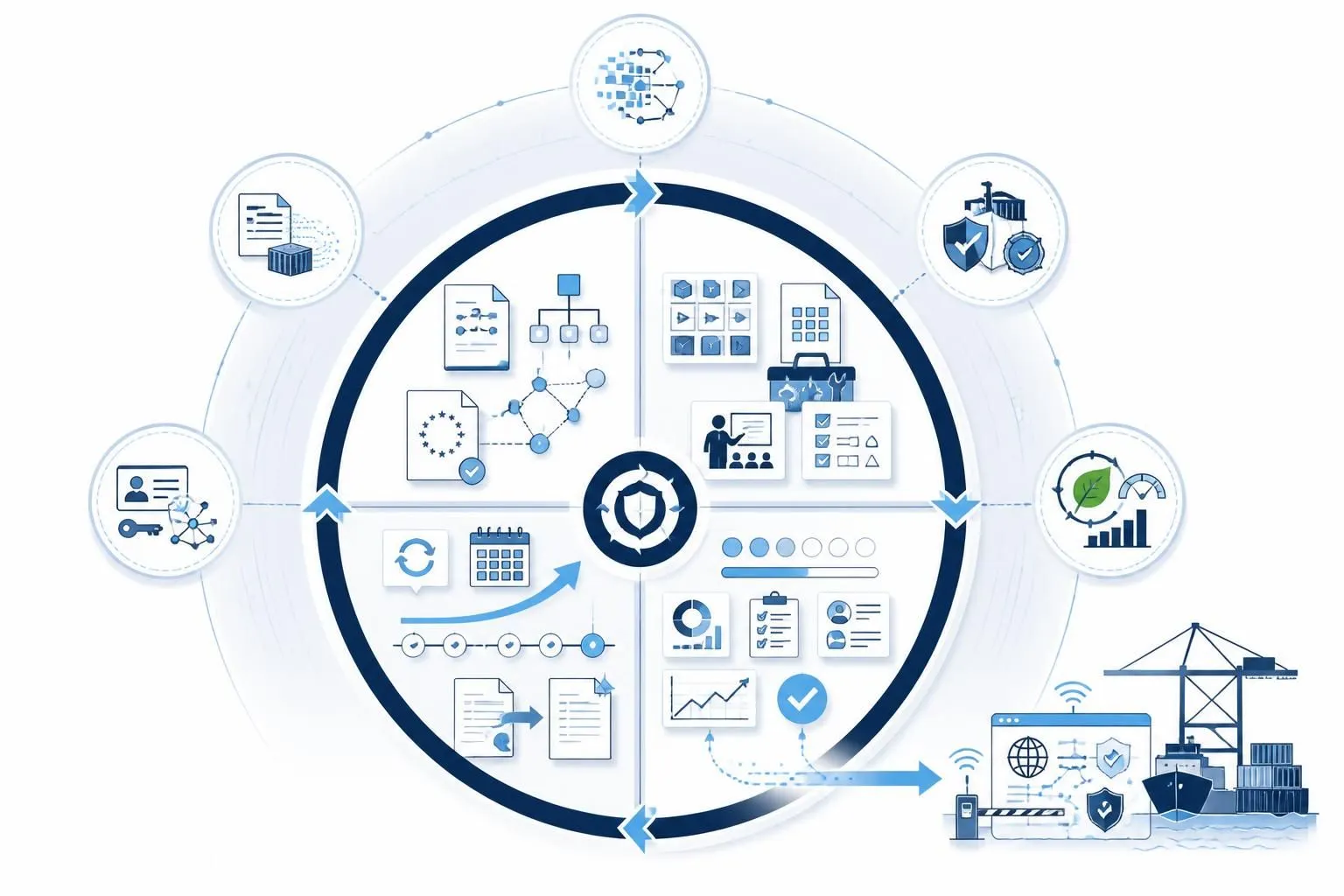
The EQAVET Continuous PDCA Quality Cycle
| Phase | Description |
|---|---|
| 1. PLAN (Designing Curriculum Alignment) | Map course learning outcomes to DigComp 3.0 & EUR-Lex regulatory updates. |
| 2. DO (Instructional Execution & Delivery) | Deliver ~7,800-word lessons minimum, practical toolkits, & LMS quizzes. |
| 3. CHECK (Evaluating Assessment & Feedback Data) | Analyze quiz completion rates, learner feedback, & SME review logs. |
| 4. ACT (Updating Course Material & Legal References) | Execute annual content revisions to reflect new EU regulations & port rules. |
2.4.1 Core European Legislative Baselines
EDTC courses integrate primary EU legislation directly into instructional workflows and practical toolkits:
- The Digital Europe Programme (Regulation (EU) 2021/694): Provides the strategic funding baseline for digital skills upskilling, artificial intelligence adoption, cybersecurity resilience, and interoperable digital public service infrastructure across all 27 Member States [3].
- The eFTI Framework (Regulation (EU) 2020/1056): Mandates that EU Member State competent authorities accept electronic freight transport information in standardized digital formats via certified eFTI platforms, eliminating paper consignment notes in road, rail, and maritime logistics [3, 18].
- The Union Customs Code (UCC – Regulation (EU) No 952/2013 & Regulation (EU) 2015/2447): Establishes the 100% paperless customs filing mandate across all EU borders, requiring electronic pre-lodgment, standardized Common Entry Module (CEM) data schemas, and electronic Economic Operators Registration and Identification (EORI) validation [7].
- eIDAS 2.0 (Regulation (EU) No 910/2014 & Regulation (EU) 2024/1183): Governs electronic identification, European Digital Identity Wallets, qualified electronic signatures (QES), and trusted electronic seals for cross-border B2B and B2G document authentication [10, 19].
- ESG Sustainability Regulations (CSRD & CBAM): Directive (EU) 2022/2464 (Corporate Sustainability Reporting Directive) and Regulation (EU) 2023/956 (Carbon Border Adjustment Mechanism) require importers to calculate and report embedded Scope 1-3 greenhouse gas emissions for goods entering the EU Single Market [15, 16].
2.4.2 Member State Implementation: The Portuguese Atlantic Gateway Baseline
To demonstrate practical administrative application, EDTC grounds its case studies, practical toolkits, and operational workflows in Portugal’s Atlantic trade logistics corridor—a primary maritime gateway for goods entering Europe from the Americas, West Africa, and transatlantic shipping routes [8].
Portuguese Atlantic Digital Trade Logistics Baseline
| Category | Details |
|---|---|
| National Legislative Roadmap | • Resolution of the Council of Ministers No. 30/2020 (Digital Transition) • Decree-Law No. 130/2015 (Portuguese Customs Code Implementation) |
| Digital Customs Interface | • Autoridade Tributária e Aduaneira (AT) ACE Portal • Automated pre-lodgment, electronic tariff classification, & BTI filings |
| Maritime & Port Community Platforms | • Port of Sines: Janela Única Logística (JUL) deep-sea container gateway • Port of Aveiro: Logistics Platform (PLASS / ZALI) industrial cabotage • Port of Leixões & Port of Lisbon: Integrated multimodal rail/sea hubs |
In Portugal, Resolution of the Council of Ministers No. 30/2020 established the Action Plan for Digital Transition (Plano de Ação para a Transição Digital), prioritizing SME digital onboarding, administrative modernization, and digital supply chain integration [1]. The Portuguese Tax and Customs Authority (Autoridade Tributária e Aduaneira – AT) executes customs enforcement via the ACE Portal, providing electronic interfaces for customs pre-lodgment, tariff classification inquiries, and Binding Tariff Information (BTI) applications [7].
At maritime port gateways, the Janela Única Logística (JUL) platform connects maritime terminal operators, shipping lines, customs authorities, and inland rail/road hauliers into a single digital data exchange [8]. Vessels arriving at the deep-water Port of Sines or the industrial Port of Aveiro transmit advance electronic manifests via JUL, enabling automated pre-arrival customs clearance while ships are still at sea [8]. SMEs that adopt these digital corridors achieve rapid cargo dispatch, eliminating physical terminal detention and positioning themselves for competitive growth in the European Single Market [1, 8].
3. Practical Workflow: Enterprise Digital Readiness & Orientation Matrix
To translate macro EU digital trade policies into daily operational practice, enterprise managers must execute a structured digital orientation workflow. The table below outlines the 4-step orientation protocol for small and medium-sized exporting enterprises initiating their digital trade transition.
Trade Documentation Digital Transformation Roadmap
| Step | Action Item | Required Input / Tool | Operational Decision Point | Escalation Trigger |
|---|---|---|---|---|
| 1 | Audit Existing Trade Documentation Workflows | Shipping Logs, Invoices, Packing Lists & Transport Contracts | Are >50% of trade files prepared manually on paper or static Word/Excel files? | If manual paper files exceed 50%, flag for immediate digital transition to eliminate demurrage risk [2] |
| 2 | Assess Digital Skills & DigComp 3.0 Readiness | EDTC DigComp 3.0 Self-Assessment Tool (Tool 1) |
Do operational staff possess Level 3+ proficiency in digital data entry and portal navigation? | If staff digital literacy is below Level 3, enroll team in EDTC-0-F100 and EDTC-10-F1001 [13] |
| 3 | Verify Portal Credentials & Authority System Registration | EORI EOS Database, Portuguese ACE Portal, Sines/Aveiro JUL Platform | Does the enterprise possess active digital certificates (eIDAS e-Seals) and AEO/EORI credentials? | If digital certificates are missing or expired, apply immediately via Autoridade Tributária [7, 19] |
| 4 | Map Professional Upskilling Pathway & Implementation Roadmap | EDTC Pathway Selection Matrix (Tool 2) & Action Plan Canvas (Tool 3) |
Which specific EDTC credential pathway matches the enterprise’s 12-month export growth goals? | Consult EDTC Trade Advisory Helpdesk to select between Compliance, Logistics, or E-Commerce pathways [4] |
4. Realistic Enterprise Scenario

in concrete SME operational reality, illustrating the tangible financial and competitive benefits of workforce upskilling and digital platform adoption within Portugal’s Atlantic Gateway logistics corridor.
4.1 Scenario Narrative
Conservas do Atlântico Lda., a medium-sized seafood processing and canning company based near Peniche, Portugal, exports premium canned sardines and mackerel to commercial distributors in France, Germany, and the United Kingdom. Currently, the company’s export team prepares physical commercial invoices, types paper packing lists on desktop word processors, and couriers paper certificates of origin to a regional shipping agent in Lisbon.
During a recent 20-container export shipment dispatched via the Port of Sines to Hamburg, physical packing list documents were delayed by two days due to courier error. Upon arrival at the Sines terminal, customs declarants discovered a 1.8% discrepancy between the gross weight recorded on the paper packing list and the electronic weight manifest logged into the Janela Única Logística (JUL) platform.
The Portuguese Tax and Customs Authority (ACE Portal) automatically flagged the shipment with a red-lane inspection hold, requiring physical container re-weighing and manual document reconciliation. The delay resulted in a 3-day vessel loading hold, incurring €4,800 in port demurrage and container standing charges, while threatening the buyer’s promotional delivery window in Hamburg. The Managing Director of Conservas do Atlântico Lda. needs an immediate operational solution to modernize export documentation and prevent future port holds.
4.2 Evaluation Key
1. Primary Operational Diagnosis
Conservas do Atlântico Lda. operates under legacy paper-dependent shipping workflows, creating three major points of operational failure [2]:
- Data Discrepancy Risk: Preparing documents manually in separate software applications leads to weight and value variances between commercial invoices, packing lists, and customs manifests [7].
- Physical Courier Dependency: Relying on physical paper couriers introduces transit delays and risk of document loss [10].
- Non-Compliance with Digital Port Manifests: The company failed to pre-lodge electronic cargo declarations on the Sines JUL platform prior to truck arrival at the terminal gate [8].
2. Recommended 4-Step Strategy
- Immediate Port Clearance: Engage a licensed customs broker via the EDTC Marketplace Helpdesk to execute an emergency data amendment on the AT ACE Portal, matching the physical container weighbridge certificate to the electronic JUL manifest [7, 8].
- Standardize Electronic Trade Data: Transition from manual paper documents to structured PDF/A invoices with eIDAS-compliant qualified electronic signatures (QES) and XML data schemas conforming to UN/CEFACT standards [10, 19].
- Onboard onto Port Community Platforms: Register the enterprise on the Port of Sines JANELA ÚNICA LOGÍSTICA (JUL) platform for direct pre-lodgment of export manifests [8].
- Workforce Upskilling via EDTC: Enroll the export operations coordinator and commercial assistant in
EDTC-0-F100(Orientation) followed byEDTC-1-F101(Introduction to Digital Trade) andEDTC-2-AP201(Trade Documentation) to build in-house procedural compliance competence [4].
3. Alternative Acceptable Approach
The enterprise may partner with a digital freight forwarder that provides a integrated cloud customer portal. The forwarder ingests raw sales order data from Conservas do Atlântico Lda., automatically generates compliant electronic transport records (e-CMR / eFBL), and handles pre-arrival ACE Portal customs declarations [8, 20]. While this bypasses internal software redevelopment, the enterprise must still upskill its export staff to verify data accuracy prior to forwarder transmission [4].
4. Common Learner Misconceptions
- Misconception 1: Assuming digital trade requires multimillion-euro custom ERP investments. In reality, EU and Portuguese digital transition policies provide free, open-access web portals (ACE Portal, JUL) and micro-credential training for immediate SME onboarding [1, 7].
- Misconception 2: Believing that paper documents are legally required for customs clearance. Under the Union Customs Code (UCC), 100% of customs declarations in the EU must be executed electronically [7].
5. Governance, Educational Limitations & Glossary
5.1 Key Takeaways
- Bridging the Productivity Paradox: EDTC unifies outcomes-based vocational education with an operational B2B trade marketplace to eliminate administrative delays and lower supply chain transaction costs [1, 4].
- Vocational Micro-Credentials: EDTC courses deliver short, focused learning units (12–32 study hours) mapped to EQF Levels 3–6 and DigComp 3.0, evaluated under EQAVET quality standards rather than Higher Education university degree frameworks [5, 6].
- The Tri-Pillar Architecture: The 12-Pillar / 44-Course Curriculum, the B2B Marketplace, and the 4-Gate Quality Assurance Review Model ensure that learning leads directly to commercial execution [4].
- Atlantic Digital Corridors: Practical learning is grounded in Member State digital customs and port community platforms, including the Portuguese AT ACE Portal and the Port of Sines Janela Única Logística (JUL) [7, 8].
5.2 Educational Limitation & Non-Automation Disclaimer
This unit provides general vocational orientation regarding the European Digital Trade Center ecosystem, digital trade legislation, and port community platforms. It does NOT constitute formal legal advice, tax opinion, or official customs software certification. Short VET micro-credentials provide procedural knowledge and operational execution competence, but do NOT independently confer university degrees, academic titles, or statutory licenses (such as licensed customs broker status). Enterprise managers must verify specific customs entry fields and portal credentials with competent national tax and customs authorities (such as the Portuguese Autoridade Tributária e Aduaneira) or licensed customs brokers.
5.3 Technical Glossary
- Digital Trade: Digitally enabled or digitally delivered cross-border transactions in goods, services, and data [3].
- Micro-Credential: A certified record of learning outcomes achieved through a small, focused learning volume (12–32 study hours) mapped to the European Qualifications Framework [12].
- Janela Única Logística – JUL (Logistics Single Window): The integrated Portuguese port community system connecting maritime terminals, customs, shipping lines, and inland transport operators [8].
- ACE Portal: The official web portal of the Portuguese Tax and Customs Authority (Autoridade Tributária e Aduaneira) for electronic customs pre-lodgment and BTI applications [7].
- eFTI Platform: Certified digital freight transport information platform operating under Regulation (EU) 2020/1056 for B2B and B2A electronic data exchanges [18].
- DigComp 3.0: The European Digital Competence Framework defining 21 competences across 5 thematic digital areas [13].
6. References & Source Material
- Presidência do Conselho de Ministros. (2020). Resolução do Conselho de Ministros n.º 30/2020: Aprova o Plano de Ação para a Transição Digital de Portugal. Diário da República, 1.ª série, N.º 78, 2–21. https://diariodarepublica.pt/dr/detalhe/resolucao-conselho-ministros/30-2020-132133465
- European Commission. (2022). SME Performance Review 2021/2022: European SMEs and the Digital Transition. Publications Office of the European Union. https://ec.europa.eu/growth/smes/sme-strategy/sme-performance-review_en
- European Parliament & Council of the European Union. (2021). Regulation (EU) 2021/694 establishing the Digital Europe Programme and repealing Decision (EU) 2015/2240. Official Journal of the European Union, L 166, 1–34. https://eur-lex.europa.eu/legal-content/EN/TXT/?uri=CELEX:32021R0694
- European Digital Trade Center. (2026). EDTC AI Course Production Framework & Quality Assurance Architecture (Master Specification V1.5). EDTC Press.
- European Centre for the Development of Vocational Training. (2022). European guidelines for the development and writing of short, learning-outcomes-based descriptions of qualifications. CEDEFOP Reference Series, No. 122. Publications Office of the European Union. https://www.cedefop.europa.eu/
- European Association for Quality Assurance in Higher Education. (2015). Standards and Guidelines for Quality Assurance in the European Higher Education Area (ESG 2015). EURASHE. https://www.enqa.eu/
- Autoridade Tributária e Aduaneira. (2024). Manual de Operações do Portal ACE: Submissão Eletrónica de Declarações Aduaneiras e Pré-Alojamento de Mercadorias. Ministério das Finanças de Portugal.
- Administração do Porto de Sines e do Algarve, S.A. (2021). Visão Estratégica 2030: Janela Única Logística (JUL) e a Digitalização do Corredor Atlântico. APS Editorial. https://www.portodesines.pt/
- AICEP Portugal Global. (2023). Guia Prático de Digitalização e Internacionalização para PMEs Exportadoras. Agência para o Comércio Externo e Investimento de Portugal.
- United Nations Centre for Trade Facilitation and Electronic Business. (2020). UN/CEFACT Recommendation No. 1: UN Layout Key for Trade Documents (ECE/TRADE/137/Rev.2). United Nations.
- World Customs Organization. (2025). Harmonized System Explanatory Notes (2026 Edition). WCO Publications.
- Council of the European Union. (2022). Council Recommendation of 16 June 2022 on a European approach to micro-credentials for lifelong learning and employability (2022/C 243/02). Official Journal of the European Union, C 243, 10–25.
- Joint Research Centre (European Commission). (2025). DigComp 3.0: The European Digital Competence Framework for Citizens with Learning Outcomes and Performance Indicators. Publications Office of the European Union. https://joint-research-centre.ec.europa.eu/digcomp_en
- European Parliament & Council of the European Union. (2022). Directive (EU) 2022/2555 on measures for a high common level of cybersecurity across the Union (NIS2 Directive). Official Journal of the European Union, L 333, 80–152.
- European Parliament & Council of the European Union. (2022). Directive (EU) 2022/2464 as regards corporate sustainability reporting (CSRD Directive). Official Journal of the European Union, L 322, 15–80.
- European Parliament & Council of the European Union. (2023). Regulation (EU) 2023/956 establishing a carbon border adjustment mechanism (CBAM Regulation). Official Journal of the European Union, L 130, 52–104.
- European Quality Assurance in Vocational Education and Training. (2009). Recommendation of the European Parliament and of the Council on the establishment of a European Quality Assurance Reference Framework for Vocational Education and Training (EQAVET) (2009/C 155/01). Official Journal of the European Union, C 155, 1–10.
- European Parliament & Council of the European Union. (2020). Regulation (EU) 2020/1056 on electronic freight transport information (eFTI). Official Journal of the European Union, L 249, 33–43.
- European Parliament & Council of the European Union. (2024). Regulation (EU) 2024/1183 amending Regulation (EU) No 910/2014 as regards establishing the European Digital Identity Framework (eIDAS 2.0). Official Journal of the European Union, L 2024/1183.
- International Multimodal Transport Association & FIATA. (2023). FIATA Digital Bill of Lading (eFBL) Standard Rules and Data Schema. FIATA Publications.