
Lesson 4: National & Strategic Baselines — Portugal & The Atlantic Gateway
Unit Information & Metadata
- Lesson ID: EDTC-0-F100_L04
- Estimated Study Duration: 90 Minutes (60 Minutes Core Instructional Study + 30 Minutes Practical Exercise & Assessment)
- Target EQF Level: EQF Level 3–4 (Vocational Awareness / Prerequisite Micro-Credential)
1. Lesson Opening & Business Relevance
1.1 Primary Learning Objectives
Upon completion of this lesson, learners will be able to:
- Analyze Portugal’s geopolitical, infrastructural, and digital role as the primary European Atlantic maritime and data gateway connecting South America, North America, West Africa, and the European Single Market (LO0.4.01).
- Evaluate the statutory requirements and operational workflows of the Portuguese Action Plan for Digital Transition (Resolution of the Council of Ministers No. 30/2020) and Decree-Law No. 130/2015 regarding customs code implementation and pre-arrival electronic data lodgment via the Portuguese Tax and Customs Authority (Autoridade Tributária e Aduaneira – AT) ACE Portal (LO0.4.02).
- Differentiate the operational architectures and digital single-window interoperability protocols of major Portuguese Atlantic port logistics platforms, specifically the Port of Sines Janela Única Logística (JUL), the Port of Leixões, and the Port of Aveiro Logistics Platform (PLASS) (LO0.4.03).
- Formulate an enterprise digital onboarding strategy that leverages public trade promotion agencies (AICEP Portugal Global), industrial support bodies (IAPMEI), and accredited vocational training frameworks (DGERT / ANQEP) to achieve compliant cross-border execution (LO0.4.04).
1.2 Business Relevance
For small and medium-sized enterprises (SMEs) and international freight logistics operators across Europe, navigating cross-border trade requires combining overarching European Union regulatory compliance with specific national administrative and digital gateway workflows. Portugal occupies a strategic position in global trade logistics, serving as the European Union’s deep-sea Atlantic frontier and a primary digital data hub for submarine cable systems linking Europe, the Americas, and Africa.
However, enterprise managers frequently encounter operational friction when transitioning from theoretical European customs rules to live, national-level execution platforms. Discrepancies between commercial shipping documents and pre-arrival data submissions on the Portuguese Tax and Customs Authority (AT) ACE Portal, or misalignments in terminal slot bookings on the Janela Única Logística (JUL) platform at the Port of Sines or Port of Aveiro, result in immediate vessel discharge delays, customs detention holds, and severe physical demurrage penalties. Understanding Portugal’s national digital transition frameworks and maritime logistics platforms provides enterprise leaders with the practical capability to optimize supply chain speed, reduce administrative compliance costs, and execute seamless multimodal transport operations across Atlantic trade corridors.
1.3 Key Concepts Preview
- Atlantic Gateway Logistics: The strategic positioning of Portuguese maritime ports (Sines, Leixões, Aveiro, Lisbon, Setúbal) as primary deep-sea transshipment and short-sea shipping corridors connecting global ocean trade routes to the European hinterland [1, 2].
- Action Plan for Digital Transition (Resolution No. 30/2020): Portugal’s national strategic policy framework establishing digital transformation roadmaps for enterprise modernization, SME digital literacy, administrative paperless workflows, and public portal integration [3].
- ACE Portal (Autoridade Tributária e Aduaneira): The national electronic customs portal administered by the Portuguese Tax and Customs Authority for customs declarations, EORI verification, pre-lodgment filings, and Binding Tariff Information (BTI) administration under Decree-Law No. 130/2015 [4, 5].
- Janela Única Logística (JUL): The Portuguese national Port Community System (PCS) and digital single-window platform connecting maritime port authorities, shipping lines, customs officials, terminal operators, and inland transport hauliers into a unified, paperless data exchange ecosystem [1, 6].
- Port of Aveiro Strategic Platform (PLASS): The specialized maritime and industrial logistics node serving the Northern and Central Iberian economic corridors, focusing on short-sea shipping, dry/liquid bulk, manufactured export goods, and regional railway integration [2, 7].
- National Support Agencies (AICEP & IAPMEI): Public bodies providing exporting SMEs with international market intelligence, digital transformation co-funding grants, trade promotion guidance, and enterprise innovation support [3, 8].
2. Core Instructional Content & National Regulatory Mechanics
2.1 Portugal’s Strategic Position in European & Atlantic Digital Trade
2.1.1 Geopolitical & Maritime Trade Significance
Portugal occupies a unique and pivotal geographic position within the European Union’s international trade architecture. Situated at the southwestern extremity of the European continent, Portugal functions as the primary Atlantic maritime gateway for goods entering and departing the European Single Market [1]. The nation’s deep-water ports along the Atlantic coast—most notably the Port of Sines, the Port of Leixões, the Port of Aveiro, the Port of Lisbon, and the Port of Setúbal—serve as vital transshipment and gateway nodes for international containerized cargo, energy commodities, liquid and dry bulk, and automotive freight moving across global ocean trade lanes [2, 6].
Unlike inland European logistics hubs that rely heavily on intra-EU road and rail transport, Portuguese maritime gateways connect the European Union directly to major intercontinental trade corridors [1]. These corridors include the North Atlantic routes connecting Europe to the United States and Canada, the South Atlantic routes linking South America (specifically Brazil and the Mercosur trade bloc), the West African maritime trade lanes, and the maritime routes operating through the Strait of Gibraltar toward the Mediterranean Sea and the Suez Canal [1, 8]. Consequently, Portuguese port infrastructure acts as an essential commercial bridge where deep-sea ocean vessels discharge cargo onto short-sea feeder vessels, coastal shipping networks, and trans-Iberian rail and road transport systems bound for destination markets across Spain, France, and Central Europe [2, 9].
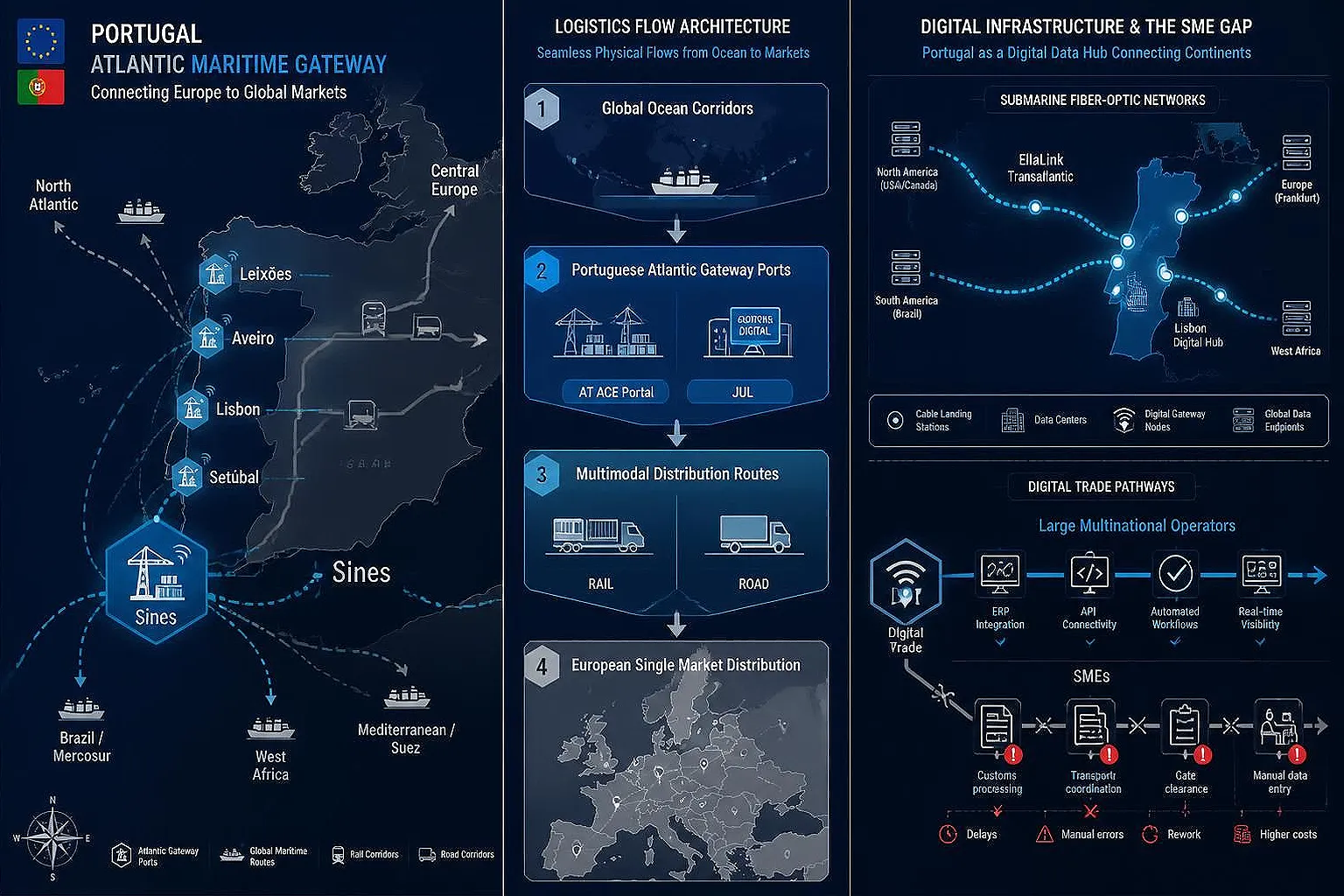
Global Ocean Corridors (Americas, Africa, Asia) – Logistics Flow
| Stage | Component | Function |
|---|---|---|
| Global Entry | Global Ocean Corridors (Americas, Africa, Asia) | International maritime routes and origin markets. |
| Gateway Ports | Portuguese Atlantic Gateway Ports (Sines, Leixões, Aveiro) | Primary port entry points for Atlantic corridor traffic. |
| Distribution Routes | National E-Customs & Digital Window (AT ACE Portal & JUL PCS) | Regulatory clearance, customs processing, and digital documentation. |
| Multimodal Inland Transport (Trans-Iberian Rail & Highway) | Freight distribution via rail and road networks across the Iberian Peninsula. | |
| Market Distribution | European Single Market Hinterland Distribution | Final destination distribution across the European Union market. |
2.1.2 Digital Submarine Connectivity & Data Gateway Infrastructure
Beyond physical maritime cargo handling, Portugal has emerged as a premier digital infrastructure and data gateway for the European Union [3]. The city of Sines and the greater Lisbon metropolitan area host critical landings for next-generation intercontinental submarine fiber-optic cable networks, such as the Ellalink cable connecting Europe directly to South America, as well as major transatlantic and pan-African cable systems [3, 10]. This digital subsea infrastructure provides high-capacity, ultra-low latency data transmission channels connecting European enterprise data centers directly to international trading partners [10].
This convergence of physical maritime logistics and digital telecommunications infrastructure makes Portugal an ideal testing ground and operational node for the European Union’s paperless trade initiatives [1, 3]. As the European Union accelerates the implementation of binding digital single market regulations—such as Regulation (EU) 2020/1056 on Electronic Freight Transport Information (eFTI), the Union Customs Code (UCC) electronic declaration mandates, and eIDAS 2.0 electronic trust services—Portugal’s digital trade ecosystem offers an integrated environment where physical goods clearance and digital data flows operate in lockstep [5, 11].
2.1.3 The SME Adoption Reality & Operational Disconnect
Despite the presence of world-class port infrastructure and advanced national public portals, small and medium-sized enterprises (SMEs) across Portugal and Southern Europe experience an operational disconnect [3, 12]. While large multinational logistics operators and global ocean carriers utilize automated Enterprise Resource Planning (ERP) integrations to transmit customs and transport data directly to public portals via Application Programming Interfaces (APIs), regional exporting SMEs frequently rely on fragmented, paper-heavy administrative processes [4, 12].
This administrative disconnect manifests in several concrete operational bottlenecks:
- Manual Data Entry Errors: Export clerks manually transcribe commercial invoice data, packing list weights, and tariff codes into standalone customs software, resulting in frequent data discrepancies on the AT ACE Portal [4, 5].
- Fragmented Communication Channels: Transport instructions, consignment notes, and origin declarations are exchanged via unstandardized email attachments or physical paper forms rather than certified electronic freight transport information (eFTI) data exchanges [11, 13].
- Port Gate Clearance Delays: Freight hauliers arrive at port terminal gates without pre-validated digital gate passes or synchronized Janela Única Logística (JUL) terminal slot bookings, causing physical truck staging queues and port demurrage charges [1, 6].
Addressing this operational disconnect requires enterprise personnel to master both the statutory rules governing national customs administration and the practical mechanics of Portugal’s digital single-window logistics platforms [3, 4].
2.2 The National Digital Transition Framework & Regulatory Baselines
2.2.1 Resolution of the Council of Ministers No. 30/2020 (Action Plan for Digital Transition)
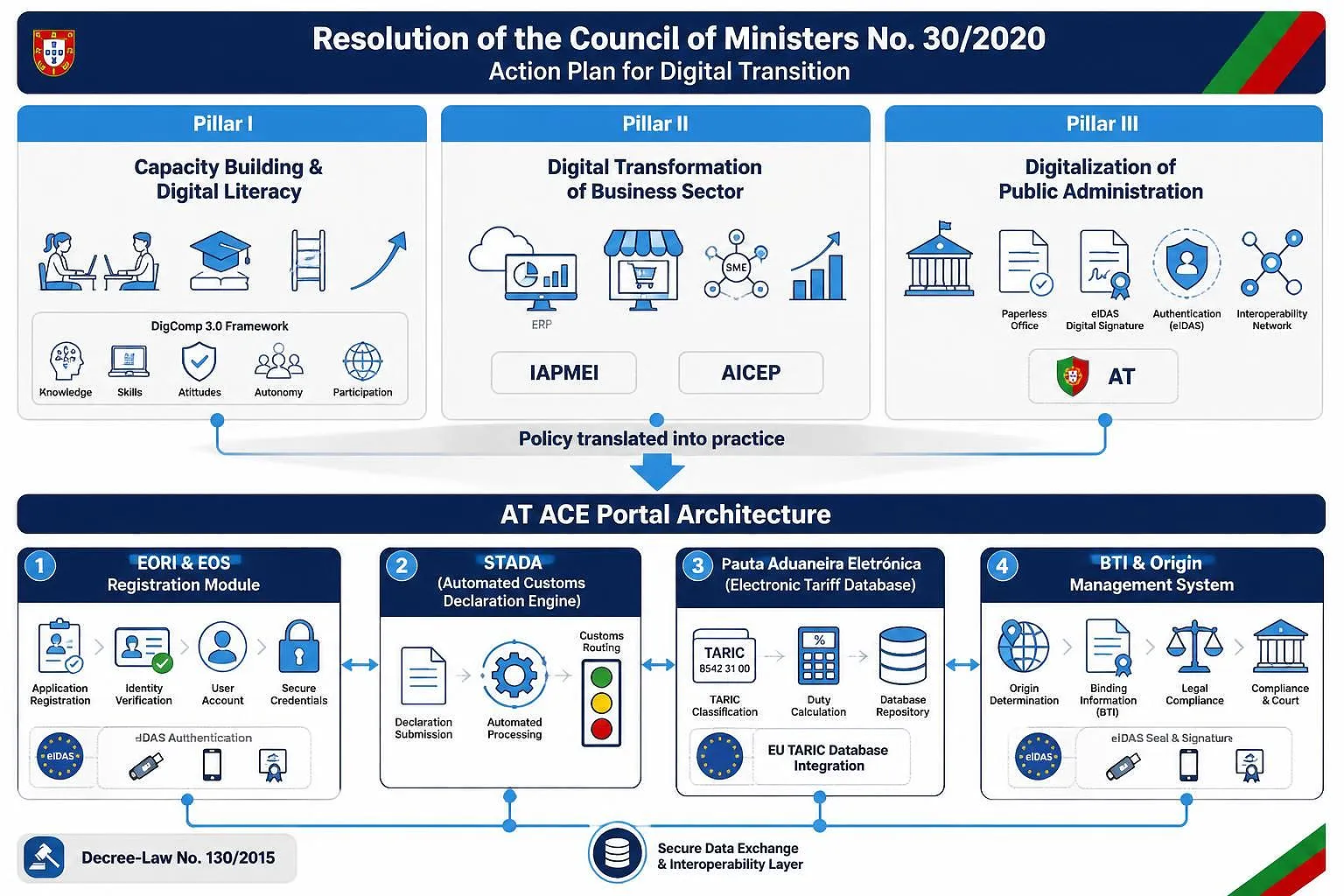
The foundation of Portugal’s national digital trade policy is established by the Action Plan for Digital Transition (Plano de Ação para a Transição Digital), enacted through Resolution of the Council of Ministers No. 30/2020 on April 21, 2020 [3]. Designed to align Portugal with the European Union’s Digital Europe Programme (Regulation EU 2021/694), the Action Plan establishes a comprehensive roadmap to digitize the national economy, modernize public administration, and empower the workforce with advanced digital skills [3, 14].
The Action Plan is organized around three primary strategic pillars, each directly influencing cross-border trade and logistics operations MANDATORY:
- Pillar I: Capacity Building and Digital Literacy: Focuses on upskilling the national workforce in digital competencies, integrating the European Digital Competence Framework (DigComp 3.0) into vocational education, and training SME personnel in digital business operations [3, 15].
- Pillar II: Digital Transformation of the Business Sector: Provides direct financial incentives, grant mechanisms, and technical support through public agencies (IAPMEI and AICEP) to assist exporting enterprises in adopting cloud computing, enterprise resource planning systems, automated e-commerce platforms, and digital supply chain workflows [3, 8].
- Pillar III: Digitalization of Public Administration: Mandates the complete paperless transformation of state administrative services, requiring public authorities—including the Tax and Customs Authority (AT), port authorities, and transport regulators—to deploy interoperable digital single-window portals, electronic signature systems under eIDAS, and open data APIs [3, 11].
Portuguese Action Plan for Digital Transition (Res. No. 30/2020)
| Pillar I | Pillar II | Pillar III |
|---|---|---|
| Workforce Digital Skills | SME Enterprise Model Modernization | Public Administration |
| DigComp 3.0 / DGERT | IAPMEI | AT ACE Portal & JUL |
For enterprises engaged in cross-border commerce, Resolution No. 30/2020 established the statutory imperative to eliminate paper-based administrative documentation, mandate electronic invoicing for public procurement and commercial transactions, and adopt digital authentication credentials across all interactions with state authorities [3, 4].
2.2.2 Decree-Law No. 130/2015 & National Customs Code Implementation
While European Union customs legislation is governed primarily by the Union Customs Code (UCC – Regulation EU No 952/2013) and its Implementing and Delegated Regulations (EU 2015/2447 and EU 2015/2446), national enforcement, penalty regimes, procedural appeal mechanics, and specific administrative customs workflows in Portugal are governed by Decree-Law No. 130/2015 of July 9, 2015 [4, 5].
Decree-Law No. 130/2015 establishes the statutory rules for customs representation, customs clearance procedures, customs debt guarantees, and administrative appeals within the Portuguese jurisdiction MANDATORY:
- Customs Representation & Brokerage Rules: Regulates the legal conditions under which indirect and direct customs representatives (licensed customs brokers – Despachantes Oficiais) operate before Portuguese customs authorities [4].
- Pre-Arrival Data Lodgment Requirements: Mandates that all entry summary declarations (ENS), exit summary declarations (EXS), and standard customs declarations must be lodged electronically via the official state portal prior to physical cargo arrival at national border crossing points or maritime ports [4, 5].
- Administrative Infringements & Penalty Frameworks: Establishes specific financial fines and legal sanctions for false tariff classifications, incorrect origin declarations, undervaluation of imported goods, or failure to maintain required supporting documents in audit files [4, 16].
- Binding Tariff Information (BTI) & Local Clearance Procedures: Defines the administrative submission channels and service level agreements for requesting national rulings on tariff classification, binding origin information, and authorized declarant status under Portuguese tax authority guidance [4, 17].
2.2.3 The Portuguese Tax and Customs Authority (AT) ACE Portal Architecture
Electronic execution of customs clearance in Portugal occurs through the ACE Portal (Área de Operações Tabela / Controlo do Comércio Externo), operated by the Tax and Customs Authority (Autoridade Tributária e Aduaneira – AT) under the Ministry of Finance [4, 5]. The ACE Portal serves as the national digital single window for all customs management, tariff administration, economic operator registration, and trade control functions [4].
Key functional modules of the AT ACE Portal include MANDATORY:
- EORI & EOS Registration Module: Manages the Economic Operators Registration and Identification (EORI) system, validating economic operator status, tax identification numbers (NIF), and special customs authorizations across EU databases [4].
- STADA (Sistema de Tratamento Automático da Declaração Aduaneira): The automated customs declaration processing engine that receives, validates, and processes standard customs declarations (SAD / Single Administrative Document), executing automated risk-analysis checks across green, yellow, and red customs clearance channels [4, 5].
- Pauta Aduaneira Eletrónica (Electronic Customs Tariff): Integrates the EU TARIC database with Portuguese national taxes, specific consumption taxes (IEC), environmental duties, and national administrative fees, allowing declarants to query active duty rates, anti-dumping measures, and tariff quotas [4, 17].
- BTI and Origin Management System: Handles electronic applications for Binding Tariff Information (BTI) rulings, processing documentation, issuing official classification decisions, and maintaining national precedent registries aligned with Court of Justice of the European Union (CJEU) jurisprudence [4, 18].
Portuguese Tax and Customs Authority (AT) ACE Portal
| EORI / EOS Module | STADA Automated Customs Declaration | Electronic Tariff Pauta | BTI & Origin Management System |
|---|---|---|---|
| Registration and economic operator status management | Green/Red Lanes automated customs declaration processing | TARIC + IEC tariff management | Binding Tariff Information & origin determination system |
Declarants and enterprise managers log into the ACE Portal using certified digital identification credentials issued by the Portuguese state (e.g., Chave Móvel Digital or corporate digital certificates validated under eIDAS rules) [3, 4]. Operating the ACE Portal requires strict data validation; even minor typographical errors in 10-digit TARIC subheadings, gross mass figures, or net weight fields result in automated declaration rejection or customs hold notices [4, 5].
2.3 Atlantic Port Gateway Systems & Digital Infrastructure
2.3.1 The Janela Única Logística (JUL) Platform Architecture
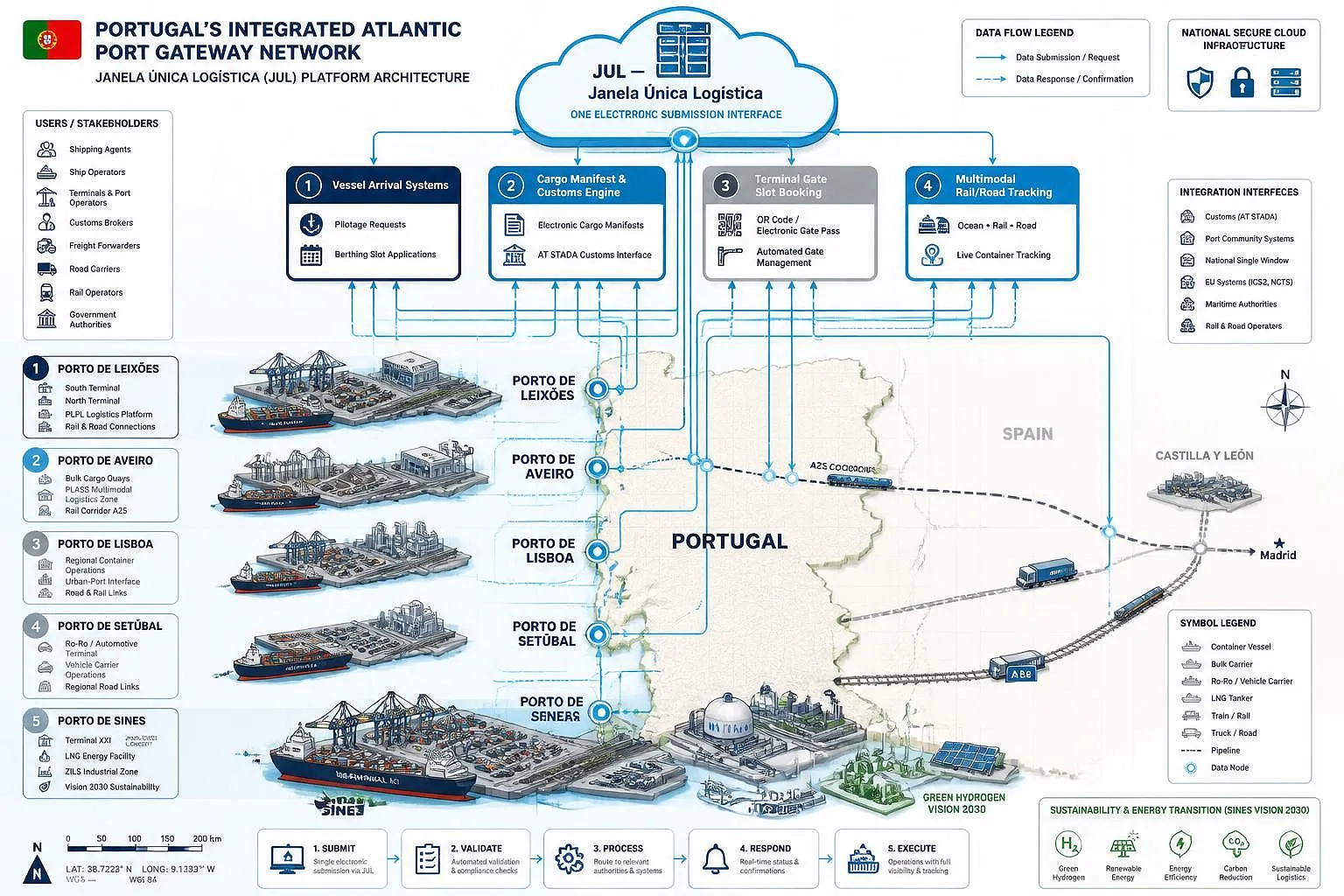
The flagship digital initiative governing maritime logistics in Portugal is the Janela Única Logística (JUL), an advanced Port Community System (PCS) and national logistics single window expanded from the legacy Janela Única Portuária (JUP) framework [1, 6]. Enacted under national port modernization directives and coordinated by the Ministry of Economy and Maritime Affairs, JUL provides an integrated, cloud-based data exchange platform connecting all public and private actors operating within the maritime logistics chain [1, 2].
The JUL platform establishes a single electronic submission interface for MANDATORY:
- Vessel Port Calls & Pilotage Requests: Shipping agents lodge electronic vessel arrival notifications, pilotage requests, and berthing slot applications directly to port authorities [1].
- Customs Manifest Integration: Electronic cargo manifests (containerized, liquid bulk, dry bulk, Ro-Ro) are transmitted simultaneously to port terminal operators and the Tax and Customs Authority (AT) STADA engine prior to vessel arrival [1, 4].
- Terminal Gate Access & Slot Booking: Inland road hauliers and rail freight operators schedule automated gate access appointments, receiving digital gate passes (QR codes/electronic tokens) that automate physical port gate entry [1, 6].
- Multimodal Rail and Road Tracking: Enables real-time container status tracking across ocean shipping lines, port container yards, inland dry ports, and railway logistics platforms [1, 2].
Janela Única Logística (JUL) Platform
Integrated National Port Community System
| Module | Function |
|---|---|
| Vessel Arrival Systems | Manage vessel scheduling and port entry documentation. |
| Cargo Manifest & Customs Engine | Process cargo manifests and customs clearance via AT STADA interface. |
| Terminal Gate Slot Booking | Schedule and authorize terminal gate access and gate passes. |
| Multimodal Rail / Road Tracking | Track and coordinate cargo movement across rail and road networks. |
By unifying vessel, cargo, customs, and land transport data into a standardized electronic interface, JUL eliminates physical paper document checks at terminal gates, drastically reduces container dwell times, and optimizes port berth productivity [1, 6].
2.3.2 Deep-Sea Transshipment & Energy Gateway: The Port of Sines
The Port of Sines (Porto de Sines), managed by Administração do Porto de Sines e do Algarve, S.A. (APS), is Portugal’s largest maritime port complex and the leading deep-water port on the Atlantic coast of Europe [1, 10]. Benefiting from natural deep-water basins (water depths reaching -28 meters) capable of accommodating the world’s largest ultra-large container vessels (ULCVs) and liquid gas tankers without tidal restrictions, Sines serves as a primary European energy gateway and deep-sea container transshipment hub [1, 10].
Key operational infrastructure and digital capabilities at the Port of Sines include RECOMMENDED:
- Terminal XXI (Container Terminal): Operated by PSA Sines, featuring state-of-the-art automated ship-to-shore gantry cranes, direct railway terminal integration, and fully automated gate-in/gate-out optical character recognition (OCR) systems linked to the JUL platform [1].
- Liquid Bulk & LNG Energy Terminal: The primary national gateway for liquefied natural gas (LNG), crude oil, and refined petroleum products, featuring automated pipeline monitoring and safety telemetry integration [1, 10].
- ZILS (Sines Industrial and Logistics Zone): A vast industrial park adjacent to the port complex hosting energy transition projects (green hydrogen, solar power), high-tech data centers, and advanced manufacturing facilities [10].
- Strategic Vision 2030: A comprehensive strategic development roadmap focusing on complete port decarbonization, 100% digital paperless logistics integration, expanded railway connectivity to Madrid and Central Spain, and zero-emission shore power systems [1, 10].
Port of Sines Strategic Complex
| Strategic Division | Description |
|---|---|
| Terminal XXI Container (PSA) | Container terminal operations |
| Liquid Bulk & LNG Energy Hub | Deep water liquid bulk and liquefied natural gas energy infrastructure |
| ZILS Logistics & Data Zone | Logistics services and subsea cables data zone |
| Vision 2030 Decarbonization & JUL Digital | Sustainability initiatives and digital transformation program |
Sines provides exporting enterprises with direct ocean shipping services to North America, South America, Asia, and West Africa, cutting ocean transit times by several days compared to Northern European ports [1, 10].
2.3.3 Industrial Export Gateway: The Port of Leixões
Located in Matosinhos near Porto, the Port of Leixões (Porto de Leixões), managed by APDL – Administração dos Portos de Douro, Leixões e Viana do Castelo, S.A., is the primary industrial export gateway for Northern Portugal [2, 19]. The port serves the dense manufacturing, textile, footwear, furniture, metallurgical, and wine export sectors of the Norte region [19].
Key features of Leixões include RECOMMENDED:
- South and North Container Terminals: High-density container terminals equipped with modern logistics operating software, processing high volumes of short-sea container traffic connecting Portugal to Northern Europe and the United Kingdom [19].
- Leixões Logistics Platform (PLPL): An advanced logistics park offering warehousing, cold storage, consolidation, and customs warehousing facilities linked by dedicated transport corridors to the port terminals [2, 19].
- Single Window Port Integration: APDL was an early pioneer in electronic port management, implementing advanced pilotage automation, virtual vessel tracking, and direct EDI customs linkages that served as the prototype for the national JUL system [1, 19].
2.3.4 Short-Sea & Industrial Gateway: The Port of Aveiro (PLASS)
The Port of Aveiro (Porto de Aveiro), managed by APA – Administração do Porto de Aveiro, S.A., represents a strategic maritime and industrial hub serving the Central region of Portugal and the wider Iberian hinterland [2, 7]. Situated along the Ria de Aveiro, the port specializes in handling liquid and dry bulk commodities, breakbulk cargo, forest products, metallic manufactures, and short-sea shipping lines [2, 7].
Key features and strategic developments at Aveiro include RECOMMENDED:
- Logistics and Industrial Platform of the Port of Aveiro (PLASS): A multimodal industrial logistics zone integrated directly with port quays, highway networks (A17/A25), and the national rail network, providing dedicated land for manufacturing, logistics assembly, and customs storage [2, 7].
- Iberian Hinterland Connectivity: Aveiro serves as the Atlantic terminus of the East-West Iberian transport corridor (A25/IP5 rail line), providing direct, low-cost freight access to the industrial regions of Castilla y León, Madrid, and Northern Spain [2, 7].
- Digitalization & Green Logistics Transition: Implementation of digital berth management tools within the JUL platform, expanded short-sea shipping connections to lower road freight carbon emissions, and specialized breakbulk handling technologies for advanced manufacturing sectors [2, 7].
Port of Aveiro Logistics Platform (PLASS & Central Corridor Hub)
| Component | Function / Description |
|---|---|
| Bulk & Breakbulk Quays | Traditional cargo handling for general cargo and breakbulk operations. |
| Multimodal PLASS Logistics Zone (Industrial) | Integrated logistics hub supporting multimodal transport and industrial operations. |
| East-West Iberian Rail (A25 Corridor) | Rail connectivity serving the A25 Corridor linking Iberian rail networks. |
| JUL Single Window Berth Management | Centralized berth allocation and single-window management system for vessel operations. |
2.3.5 Regional Gateways: Port of Lisbon & Port of Setúbal
Completing Portugal’s Atlantic port network are the Port of Lisbon (Porto de Lisboa) and the Port of Setúbal (Porto de Setúbal), serving the greater Lisbon economic region and Southern Portugal [2, 9].
- Port of Lisbon: Focuses on containerized freight, agri-food bulk imports, cruise tourism, and urban river logistics, operating container terminals at Alcântara and Santa Apolónia integrated with national rail connections [2].
- Port of Setúbal: A major roll-on/roll-off (Ro-Ro) automotive export gateway serving national automobile assembly plants (e.g., Autoeuropa), paper and pulp industries, cement manufacturing, and heavy metallic construction sectors [2, 9].
2.4 Trade Promotion, Enterprise Support & Digital Upskilling Integration
2.4.1 AICEP Portugal Global (Trade & Investment Agency)
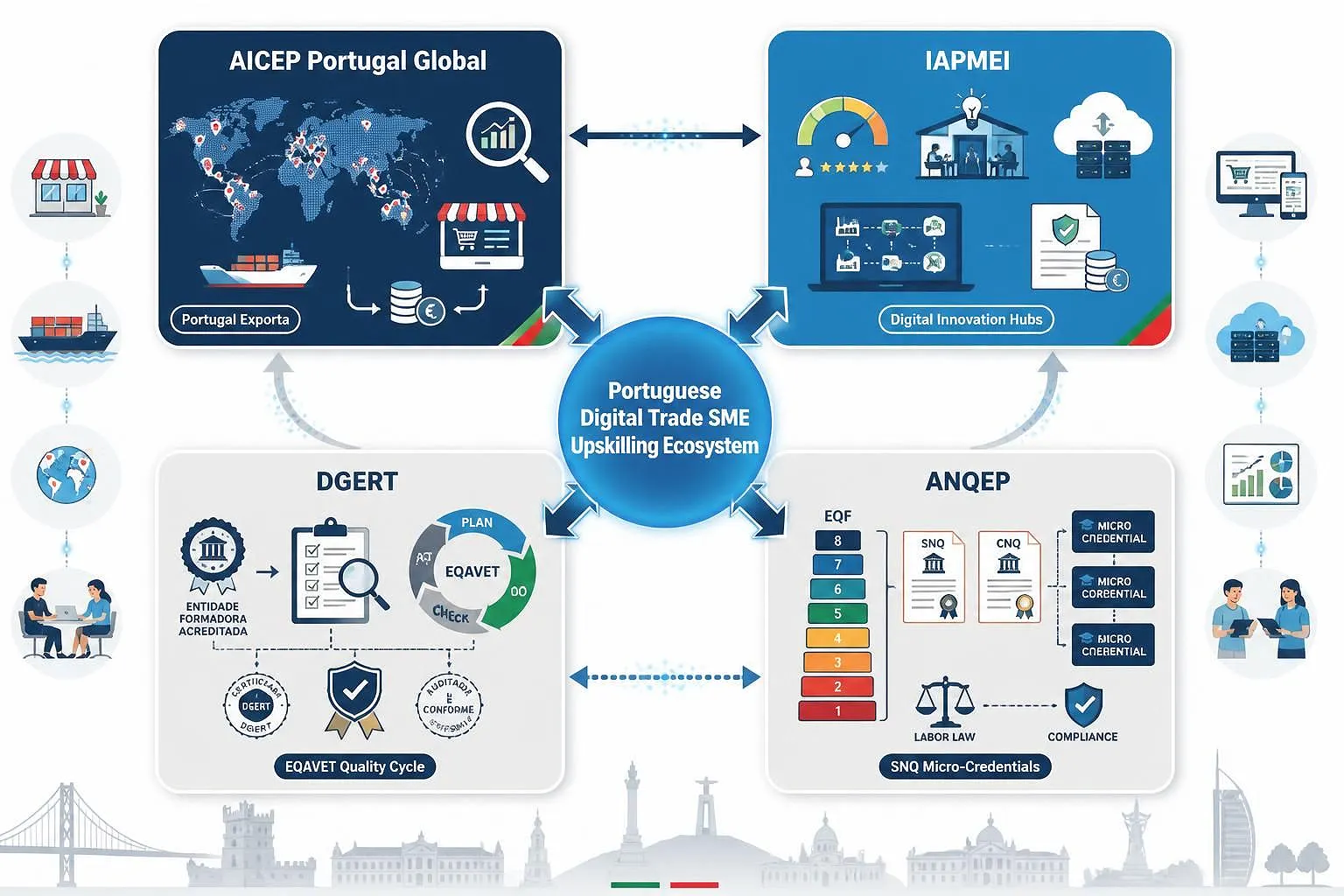
To succeed in international trade, exporting enterprises require more than administrative software access; they require market intelligence, trade diplomacy, and strategic expansion support [8]. AICEP Portugal Global (Agência para o Investimento e Comércio Externo de Portugal, E.P.E.) is the official government agency responsible for promoting Portuguese exports, attracting foreign direct investment (FDI), and supporting the internationalization of domestic businesses [8].
Key support mechanisms provided by AICEP for digital trade expansion include RECOMMENDED:
- International Market Intelligence & Network: A global network of commercial attachés and trade offices across more than 50 countries, offering exporting SMEs tailored market research, tariff analysis, regulatory guidance, and business matchmaking [8].
- Digital Exporting Support Programs (Portugal Exporta): Provides structured guidance for onboarding onto global e-commerce marketplaces, digital marketing strategies, and international customer acquisition frameworks [8].
- Investment Incentive Management: Administers tax incentives, financial grants, and co-funding programs under European structural funds (Portugal 2030 / PRR – Recovery and Resilience Plan) to support enterprise capital investment in export capacity [3, 8].
2.4.2 IAPMEI (Agency for Competitiveness and Innovation)
While AICEP focuses on international markets, IAPMEI (Agência para a Competitividade e Inovação, I.P.) is the public agency dedicated to strengthening the internal competitiveness, financial stability, and technological innovation of small and medium-sized enterprises (SMEs) within Portugal [3, 8].
Key IAPMEI initiatives supporting digital trade adoption include RECOMMENDED:
- Digital Innovation Hubs (DIHs) & Test Beds: Co-funds regional technological hubs where SMEs can test digital supply chain software, cloud ERP solutions, and automated customs integrations prior to commercial deployment [3, 8].
- PME Digital & Digital Maturity Assessments: Offers structured digital maturity evaluation frameworks aligned with DigComp 3.0, allowing SME managers to identify operational gaps in technology, skills, and regulatory compliance [3, 15].
- SME Financial Guarantees & Innovation Grants: Administers subsidized credit lines, mutual guarantee schemes, and innovation vouchers that reduce the financial risk of enterprise digital transformation projects [3, 8].
National Enterprise Support Architecture (AICEP & IAPMEI)
| AICEP Portugal Global | IAPMEI |
|---|---|
| Focus: International Trade & Market Intelligence | Focus: SME Competitiveness & Innovation |
| • Global Attaché Network & Market Matching | • Digital Maturity Self-Assessments |
| • “Portugal Exporta” E-Commerce Guidance | • Digital Innovation Hubs (DIHs) & Test Beds |
| • Internationalization Grants (Portugal 2030) | • PRR / Innovation Vouchers & Subsidized Credit |
2.4.3 Vocational Training Governance: DGERT & ANQEP
Executing compliant digital trade operations requires a workforce possessing certified, workplace-applicable competencies [15, 20]. In Portugal, vocational education and training (VET) quality and qualification frameworks are governed by two primary public bodies:
- DGERT (Direção-Geral do Emprego e das Relações de Trabalho): The government body responsible for accrediting training entities (Entidades Formadoras Acreditadas), auditing educational quality management systems, and enforcing compliance with national training quality standards aligned with EQAVET [20].
- ANQEP (Agência Nacional para a Qualificação e o Ensino Profissional, I.P.): The national agency managing the National Qualifications System (SNQ) and the National Qualifications Catalogue (CNQ), mapping vocational certifications to the European Qualifications Framework (EQF) [15, 20].
Enterprise upskilling programs aligned with DGERT quality accreditation and ANQEP qualification catalogs ensure that employee training in e-customs, transport documentation, and trade finance generates official, legally recognized micro-credentials that qualify for mandatory corporate continuous training hours under Portuguese labor law [15, 20].
3. Practical Operational Workflow: Enterprise National Gateway Onboarding
3.1 Business Activity Context
Initial Organizational Gateway Onboarding and Digital Trade Alignment for a Portuguese Exporting SME Transitioning from Legacy Paper Logistics to Automated Customs and Port Clearance.
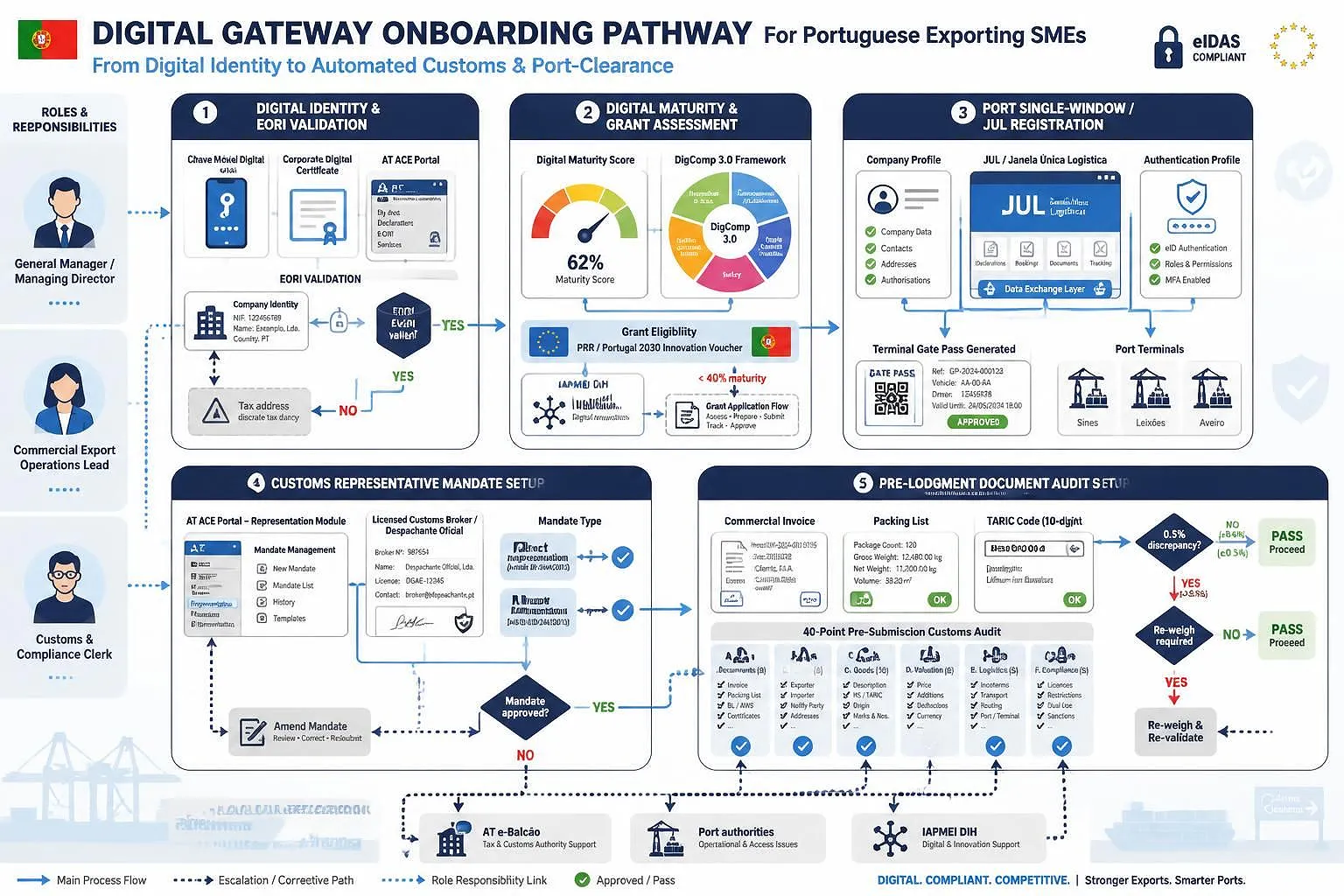
3.2 Responsible Roles
- General Manager / Managing Director: Approves enterprise digital transformation strategy, secures state grant co-funding, and signs legal portal representation mandates.
- Commercial Export Operations Lead: Manages day-to-day international shipping documents, oversees product tariff classification, and coordinates with freight forwarders.
- Customs & Compliance Clerk: Operates the AT ACE Portal, validates EORI status, verifies pre-lodgment customs declarations, and schedules JUL port gate appointments.
3.3 Step-by-Step Enterprise Onboarding Matrix
Digital Compliance & Customs Pre-Lodgment Workflow
| Step | Action Item | Required Tool / Input | Operational Decision Point | Escalation Trigger |
|---|---|---|---|---|
| 1 | Digital Identity & EORI Validation | Portuguese Digital Mobile Key (Chave Móvel Digital), Corporate Digital Certificate, AT ACE Portal EORI Registration Module [4]. | Does the enterprise possess an active EORI number linked to its valid tax identification number (NIF) on the EU EOS database? | Trigger: EORI status inactive or tax address discrepancy on AT database. Action: Submit formal EORI update request via AT e-Balcão portal before lodging trade files [4]. |
| 2 | Digital Maturity & Grant Assessment | IAPMEI Digital Maturity Self-Assessment Tool, DigComp 3.0 Competency Matrix [3, 15]. | Is the enterprise eligible for digital transformation co-funding under PRR / Portugal 2030 Innovation Vouchers? | Trigger: Internal digital maturity score below 40% (Stage 1 Paper-Reliant). Action: Apply for IAPMEI Digital Innovation Hub (DIH) technical assistance and grant co-funding [3, 8]. |
| 3 | Port Single-Window (JUL) Registration | Janela Única Logística (JUL) User Registration Portal, Port Authority Service Contracts (Sines / Leixões / Aveiro) [1, 6]. | Has the enterprise or its contracted hauliers registered electronic authentication profiles on the national JUL platform? | Trigger: Freight haulier unable to generate digital terminal gate pass. Action: Register corporate profile on JUL single window and link contracted freight forwarders [1]. |
| 4 | Customs Representative Mandate Setup | AT ACE Portal Representation Module, Decree-Law No. 130/2015 Authorization Forms [4]. | Is the contracted customs broker (Despachante Oficial) legally authorized via direct or indirect representation on the ACE Portal? | Trigger: ACE Portal rejects customs declaration due to missing representation mandate. Action: Execute digital representation mandate approval inside the AT ACE Portal module [4]. |
| 5 | Pre-Lodgment Document Audit Setup | EDTC 40-Point Pre-Submission Customs Audit Checklist, Standard Invoicing ERP [4, 5]. | Do internal commercial invoices and packing lists automatically generate required TARIC 10-digit codes and gross/net weight fields? | Trigger: Data discrepancies exceed 0.5% tolerance between packing list and bill of lading. Action: Halt electronic submission; re-weigh physical cargo and correct invoice metadata [4]. |
4. Realistic Enterprise Scenario & Evaluation Key
4.1 Enterprise Scenario Narrative
Vinhos do Dão Lda., a medium-sized wine producer located in Nelas (Viseu district, Central Portugal), exports premium bottled wines to commercial distributors in the United States, the United Kingdom, and Canada. Historically, the company sold its wine under Ex Works (EXW) or Free Carrier (FCA) Incoterms rules, relying entirely on foreign buyers’ freight forwarders to manage export customs declarations and ocean transport.
To capture higher commercial margins, the General Manager decides to transition to Cost, Insurance, and Freight (CIF) export terms, shipping 20-foot ocean container loads through the Port of Aveiro (utilizing the Logistics and Industrial Platform – PLASS for short-sea European movements) and the Port of Sines (Terminal XXI for deep-sea North American routes).
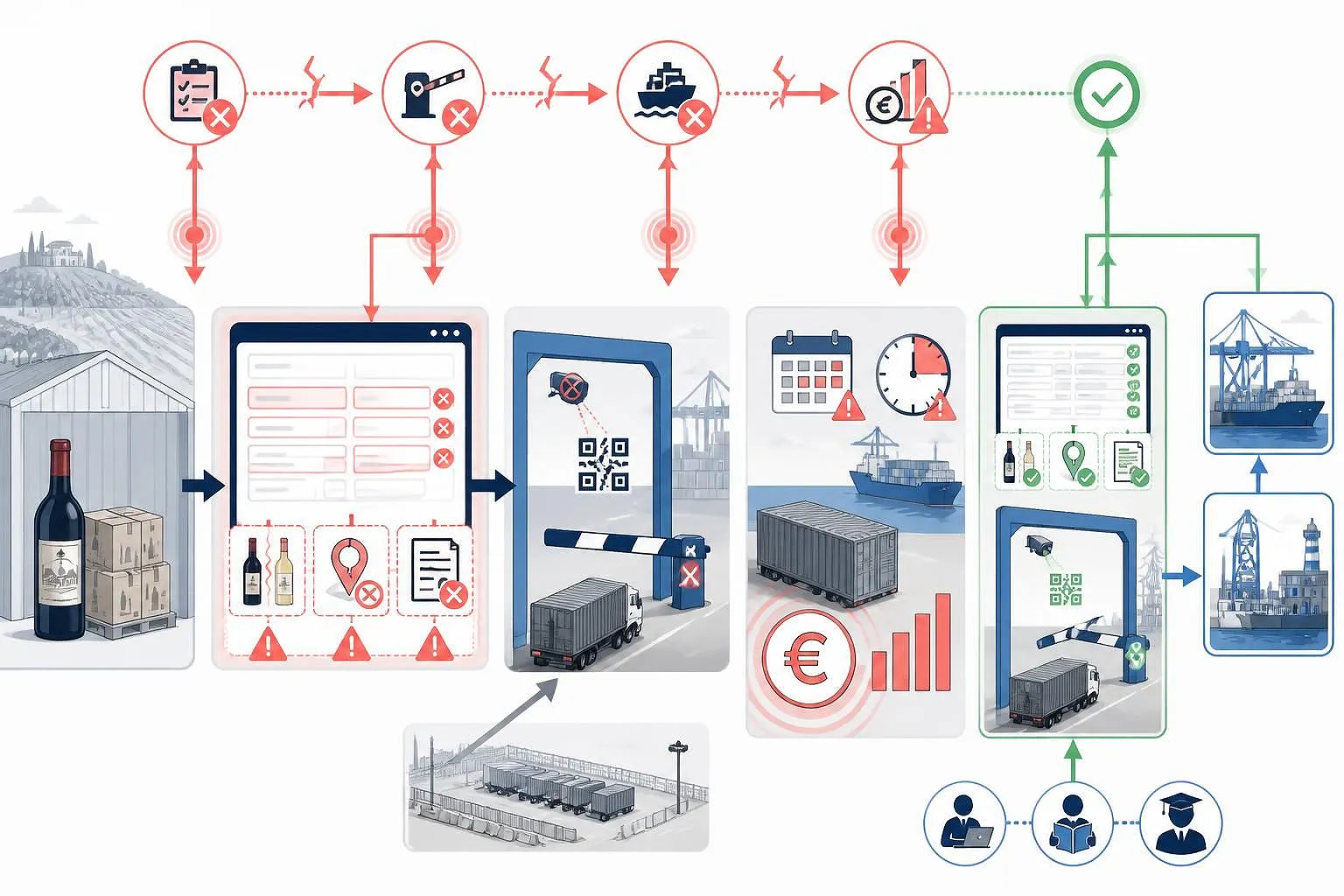
During the first trial shipment of 1,200 cases of Reserva red wine destined for New York via the Port of Sines, severe operational breakdowns occur:
- AT ACE Portal Rejection: The electronic export declaration lodged by the company’s internal junior clerk on the AT ACE Portal is rejected by the STADA engine due to an invalid 10-digit TARIC subheading for fortified vs. still wine, an unvalidated EORI address, and missing excise duty (IEC – Imposto Sobre o Álcool e Bebidas Alcoólicas) exemption codes [4, 17].
- JUL Gate Clearance Failure: The contracted road haulage truck arrives at Terminal XXI gate at Sines without an active Janela Única Logística (JUL) electronic gate pass or container slot reservation. The automated OCR gate system denies entry, forcing the truck to park in an off-dock staging area [1, 6].
- Accrued Demurrage Penalties: Because physical container gate-in is delayed beyond the vessel’s cut-off window, the container misses its scheduled ocean feeder vessel. The ocean carrier assesses a €3,500 container detention and demurrage penalty, while the customer threatens contract cancellation due to missed retail distribution deadlines [1].
The General Manager contacts an EDTC trade compliance advisor to audit the company’s onboarding workflow and establish a defensible, automated gateway execution plan.
4.2 Evaluation Key
1. Primary Operational & Regulatory Diagnosis
Vinhos do Dão Lda. attempted to execute CIF ocean export clearance without completing the mandatory enterprise digital onboarding steps required by Portuguese national portals and EU customs legislation [1, 4].
- Customs Portal Breakdown: The junior clerk lacked certified training in TARIC 10-digit classification and national excise tax (IEC) procedures under Decree-Law No. 130/2015. Attempting to lodge declarations without verifying EORI database synchronization on the AT ACE Portal triggered an immediate STADA automated rejection [4, 17].
- Port Single-Window Failure: The enterprise failed to integrate its logistics operations with the Janela Única Logística (JUL) platform, assuming that booking a truck driver was sufficient for port gate entry. Sines Terminal XXI operates fully automated OCR gates requiring pre-validated JUL slot bookings and electronic gate passes [1, 6].
2. Recommended 4-Step Remediation Strategy
- Execute AT ACE Portal Representation & Master Data Fix: Update corporate EORI registration details on the AT portal. Execute a formal direct customs representation mandate for an accredited customs broker (Despachante Oficial) inside the ACE Portal representation module to oversee complex tariff classification and IEC excise duty filings [4, 5].
- Onboard onto the JUL Platform: Register Vinhos do Dão Lda. as a certified cargo owner on the national Janela Única Logística (JUL) single window. Ensure that all contracted road hauliers and freight forwarders are linked to the corporate JUL profile so that digital gate passes (QR codes) are generated automatically upon container dispatch from the Nelas winery [1, 6].
- Establish a Dual-Gateway Port Strategy (Sines + Aveiro): Route deep-sea North American container shipments through the deep-water Terminal XXI at Port of Sines via direct rail feeder, while routing European short-sea shipments (UK and Northern Europe) through the Port of Aveiro (PLASS platform) to leverage lower regional haulage costs and dedicated breakbulk/container quays [1, 2, 7].
- Enroll Export Staff in Accredited EDTC Upskilling: Enroll the commercial export lead and customs clerk in accredited micro-credential courses (e.g.,
EDTC-1-F101andEDTC-2-AP201Trade Documentation), utilizing IAPMEI Innovation Vouchers to co-fund training costs [3, 8, 15].
3. Alternative Acceptable Operational Approaches
- Outsourced Freight Forwarding Model: Temporarily contract an integrated digital freight forwarder offering full e-customs and JUL single-window management as a managed service, allowing internal staff time to complete accredited training before taking clearance in-house [1, 4].
- Feeder Rail Transport Integration: Utilize inland rail container terminals (e.g., Bobadela or Guarda dry ports) linked directly by rail to Sines and Aveiro, transferring container pre-lodgment checks to the rail terminal operator [1, 2].
4. Common Learner & Management Misconceptions
- Misconception 1: “Incoterms rules like CIF only affect freight payment, not customs portal responsibilities.” Correction: Changing to CIF transfers full responsibility for export customs pre-lodgment and port gate clearance to the seller, requiring direct operational integration with national portals [4, 21].
- Misconception 2: “A paper shipping invoice is sufficient for port terminal entry.” Correction: Modern Atlantic gateways (Sines, Leixões, Aveiro) utilize automated gate OCR systems enforcing mandatory pre-arrival electronic data transmission via JUL [1, 6].
5. Governance, Limitations & Glossary
5.1 Key Takeaways
- Portugal functions as the European Union’s primary Atlantic maritime frontier and data gateway, offering strategic transshipment and short-sea shipping corridors through deep-water ports (Sines, Leixões, Aveiro, Lisbon, Setúbal) [1, 2].
- Resolution of the Council of Ministers No. 30/2020 (Action Plan for Digital Transition) mandates paperless public administration and enterprise digital transformation across Portugal, aligning national policy with the EU Digital Europe Programme [3, 14].
- The Portuguese Tax and Customs Authority (AT) ACE Portal is the mandatory national digital single window for customs declarations, EORI validation, TARIC Pauta queries, and BTI rulings under Decree-Law No. 130/2015 [4, 5].
- The Janela Única Logística (JUL) platform is the national Port Community System unifying vessel calls, cargo manifests, customs clearance, and terminal gate slot bookings across all Portuguese maritime ports [1, 6].
- Public agencies AICEP (export promotion and market intelligence) and IAPMEI (SME innovation grants and digital maturity) provide essential co-funding and strategic support for enterprise digital trade onboarding [3, 8].
5.2 Learner Limitations & Educational Non-Automation Disclaimer Box
This instructional unit provides general guidance regarding Portugal’s geopolitical, infrastructural, and digital role as the primary European Atlantic maritime and data gateway, the statutory requirements and operational workflows of the Portuguese Action Plan for Digital Transition, and operational architectures and digital single-window interoperability protocols of major Portuguese Atlantic port logistics platforms. Completion of this unit confirms vocational awareness and skill development under EQF Levels 3–4 parameters. It does NOT constitute formal academic university degree conferral, statutory customs broker licensing, or direct accreditation by national qualification agencies. Enterprise training managers must verify specific national VET registration requirements with competent national bodies (such as DGERT and ANQEP in Portugal).
5.3 Technical Glossary
- ACE Portal (Área de Operações Tabela / Controlo do Comércio Externo): The official digital single-window portal operated by the Portuguese Tax and Customs Authority (AT) for customs declarations, EORI registration, and trade control [4].
- Action Plan for Digital Transition: Portugal’s national digital strategy (Resolution No. 30/2020) establishing enterprise modernization, digital literacy, and paperless public administration roadmaps [3].
- Janela Única Logística (JUL) (Single Window Logistics): The national Port Community System and single-window logistics platform connecting maritime ports, customs authorities, shipping lines, terminal operators, and inland transport hauliers in Portugal [1, 6].
- Port of Aveiro Logistics Platform (PLASS – Plataforma Logística de Aveiro): The specialized industrial and multimodal logistics hub at the Port of Aveiro serving short-sea shipping and Iberian rail freight corridors [2, 7].
- Port of Sines: The deep-water Atlantic transshipment port and energy gateway capable of handling ultra-large ocean container vessels and LNG gas carriers [1, 10].
- STADA (Sistema de Tratamento Automático da Declaração Aduaneira): The automated customs declaration engine inside the AT ACE Portal that processes electronic single administrative documents (SAD) [4, 5].
- Licensed Customs Broker: A legally certified professional authorized under Decree-Law No. 130/2015 to represent economic operators before Portuguese customs authorities [4].
6. References & Source Material
- Administração do Porto de Sines e do Algarve, S.A. (2021). Visão Estratégica 2030: Janela Única Logística (JUL) e a Digitalização do Corredor Atlântico. APS Editorial.
- Ministério da Economia e do Mar. (2022). Estratégia para a Competitividade da Rede Portuária Nacional do Continente – Horizonte 2030. Governo da República Portuguesa.
- Presidência do Conselho de Ministros. (2020). Resolução do Conselho de Ministros n.º 30/2020: Aprova o Plano de Ação para a Transição Digital de Portugal. Diário da República, 1.ª série, N.º 78, 2–21.
- Ministério das Finanças. (2015). Decreto-Lei n.º 130/2015: Modifica o Código de Processo e de Procedimento Tributário e regulamenta a representação aduaneira. Diário da República, 1.ª série, N.º 132, 4652–4678.
- Autoridade Tributária e Aduaneira. (2024). Manual de Operações do Portal ACE: Submissão Eletrónica de Declarações Aduaneiras e Pré-Alojamento de Mercadorias. Ministério das Finanças de Portugal.
- IMT – Instituto da Mobilidade e dos Transportes, I.P. (2023). Relatório de Acompanhamento da Janela Única Logística (JUL) e da Interoperabilidade Multimodal. Governo de Portugal.
- Administração do Porto de Aveiro, S.A. (2023). Plano de Desenvolvimento Estratégico do Porto de Aveiro e da Plataforma Logística (PLASS) 2020-2030. APA Editorial. https://www.porto-de-aveiro.pt/
- Agência para o Investimento e Comércio Externo de Portugal, E.P.E. (2024). Guia Prático de Exportação e Digitalização de Mercados: Programa Portugal Exporta. AICEP Portugal Global.
- Administração dos Portos de Lisboa, Setúbal e Sesimbra, S.A. (2023). Plano Diretor do Porto de Lisboa e do Porto de Setúbal: Logística Ro-Ro e Descarbonização. APL/APSS.
- Sines Tecnopolo & ZILS. (2024). Sines Tech – Innovation & Data Campus: Subsea Cable Infrastructure and Logistics Synergies. ZILS Hub Publications.
- European Parliament & Council of the European Union. (2020). Regulation (EU) 2020/1056 on electronic freight transport information (eFTI). Official Journal of the European Union, L 249, 33–43.
- IAPMEI – Agência para a Competitividade e Inovação, I.P. (2024). Relatório de Maturidade Digital das PME Portuguesas: Inovação e Transição Digital no Setor Exportador. IAPMEI Editorial.
- United Nations Centre for Trade Facilitation and Electronic Business. (2020). UN/CEFACT Recommendation No. 1: UN Layout Key for Trade Documents (ECE/TRADE/137/Rev.2). United Nations.
- European Parliament & Council of the European Union. (2021). Regulation (EU) 2021/694 establishing the Digital Europe Programme and repealing Decision (EU) 2015/2240. Official Journal of the European Union, L 166, 1–34.
- Agência Nacional para a Qualificação e o Ensino Profissional, I.P. (2023). Catálogo Nacional de Qualificações: Mapeamento de Competências Digitais e Logísticas. ANQEP.
- European Parliament & Council of the European Union. (2013). Regulation (EU) No 952/2013 laying down the Union Customs Code (UCC). Official Journal of the European Union, L 269, 1–101.
- Autoridade Tributária e Aduaneira. (2024). Pauta Aduaneira Eletrónica e Guias Práticos de Classificação Pautal e Impostos Especiais de Consumo (IEC). Direção de Serviços de Tributação e Sudoeste Aduaneiro.
- European Parliament & Council of the European Union. (2015). Regulation (EU) 2015/2447 laying down detailed rules for implementing certain provisions of Regulation (EU) No 952/2013 establishing the Union Customs Code. Official Journal of the European Union, L 343, 1–558.
- Administração dos Portos de Douro, Leixões e Viana do Castelo, S.A. (2023). Relatório de Sustentabilidade e Digitalização do Porto de Leixões. APDL.
- Direção-Geral do Emprego e das Relações de Trabalho. (2023). Manual de Acreditação de Entidades Formadoras e Mapeamento de Qualidade EQAVET. DGERT.
- International Chamber of Commerce. (2019). Incoterms® 2020: ICC rules for the use of domestic and international trade terms (ICC Publication No. 723E). ICC Publishing.
- European Commission. (2023). Economic Operators Registration and Identification (EORI) System Guidance Document. TAXUD/A3/2023/DIR.
- European Parliament & Council of the European Union. (2014). Regulation (EU) No 910/2014 on electronic identification and trust services for electronic transactions in the internal market (eIDAS). Official Journal of the European Union, L 257, 73–114.
- European Parliament & Council of the European Union. (2016). Regulation (EU) 2016/679 on the protection of natural persons with regard to the processing of personal data (GDPR). Official Journal of the European Union, L 119, 1–88.
- European Parliament & Council of the European Union. (2022). Directive (EU) 2022/2555 on measures for a high common level of cybersecurity across the Union (NIS2 Directive). Official Journal of the European Union, L 333, 80–152.
- European Quality Assurance in Vocational Education and Training. (2009). Recommendation of the European Parliament and of the Council on the establishment of a European Quality Assurance Reference Framework for Vocational Education and Training (EQAVET) (2009/C 155/01). Official Journal of the European Union, C 155, 1–10.
- Joint Research Centre (European Commission). (2022). DigComp 2.2: The Digital Competence Framework for Citizens with Learning Outcomes and Performance Indicators. Publications Office of the European Union.
- Council of the European Union. (2017). Council Recommendation of 22 May 2017 on the European Qualifications Framework for lifelong learning (2017/C 189/03). Official Journal of the European Union, C 189, 15–28.
- European Centre for the Development of Vocational Training. (2022). European guidelines for the development and writing of short, learning-outcomes-based descriptions of qualifications. CEDEFOP Reference Series, No. 122. Publications Office of the European Union.
- European Association for Quality Assurance in Higher Education. (2015). Standards and Guidelines for Quality Assurance in the European Higher Education Area (ESG 2015). ENQA.