
Lesson 6: Your Onboarding Roadmap & Pathway Selection
Unit Information & Metadata
- Lesson ID: EDTC-0-F100_L06
- Estimated Study Duration: 90 Minutes (60 min core instructional reading + 30 min practical quiz)
- Target EQF Level: Level 3–4 (Vocational Awareness / Entry Micro-Credential Prerequisite)
1. Lesson Opening
1.1 Learning Objectives
Upon successful completion of this instructional unit, adult professional learners and enterprise managers will be able to:
- Analyze Organizational Digital Readiness (
LO0.6.01): Evaluate an enterprise’s current digital trade maturity across technology infrastructure, legal compliance, logistics data flows, and workforce skill sets using standardized DigComp 3.0 and EQAVET diagnostic frameworks [1, 2]. - Map Workforce Roles to Professional Pathways (
LO0.6.02): Systematically align key enterprise job functions (customs declarants, logistics coordinators, finance managers, compliance officers) with the 8 specialized EDTC Professional Credential Pathways [3]. - Execute Stackable Micro-Credential Progression (
LO0.6.03): Structure a personalized or organizational learning trajectory that accumulates short 12–32 study hour vocational units into recognized EQF Level 3–6 micro-credentials, Europass Digital Passports, and W3C Open Badges 3.0 [4, 5]. - Formulate a Phased Enterprise Digital Action Plan (
LO0.6.04): Construct an actionable, 4-phase implementation roadmap that connects workforce upskilling with operational systems deployment (such as national customs portals, port community systems, and B2B trade platforms) while leveraging public co-funding mechanisms [6, 7].
1.2 Business Relevance
For small and medium-sized enterprises (SMEs), freight forwarders, and logistics operators across the European Union, transitioning from paper-heavy manual trade administration to fully digitized, paperless cross-border operations represents both a major competitive opportunity and a complex organizational challenge [8]. Ad-hoc, uncoordinated employee training often leads to fragmented skill sets, persistent customs data entry errors on national portals (such as the Portuguese Tax and Customs Authority ACE Portal), expensive cargo detention holds at maritime container terminals (such as the Port of Sines Janela Única Logística – JUL platform), and missed commercial opportunities in cross-border supply chains [9, 10].
Establishing a structured onboarding roadmap transforms digital transition from a reactive troubleshooting exercise into a deliberate, strategic investment. By conducting a systematic digital maturity assessment, mapping workforce roles to specialized credential pathways, and executing a phased action plan, enterprise leaders ensure that every hour spent in asynchronous online study directly translates into reduced transaction costs, accelerated clearance times, and full regulatory compliance under binding European Union directives [1, 11].
1.3 Key Concepts Preview
- Digital Maturity Diagnostics: A multi-dimensional framework evaluating an enterprise’s technical, legal, operational, and human capital readiness for paperless trade [1, 2].
- The 8 Professional Credential Pathways: Specialized, role-aligned learning tracks designed to build end-to-end operational expertise across customs, logistics, finance, sustainability, e-commerce, cybersecurity, expansion, and innovation [3].
- Stackable Micro-Credentials: Granular, quality-assured learning units (12–32 study hours) that accumulate seamlessly into higher-level vocational qualifications mapped to EQF Levels 3–6 and ECTS credit transfer principles [4, 12].
- Phased Enterprise Action Plan: A 4-stage operational blueprint guiding organizations from initial diagnostic orientation through foundation upskilling, applied specialization, and live capstone/marketplace execution [6].
- Public Co-Funding Vouchers: National and European financial support instruments—such as Portuguese IAPMEI Digital Innovation Hub (DIH) vouchers and PRR digital transition grants—that offset enterprise training and software adoption costs [7, 13].
2. Core Instructional Content
2.1 Enterprise Digital Maturity Diagnostics & Competency Mapping
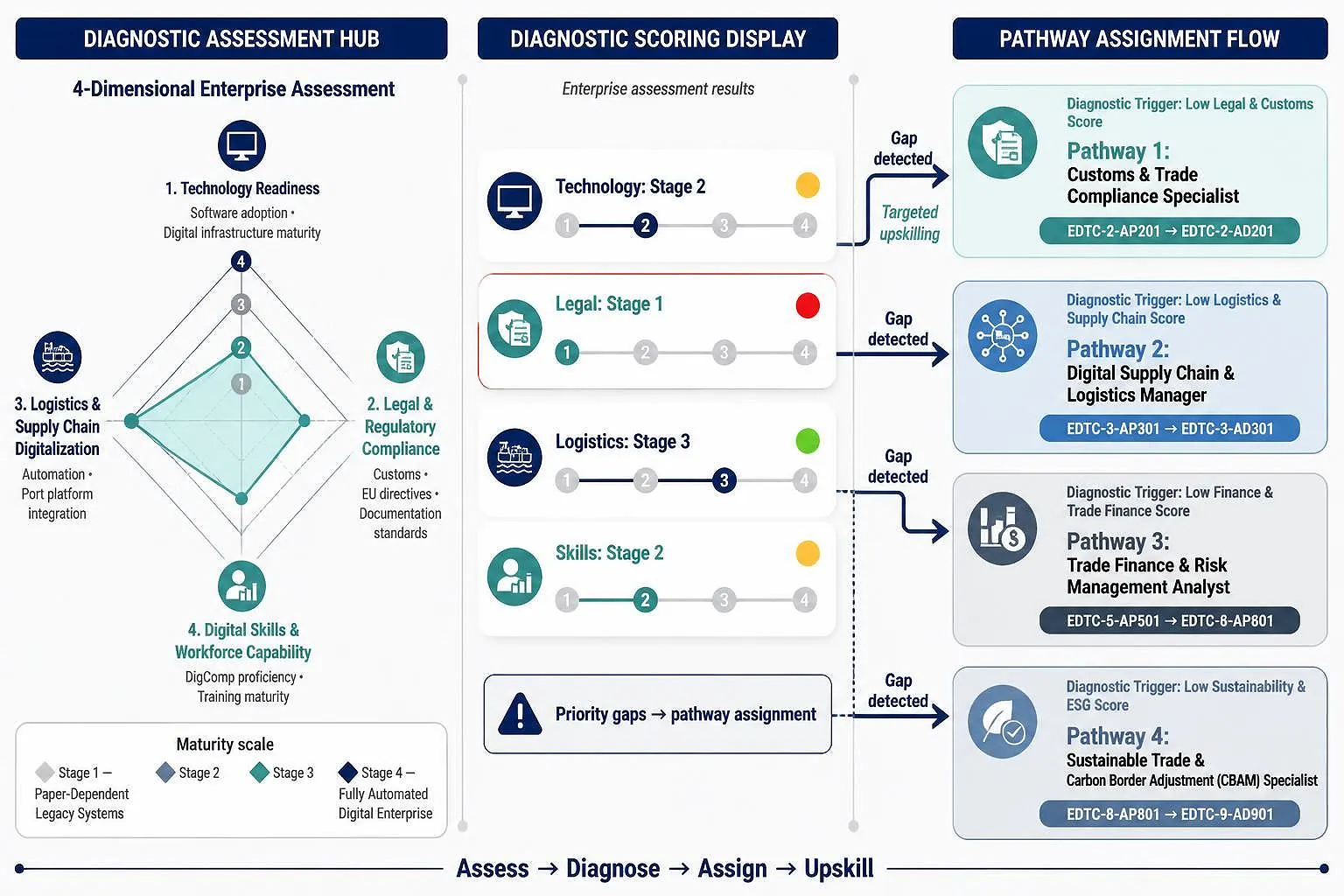
The transition toward automated, paperless cross-border trade requires a rigorous assessment of an enterprise’s baseline capabilities before enrolling personnel in specialized educational programs [1]. Under European Quality Assurance in Vocational Education and Training (EQAVET) guidelines and the European Digital Competence Framework (DigComp 3.0), digital maturity is not measured merely by the presence of modern hardware or office software; rather, it represents an integrated organizational capability encompassing technical interoperability, statutory regulatory compliance, supply chain data integration, and workforce digital literacy [2, 14].
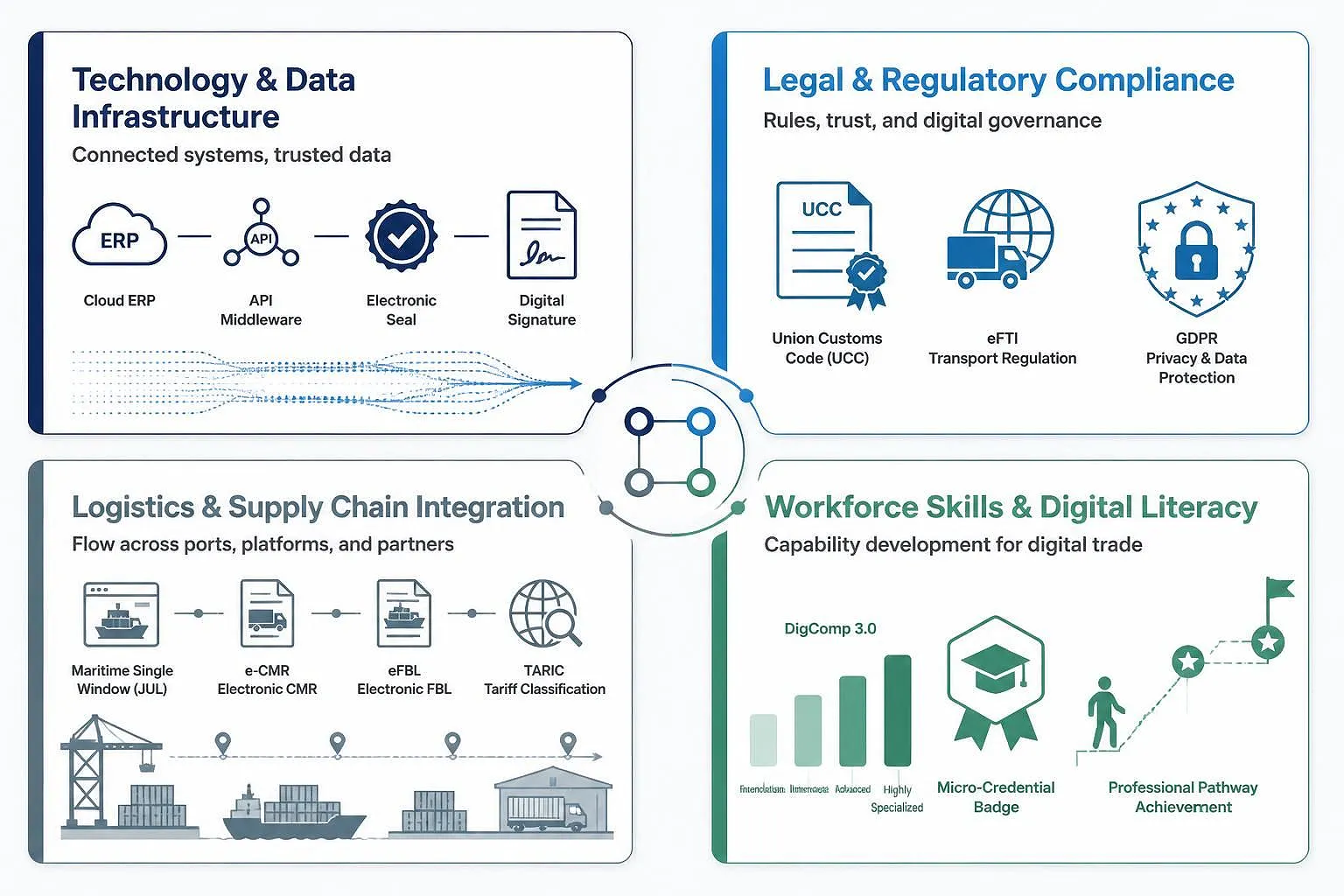
To establish an accurate digital trade baseline, enterprise management must evaluate four interconnected operational dimensions:
1. Technology & Data Infrastructure Dimension
This dimension assesses the enterprise’s hardware, enterprise resource planning (ERP) software, warehouse management systems (WMS), and electronic data interchange (EDI) capabilities [8]. Key evaluation criteria include:
- API Connectivity: Does internal enterprise software possess open Application Programming Interfaces (APIs) capable of connecting directly with external logistics portals, customs systems, and electronic transport platforms [11, 15]?
- Electronic Identification & Trust Services: Does the enterprise possess valid electronic seals, qualified e-signatures, and corporate digital certificates compliant with the eIDAS 2.0 Regulation (Regulation (EU) 2024/1183) for signing trade documents and authenticating on official public portals [16]?
- Data Standard Harmonization: Are internal commercial invoices, packing lists, and dispatch notes formatted in structured digital schemas (such as UN/CEFACT XML, GS1 XML, or EU Common Entry Module formats) rather than unstructured PDF or scanned paper files [17, 18]?
2. Legal & Statutory Regulatory Compliance Dimension
This dimension evaluates the enterprise’s adherence to binding European Union and Member State commercial laws, customs codes, and environmental regulations [9, 19]. Key evaluation criteria include:
- Customs Registration & EORI Status: Does the enterprise hold an active, validated Economic Operators Registration and Identification (EORI) number registered on the EU EOS database, along with required customs representation mandates under Portuguese Decree-Law No. 130/2015 [9, 20]?
- Tariff & Origin Verification Capabilities: Does internal staff possess the tools and knowledge required to determine correct 10-digit TARIC subheadings, verify General Interpretive Rules (GIR 1–6), apply preferential origin rules under Regulation (EU) 2026/1183, and manage Binding Tariff Information (BTI) applications [21, 22]?
- Environmental & Security Mandates: Is the enterprise prepared to submit required embedded greenhouse gas data under the Carbon Border Adjustment Mechanism (CBAM Regulation (EU) 2023/956), meet Corporate Sustainability Reporting Directive (CSRD Directive (EU) 2022/2464) standards, and maintain supply chain cybersecurity under the NIS2 Directive (Directive (EU) 2022/2555) [23, 24, 25]?
3. Logistics & Supply Chain Integration Dimension
This dimension measures how effectively the enterprise exchanges real-time operational data with transport carriers, freight forwarders, port authorities, and terminal operators [10, 11]. Key evaluation criteria include:
- Port Community System Integration: Is the enterprise registered on national port single-window platforms—such as Portugal’s Janela Única Logística (JUL) operating across the Ports of Sines, Leixões, Aveiro, Lisbon, and Setúbal—enabling pre-arrival vessel clearance and automated electronic gate-pass generation [10, 26]?
- Electronic Transport Documentation: Has the enterprise transitioned from physical consignment notes to electronic transport information platforms compliant with the eFTI Regulation (Regulation (EU) 2020/1056), utilizing e-CMR for road haulage and e-AWB for air freight [11, 27]?
- Multimodal Logistics Coordination: Does the enterprise utilize Atlantic transport corridors (such as the Aveiro PLASS platform or Sines Terminal XXI) to optimize cargo routing between maritime, rail, and road networks [10, 28]?
4. Workforce Digital Literacy & Human Capital Dimension
This dimension examines the digital competence levels of personnel across administrative, commercial, and operational departments [2]. Using the DigComp 3.0 reference framework, individual competencies are mapped across four proficiency levels:
- Foundation (DigComp Level 1–2): Personnel possess basic digital awareness, capable of performing simple web searches, retrieving digital documents, and following basic password security protocols [2].
- Intermediate (DigComp Level 3–4): Personnel can independently navigate official digital trade portals (such as the Portuguese ACE Portal), perform 10-digit tariff classification lookups, format electronic packing lists, and verify digital signature certificates [2, 9].
- Advanced (DigComp Level 5–6): Personnel can manage complex EDI data mapping, execute preferential origin regional value content (RVC) calculations, audit customs pre-lodgment files, and configure automated B2B e-commerce inventory feeds [2, 21].
- Expert (DigComp Level 7–8): Enterprise leaders can architect multi-market digital expansion strategies, lead supply chain cybersecurity audits, manage complex BTI legal appeals, and orchestrate enterprise cloud ERP migrations [2, 25].
2.2 The 8 EDTC Professional Credential Pathways
To bridge identified organizational skills gaps and provide clear career progression routes for adult professionals, the EDTC curriculum is organized into 8 specialized Professional Credential Pathways [3]. Each pathway synthesizes core instructional modules across the 12 Curriculum Pillars, delivering an end-to-end, role-aligned qualification package [3, 12].
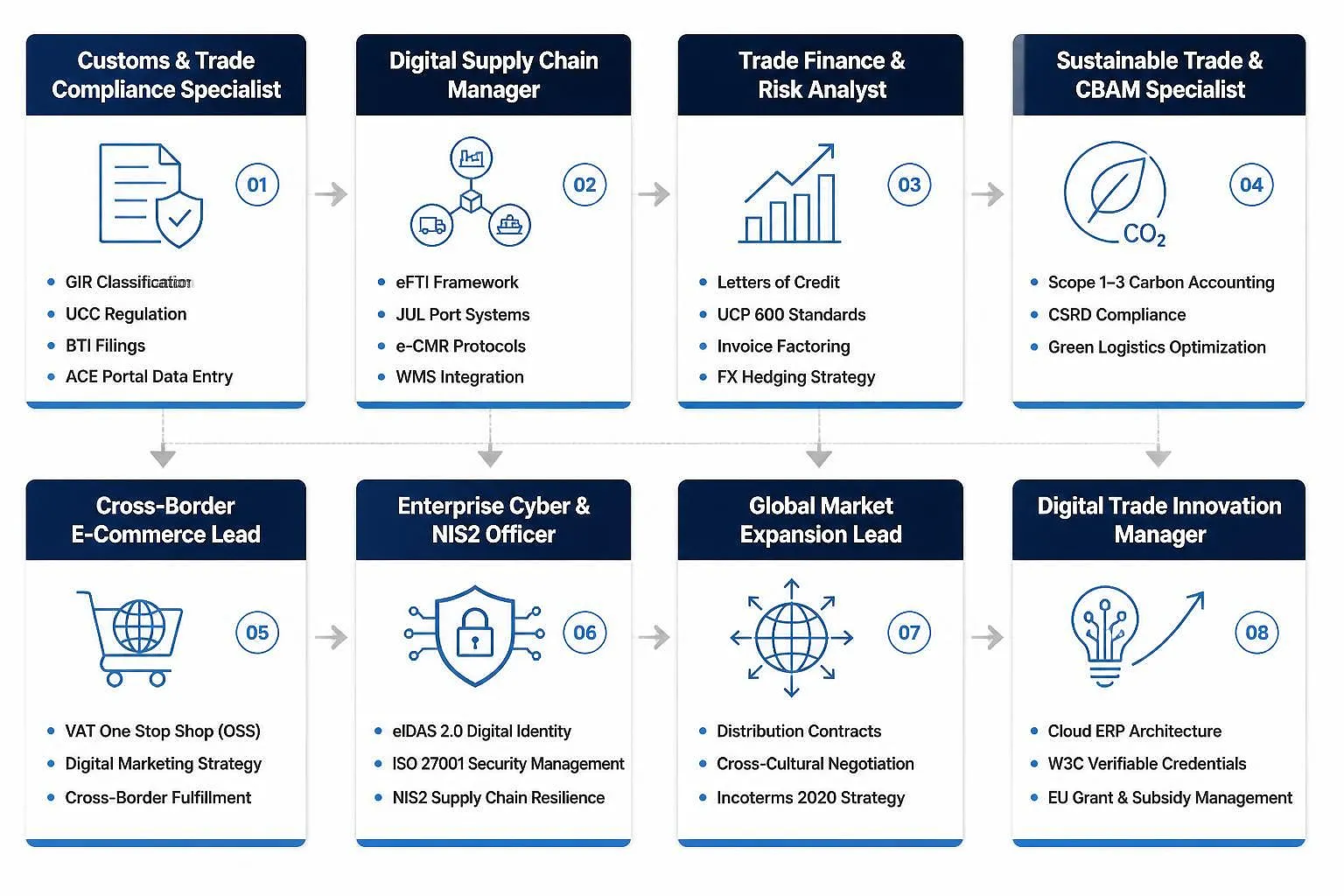
Pathway 1: Customs & Trade Compliance Specialist
- Target Enterprise Roles: Customs Declarants, Import/Export Managers, Licensed Customs Brokers, Trade Compliance Officers [3].
- Core Curriculum Focus: Deep specialization in the Union Customs Code (UCC Regulation (EU) No 952/2013 and Implementing Act Regulation (EU) 2015/2447), General Interpretive Rules (GIR 1–6) for 10-digit TARIC classification, preferential origin rules under Regulation (EU) 2026/1183, Binding Tariff Information (BTI) dossiers, and hands-on operational submission via the Portuguese Tax and Customs Authority ACE Portal [9, 20, 21, 22].
- Stackable Course Composition:
EDTC-0-F100(Orientation),EDTC-1-F101(Digital Trade Intro),EDTC-2-F201(Trade Fundamentals),EDTC-2-AP201(Trade Documentation),EDTC-2-AD201(Customs & Tariff Classification),EDTC-2-AD202(Customs Compliance & AEO), plus Capstone ProjectEDTC-CAP-001[3].
Pathway 2: Digital Supply Chain Manager
- Target Enterprise Roles: Logistics Directors, Supply Chain Coordinators, Freight Forwarders, Warehouse Operations Managers, Port Logistics Clerks [3].
- Core Curriculum Focus: Mastery of multimodal transport operations, port community single-window systems (such as the Port of Sines Janela Única Logística – JUL), electronic consignment notes under the eFTI Regulation (Regulation (EU) 2020/1056), FIATA electronic Bills of Lading (eFBL), warehouse management systems (WMS), and dangerous goods transport compliance (ADR/IMDG) [10, 11, 26, 27, 29].
- Stackable Course Composition:
EDTC-0-F100,EDTC-1-F101,EDTC-3-F301(Logistics Fundamentals),EDTC-3-AP301(Freight Forwarding),EDTC-3-AD301(Multimodal Port Logistics),EDTC-3-AD302(Supply Chain Risk), plus Capstone ProjectEDTC-CAP-002[3].
Pathway 3: Trade Finance & Risk Analyst
- Target Enterprise Roles: Commercial Finance Managers, Export Credit Control Clerks, International Banking Operations Specialists, Treasury Analysts [3].
- Core Curriculum Focus: Operational execution of international payment mechanisms, documentary letters of credit under UCP 600 rules, receivables factoring and forfaiting, supply chain trade finance facilities, credit insurance, foreign exchange (FX) exposure hedging, and structured commodity trade finance [3, 30].
- Stackable Course Composition:
EDTC-0-F100,EDTC-1-F101,EDTC-5-F501(Trade Finance Basics),EDTC-5-AP501(Working Capital & LCs),EDTC-5-AD501(Structured Trade Finance),EDTC-9-AP901(Commercial Contracts), plus Capstone ProjectEDTC-CAP-003[3].
Pathway 4: Sustainable Trade & CBAM Specialist
- Target Enterprise Roles: Sustainability Officers, ESG Compliance Leads, Environmental Auditing Consultants, Green Supply Chain Managers [3].
- Core Curriculum Focus: Carbon accounting methodologies across Scope 1, 2, and 3 supply chain emissions, data intake and reporting under the Corporate Sustainability Reporting Directive (CSRD Directive (EU) 2022/2464), embedded greenhouse gas calculations and quarterly reporting under the Carbon Border Adjustment Mechanism (CBAM Regulation (EU) 2023/956), and circular economy supply chain strategies [23, 24].
- Stackable Course Composition:
EDTC-0-F100,EDTC-1-F101,EDTC-8-F801(Sustainable Trade Essentials),EDTC-8-AP801(Carbon Accounting & CSRD),EDTC-8-AD801(CBAM Compliance),EDTC-3-AD302(Supply Chain Risk), plus Capstone ProjectEDTC-CAP-004[3].
Pathway 5: Cross-Border E-Commerce Lead
- Target Enterprise Roles: E-Commerce Managers, Digital Marketing Directors, International Marketplace Specialists, Cross-Border Retail Leads [3].
- Core Curriculum Focus: Architecture and scaling of international digital storefronts, cross-border e-commerce VAT rules including the EU One Stop Shop (OSS) and Import One Stop Shop (IOSS), GDPR-compliant digital customer acquisition, global marketplace API integrations, and international e-fulfillment strategies [19, 31].
- Stackable Course Composition:
EDTC-0-F100,EDTC-1-F101,EDTC-4-F401(E-Commerce Essentials),EDTC-4-AP401(Digital Marketing & Acquisition),EDTC-4-AD401(E-Commerce Strategy & OSS),EDTC-12-AP1201(Negotiation & Distribution), plus Capstone ProjectEDTC-CAP-005[3].
Pathway 6: Enterprise Cyber & NIS2 Officer
- Target Enterprise Roles: Information Security Officers, IT Systems Administrators, Data Protection Officers (DPOs), Cyber Risk Consultants [3].
- Core Curriculum Focus: Workplace cybersecurity hygiene, ISO 27001 information security control verification, Data Protection Impact Assessments (DPIAs) under GDPR, supply chain entity cybersecurity audits and incident response under the NIS2 Directive (Directive (EU) 2022/2555), and eIDAS 2.0 digital identity implementation [16, 19, 25].
- Stackable Course Composition:
EDTC-0-F100,EDTC-1-F101,EDTC-7-F701(Cybersecurity Hygiene),EDTC-7-AP701(Information Security & GDPR),EDTC-7-AD701(NIS2 Compliance & Supply Chain Resilience),EDTC-6-AP601(Enterprise Data Management), plus Capstone ProjectEDTC-CAP-006[3].
Pathway 7: Global Market Expansion Lead
- Target Enterprise Roles: Business Development Directors, Export Sales Managers, Overseas Distribution Leads, International Trade Consultants [3].
- Core Curriculum Focus: Cross-border market opportunity evaluation, Incoterms® 2020 risk and cost allocation rules, drafting and negotiating international commercial agency and distribution contracts, multi-cultural commercial negotiation strategies, foreign direct investment (FDI) compliance, and international commercial dispute resolution under ICC arbitration rules [8, 32].
- Stackable Course Composition:
EDTC-0-F100,EDTC-1-F101,EDTC-12-F1201(Global Expansion Basics),EDTC-12-AP1201(Negotiation & Distribution Agreements),EDTC-12-AD1201(Global Strategic Alliances & JVs),EDTC-9-AP901(Commercial Contracts), plus Capstone ProjectEDTC-CAP-007[3].
Pathway 8: Digital Trade Innovation Manager
- Target Enterprise Roles: Chief Technology Officers (CTOs), Digital Transformation Directors, Innovation Project Managers, IT Integration Engineers [3].
- Core Curriculum Focus: Enterprise cloud ERP migrations, B2B electronic data interchange (EDIFACT/XML API middleware) architecture, W3C Verifiable Credentials and blockchain distributed ledger trade systems, EU grant application management (Horizon Europe, Digital Europe Programme), and organizational change management playbooks [6, 13, 15, 33].
- Stackable Course Composition:
EDTC-0-F100,EDTC-1-F101,EDTC-6-F601(IT Infrastructure Basics),EDTC-6-AP601(Data Management & Integration),EDTC-6-AD601(Enterprise Architecture & Blockchain),EDTC-11-AP1101(Agile Management & Grants), plus Capstone ProjectEDTC-CAP-008[3].
2.3 Stackable Micro-Credential Progression, Credit Transfer & ECTS Alignment
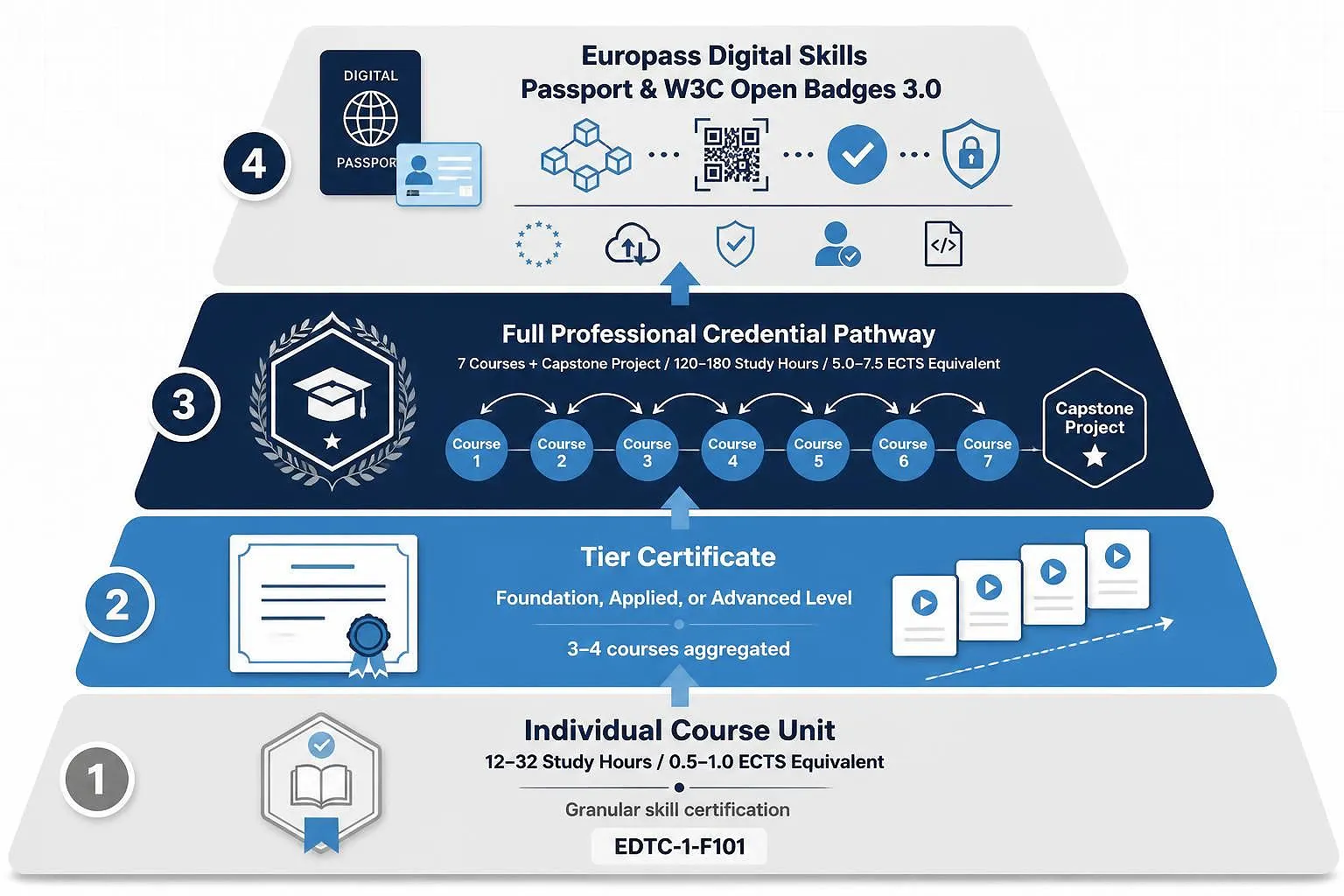
A foundational strength of the EDTC educational architecture is its adherence to European Union standards for stackable micro-credentials [4]. Under the Council Recommendation of 16 June 2022 on a European approach to micro-credentials for lifelong learning and employability (2022/C 243/02), micro-credentials represent short, targeted learning experiences that have been transparently assessed, quality-assured, and documented according to standardized European templates [4, 12].
1. Micro-Credential Volume & ECTS Credit Transfer Principles
While traditional university degree programs allocate European Credit Transfer and Accumulation System (ECTS) credits on the basis of full-time academic semesters (where 1 ECTS credit represents approximately 25 to 30 total study hours), vocational micro-credentials provide granular credit accumulation [4, 5]:
- Single Course Micro-Credential: A standard EDTC course unit involves 12 to 32 total study hours (combining core reading, interactive workflow tables, practical case studies, and formative quizzes) [3]. This corresponds to 0.5 to 1.0 ECTS credit equivalent [4].
- Full Pathway Qualification: A complete Professional Credential Pathway comprises 7 stackable course units plus an applied Capstone Project, representing 120 to 180 total study hours [3]. This corresponds to 5.0 to 7.5 ECTS credit equivalents, providing a substantial, verifiable body of vocational learning suitable for credit recognition in higher vocational education or professional licensing bodies [4, 12].
2. EQF Level Referencing & Vocational Boundaries
In strict compliance with European Union educational guidelines, EDTC short online professional courses are referenced as vocational micro-credentials mapped to EQF Levels 3 to 6 [4, 12]:
- Foundation Tier Courses (EQF Level 3–4): Deliver entry-level vocational awareness, operational terminology, and basic compliance verification skills [3, 12].
- Applied Tier Courses (EQF Level 5): Deliver practical operational execution competencies, software portal data entry skills, document auditing capabilities, and diagnostic troubleshooting [3, 12].
- Advanced Tier Courses (EQF Level 5–6): Deliver high-level technical analysis, complex legal classification expertise, strategic risk management, and enterprise architecture leadership [3, 12].
- Statutory Boundary Enforcement: EDTC micro-credentials do NOT independently confer university degree-equivalent qualifications (such as a 180 ECTS Bachelor’s degree or 120 ECTS Master’s degree) without formal National Qualifications Framework (NQF) referencing by competent national authorities (such as Portugal’s ANQEP or DGERT) [4, 12, 34].
3. Cryptographic Verification & Europass Digital Passports
Upon successful completion of an EDTC course or full pathway, digital credentials are issued through two standardized European metadata standards [5]:
- W3C Open Badges 3.0 Standard: Every issued badge contains embedded JSON-LD cryptographic metadata specifying the learner’s name, issue date, credential ID, exact learning outcomes achieved (
LOcodes), assessment pass scores, and a direct verification URL hosted on the EDTC digital registry [5]. - Europass Digital Credentials Infrastructure (EDCI): Micro-credentials are fully compatible with the European Commission’s Europass platform [5]. Learners can export their verified credentials directly into their official Europass Digital Wallet, presenting tamper-proof evidence of digital skills to employers, customs authorities, and public trade promotion agencies across all 27 EU Member States [4, 5].
2.4 Constructing a Phased Organizational Onboarding & Action Plan
To successfully execute an enterprise-wide digital trade transformation, management must translate diagnostic assessment scores and pathway selections into a structured, phased implementation roadmap [6]. Rather than attempting a disruptive, high-risk “big bang” software replacement, the EDTC implementation model enforces a 4-Phase Action Plan that aligns workforce upskilling with operational systems deployment [3, 6].
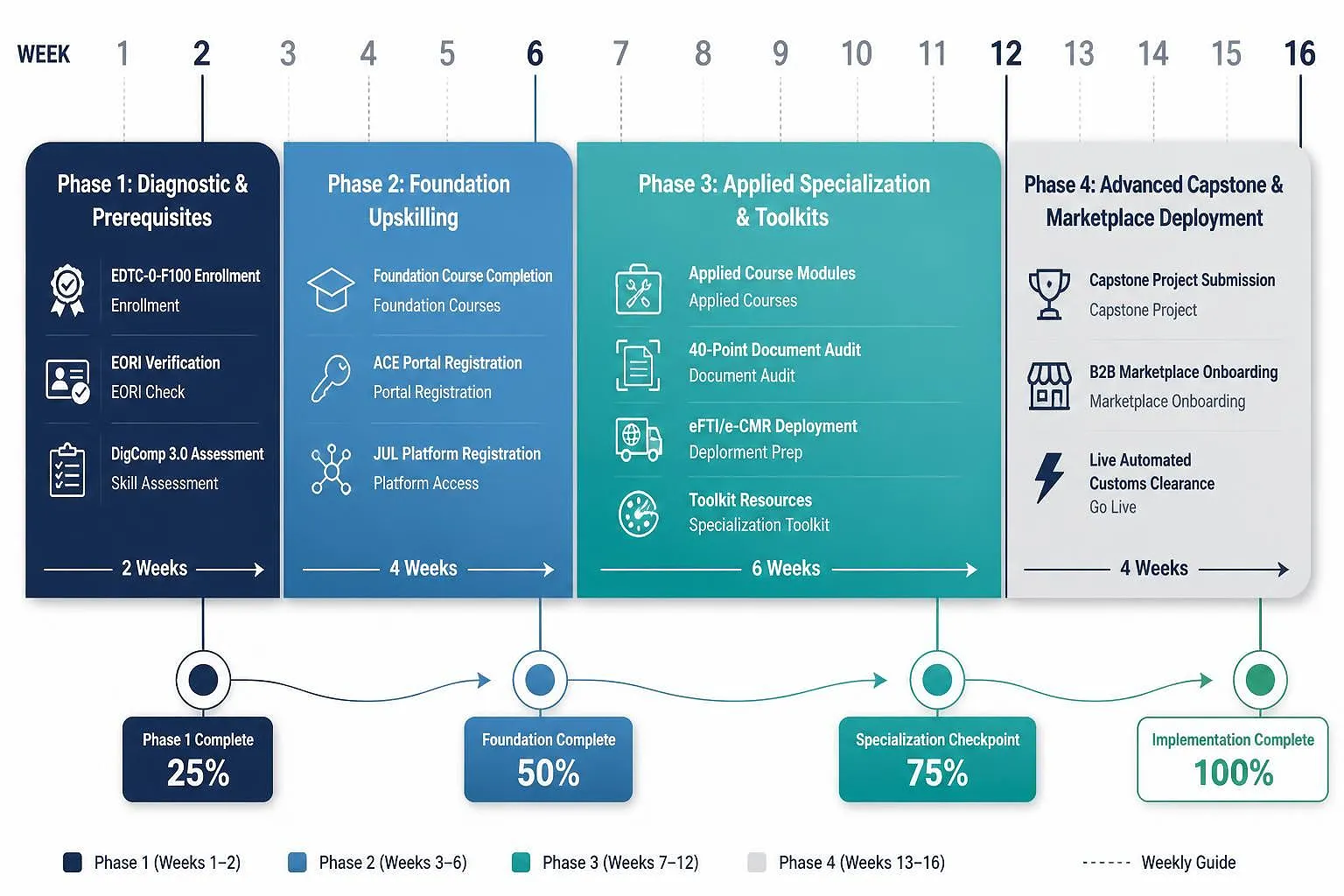
Phase 1: Orientation & Diagnostic Alignment (Weeks 1–2)
- Operational Goal: Establish organizational baseline, verify legal digital credentials, and select initial learning pathways [1, 6].
- Key Action Items:
- Enroll key enterprise personnel in the mandatory prerequisite course
EDTC-0-F100: Orientation to European Digital Trade & EDTC Ecosystem[3]. - Conduct an internal digital maturity assessment across the 4 diagnostic dimensions using the SME Digital Readiness Verification Checklist (
EDTC-1-F101_Tool_01) [1]. - Verify corporate eIDAS 2.0 digital certificates, EORI numbers on the EU EOS database, and Portuguese Tax and Customs Authority (ACE Portal) access mandates [9, 16].
- Apply for public co-funding vouchers through local Digital Innovation Hubs (DIHs) or national digital transition grant schemes (such as Portugal 2030 / PRR vouchers managed by IAPMEI) [7, 13].
- Enroll key enterprise personnel in the mandatory prerequisite course
Phase 2: Foundation Upskilling & Baseline Systems Registration (Weeks 3–6)
- Operational Goal: Eliminate basic operational knowledge gaps and complete baseline portal registrations [3, 6].
- Key Action Items:
- Complete Foundation Tier courses corresponding to selected pathways (e.g.,
EDTC-1-F101,EDTC-2-F201,EDTC-3-F301,EDTC-5-F501) [3]. - Register enterprise profiles on national port single-window systems, such as the Port of Sines Janela Única Logística (JUL) platform operating across Portuguese maritime gateways [10, 26].
- Standardize internal commercial document templates (invoices, packing lists) to conform with UN/CEFACT Layout Key standards and GS1 XML specifications [17, 18].
- Establish basic workplace cybersecurity hygiene rules and password policies compliant with NIS2 Directive guidelines [25].
- Complete Foundation Tier courses corresponding to selected pathways (e.g.,
Phase 3: Applied Specialization & Workflow Automation (Weeks 7–12)
- Operational Goal: Deploy operational software tools, execute pre-lodgment document audits, and automate trade data exchanges [3, 6].
- Key Action Items:
- Complete Applied Tier courses and practical toolkits (e.g.,
EDTC-2-AP201Trade Documentation andEDTC-2-AP201_Tool_0140-Point Pre-Submission Audit Checklist) [3]. - Transition road haulage operations from paper consignment notes to electronic transport platforms (e-CMR) compliant with the eFTI Regulation (Regulation (EU) 2020/1056) [11, 27].
- Deploy API middleware or direct portal data feeds connecting internal ERP software with national customs portals for automated pre-arrival declarations [9, 15].
- Implement Scope 1, 2, and 3 carbon accounting protocols to prepare for CBAM quarterly reporting and CSRD ESG reporting mandates [23, 24].
- Complete Applied Tier courses and practical toolkits (e.g.,
Phase 4: Advanced Capstone Execution & B2B Marketplace Integration (Weeks 13–16)
- Operational Goal: Execute an applied capstone project solving a live enterprise operational bottleneck and onboard onto the EDTC B2B Digital Marketplace [3, 6].
- Key Action Items:
- Complete Advanced Tier courses and execute an Applied Capstone Project (
EDTC-CAP-001through008) addressing a real-world enterprise trade challenge (such as a BTI tariff classification dossier or a port community API integration) [3]. - Complete Authorised Economic Operator (AEO-C / AEO-S) self-assessment audits to secure customs simplification benefits [9].
- Onboard the enterprise onto the EDTC B2B Digital Marketplace, publishing verified company profiles, product catalogs, and verified micro-credentials to international buyers, freight forwarders, and trade finance providers [3].
- Export verified W3C Open Badges 3.0 credentials into employee Europass Digital Wallets, establishing an auditable record of organizational competence [4, 5].
- Complete Advanced Tier courses and execute an Applied Capstone Project (
3. Practical Workflow: Enterprise Pathway Selection & Onboarding Protocol
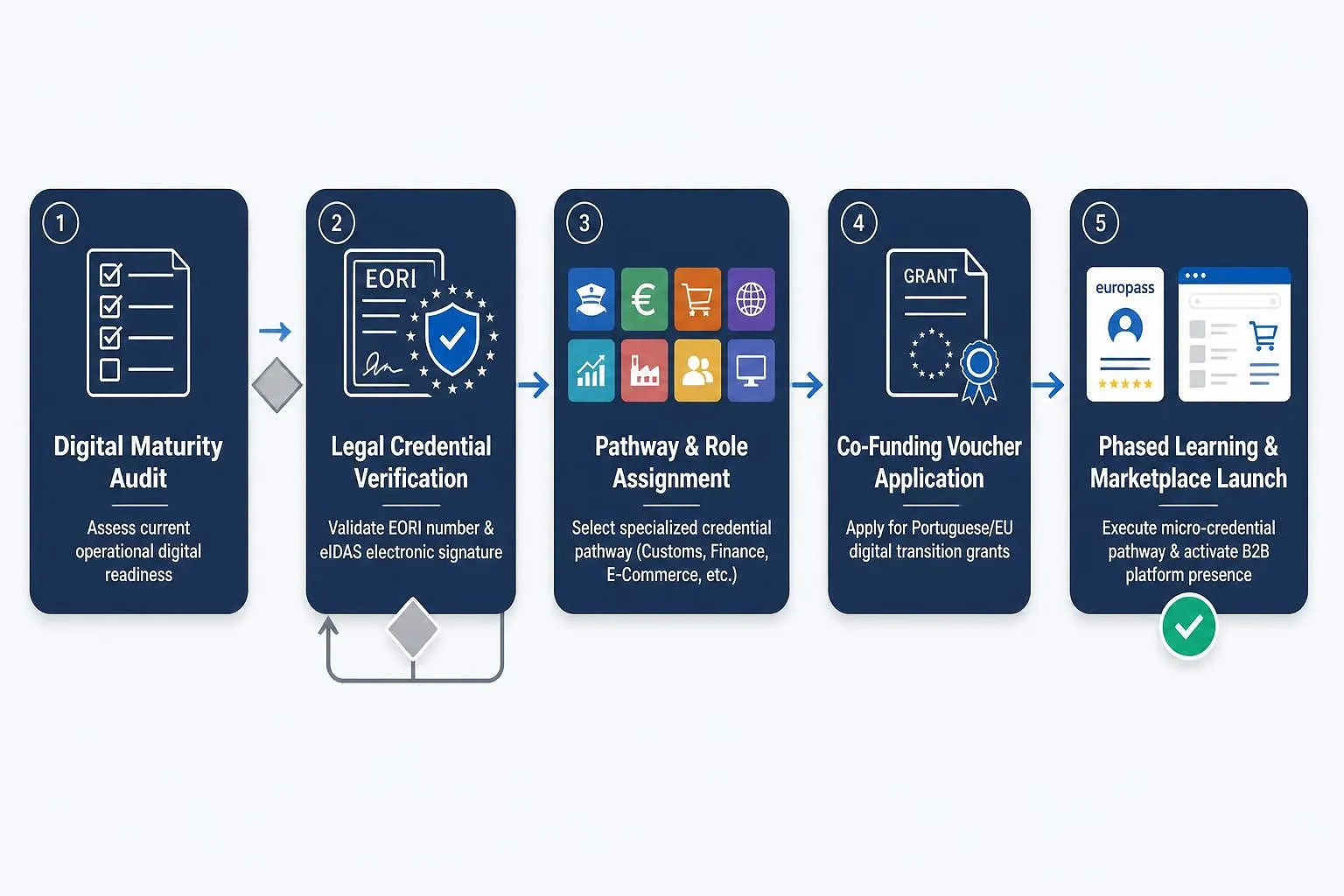
The table below outlines the 5-step operational protocol that enterprise managers, HR directors, and trade compliance leads execute to select workforce learning pathways and manage the digital trade onboarding journey:
Enterprise Digital Transformation Cycle – Implementation Roadmap
| Step # | Action Item | Required Input / Tool | Responsible Enterprise Role | Operational Decision Point | Escalation Trigger |
|---|---|---|---|---|---|
| 1 | Conduct Digital Maturity Audit | SME Digital Readiness Verification Checklist (EDTC-1-F101_Tool_01) | General Manager / Trade Compliance Officer | Is the enterprise operating primarily on paper files (Stage 1/2) or digital files (Stage 3/4)? | If >50% of trade files are paper-only, mandate enrollment in EDTC-0-F100 and EDTC-1-F101 [1, 3]. |
| 2 | Verify Legal Digital Credentials | Corporate eIDAS 2.0 Certificates & EU EOS Database | IT Administrator / Legal Counsel | Are corporate e-signatures, EORI numbers, and ACE Portal access mandates active? | If digital certificates are expired or inactive, apply immediately via national tax authorities [9, 16]. |
| 3 | Map Workforce to Pathways | EDTC Pathway Selection Matrix (EDTC-1-F101_Tool_02) | HR Director / Operations Lead | Which specific operational roles require upskilling across the 8 credential pathways? | If key roles cover multiple functions (e.g., customs + logistics), assign a dual-pathway schedule [3]. |
| 4 | Secure Public Co-Funding | IAPMEI DIH Portal / PRR Grant Application | Finance Manager / Grant Specialist | Is the enterprise eligible for digital transition vouchers or DIH training subsidies? | Consult local AICEP or IAPMEI trade advisors to submit co-funding applications [7, 13]. |
| 5 | Execute Phased Learning & System Deployment | EDTC LMS Dashboard & 40-Point Document Audit (EDTC-2-AP201_Tool_01) | Enrolled Employees / Department Leads | Have personnel achieved required quiz pass thresholds (60% F / 70% AP / 75% AD)? | If quiz scores fall below thresholds, schedule targeted re-study of specific lesson modules [3]. |
4. Realistic Enterprise Scenario
4.1 Enterprise Scenario Narrative
Frutas do Oeste S.A. is a medium-sized agricultural packing and exporting enterprise based in Torres Vedras, Portugal, employing 68 full-time staff. The enterprise exports fresh apples, pears, and citrus fruits to retail supermarket chains across the United Kingdom, Spain, and the United Arab Emirates (UAE), generating €14.2 million in annual export revenue.
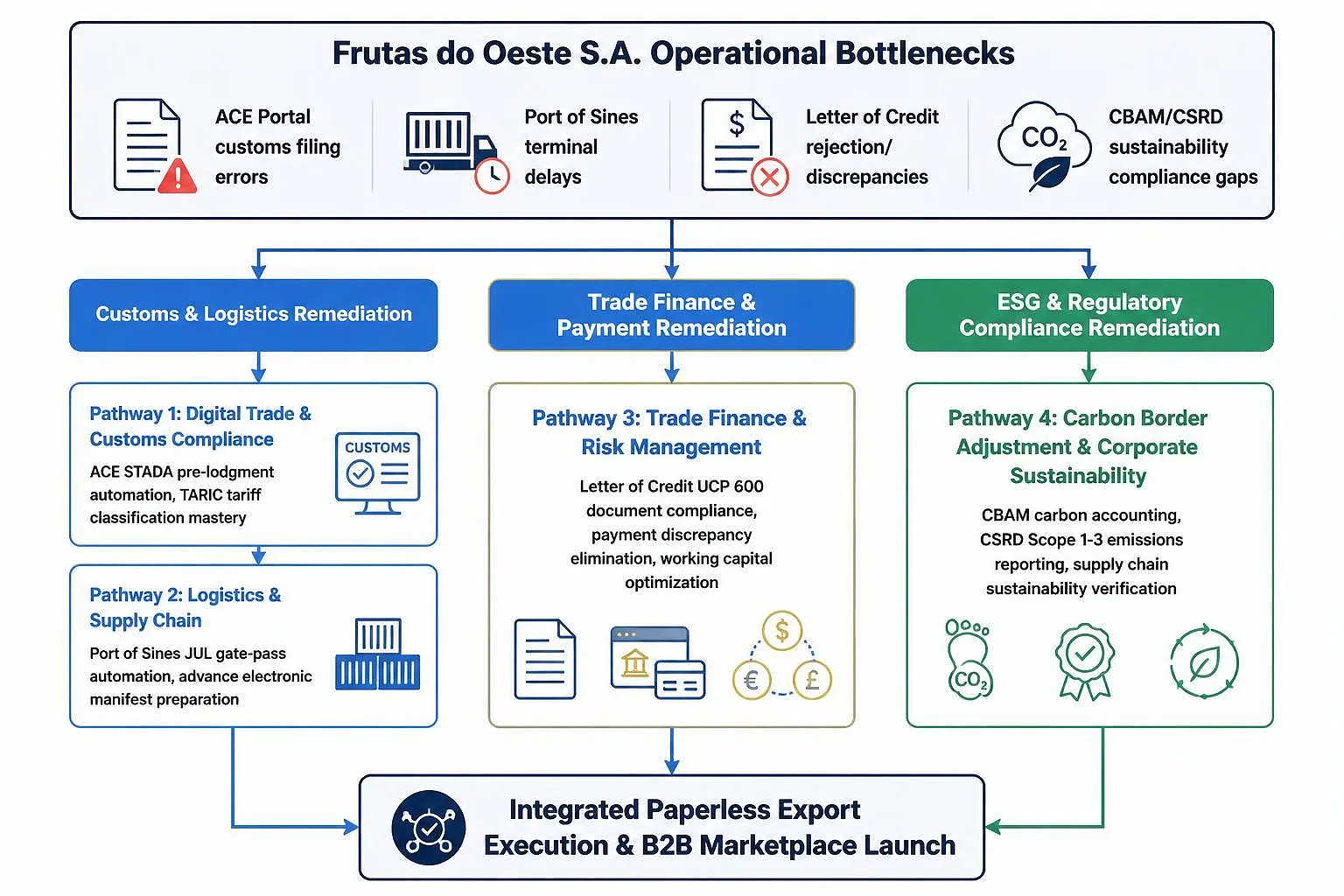
Recently, Frutas do Oeste S.A. has encountered severe operational friction across multiple international supply chain touchpoints:
- Customs Rejections at Lisbon & Sines Gateways: Export shipments destined for the UK via maritime container feeder vessels frequently experience red-lane clearance holds on the Portuguese Tax and Customs Authority ACE Portal [9]. The company’s junior dispatch clerk repeatedly selected incorrect 10-digit TARIC subheadings (confusing fresh table fruit with processed fruit preserves), while container trucks experienced gate entry delays at the Port of Sines Terminal XXI because driver consignment data had not been pre-lodged on the Janela Única Logística (JUL) platform [10, 21].
- Documentary Letter of Credit Rejections: A €380,000 shipment of pears consigned to a retail buyer in Dubai was delayed for 18 days because the bank issuing the Letter of Credit identified discrepant data between the physical Bill of Lading, the Phytosanitary Certificate, and the commercial invoice, violating UCP 600 banking rules [30].
- UK Environmental & Carbon Reporting Pressure: UK retail buyers have formally requested that Frutas do Oeste S.A. submit verified Scope 1, 2, and 3 carbon intensity data per kilogram of exported fruit, threatening to terminate supply contracts by 2027 if carbon accounting standards are not met [23].
The Managing Director of Frutas do Oeste S.A. recognizes that these recurring issues stem from fragmented, paper-dependent workforce skills, but is uncertain how to structure an enterprise-wide training and digital transition plan without disrupting daily shipping operations.
4.2 4-Part Evaluation Key
Part 1: Primary Operational & Organizational Diagnosis
Frutas do Oeste S.A. is operating at a Stage 2 (Fragmented Digital Maturity) level [1]. While the enterprise uses basic accounting software and e-mail, its core trade compliance, logistics execution, trade finance management, and sustainability reporting rely on manual paper handling and ad-hoc employee guesswork [8, 9]. The operational failures represent a classic Cross-Pillar Risk Cascade: customs data errors on the ACE Portal trigger physical port delays at Sines, which delay document presentation to banks under UCP 600 rules, while lack of ESG carbon accounting threatens long-term commercial relationships in key export markets [10, 23, 30].
Part 2: Recommended 4-Track Pathway Strategy
To resolve these bottlenecks systematically, the Managing Director should enroll key personnel in a multi-pathway upskilling plan backed by public co-funding [3, 7]:
- Track 1: Customs & Trade Compliance (Export Coordinator & Dispatch Clerk): Enroll in Pathway 1: Customs & Trade Compliance Specialist (specifically
EDTC-2-AP201Trade Documentation andEDTC-2-AD201Tariff Classification) [3]. Personnel will master 10-digit TARIC fruit subheading classification, GIR 1–6 rules, and execute pre-submission document audits using the 40-Point Audit Checklist (EDTC-2-AP201_Tool_01) before lodging declarations on the ACE Portal [9, 21]. - Track 2: Digital Logistics & Port Single Window (Logistics Manager): Enroll in Pathway 2: Digital Supply Chain Manager (specifically
EDTC-3-AP301Freight Forwarding andEDTC-3-AD301Multimodal Port Logistics) [3]. The manager will register the enterprise profile on the Port of Sines Janela Única Logística (JUL) platform, automating electronic gate-pass generation and deploying e-CMR electronic consignment notes for road transport to port terminals [10, 26, 27]. - Track 3: Trade Finance & Banking Compliance (Finance Controller): Enroll in Pathway 3: Trade Finance & Risk Analyst (specifically
EDTC-5-AP501Working Capital & Letters of Credit) [3]. The controller will master UCP 600 documentary compliance rules, ensuring perfect data alignment between eFBL bills of lading, commercial invoices, and phytosanitary certificates prior to bank presentation [29, 30]. - Track 4: Sustainability & Carbon Accounting (ESG Lead): Enroll in Pathway 4: Sustainable Trade & CBAM Specialist (specifically
EDTC-8-AP801Carbon Accounting & CSRD) [3]. The ESG lead will implement Scope 1, 2, and 3 carbon footprint calculation matrices (EDTC-8-AP801_Tool_01), establishing auditable carbon reporting for UK and EU buyers [23, 24].
Part 3: Alternative Phased Modular Approach
If Frutas do Oeste S.A. cannot commit four staff members to full pathway completion simultaneously, the enterprise can adopt a Phased Modular Sequence [3, 6]:
- Month 1: All four personnel complete
EDTC-0-F100(Orientation) andEDTC-1-F101(Digital Trade Intro) to establish a shared operational vocabulary [3]. - Month 2: Priority enrollment in
EDTC-2-AP201(Trade Documentation) andEDTC-3-AP301(Freight Forwarding) to resolve immediate ACE Portal rejections and Sines port holds [3, 9, 10]. - Month 3: Enrollment in
EDTC-5-AP501(Letters of Credit) to secure export cash flow [3, 30]. - Month 4: Enrollment in
EDTC-8-AP801(Carbon Accounting) to address long-term UK buyer requirements [3, 23].
Part 4: Common Management & Learner Misconceptions
- Misconception 1: “Software automation solves compliance errors without workforce training.” Management often assumes that purchasing an expensive ERP plug-in will automatically eliminate customs errors. In reality, software middleware merely transmits data; if personnel do not understand TARIC classification or UCP 600 rules, the software will simply transmit incorrect data faster, accelerating customs penalties and bank rejections [9, 15, 30].
- Misconception 2: “Short micro-credentials lack formal regulatory recognition.” Management may fear that 15-hour online courses carry no weight with authorities. In reality, EDTC micro-credentials adhere to EQAVET quality assurance cycles, DigComp 3.0 competency frameworks, and W3C Open Badges 3.0 cryptographic standards, providing auditable proof of competence recognized by customs authorities, port operators, and public trade agencies across the EU [1, 2, 4, 5].
5. Governance, Educational Limitations & Glossary
5.1 Key Takeaways
- Systematic Diagnostics: Enterprise digital trade transition must begin with a thorough gap analysis across Technology, Legal/Compliance, Logistics, and Skills dimensions using DigComp 3.0 and EQAVET benchmarks [1, 2].
- Targeted Pathway Alignment: The 8 EDTC Professional Credential Pathways provide structured, role-aligned upskilling trajectories that synthesize specialized modules across the 12 Curriculum Pillars [3].
- Stackable Credential Progression: Granular course units (12–32 study hours) stack seamlessly into full pathway qualifications (120–180 study hours / 5.0–7.5 ECTS equivalents) certified via W3C Open Badges 3.0 and Europass Digital Wallets [4, 5].
- Phased Action Plan: Successful digital transformation follows a 4-phase roadmap (Diagnostic, Foundation, Applied, Advanced Capstone) supported by public co-funding vouchers (IAPMEI PRR / DIH grants) [6, 7].
5.2 Multilingual Technical Glossary
- Onboarding Roadmap (Roteiro de Integração): A structured, phased operational plan guiding an enterprise or learner from baseline diagnostic assessment through workforce upskilling, software integration, and live marketplace execution [6].
- Credential Pathway (Percurso de Qualificação): A specialized, stackable cluster of vocational course units and an applied capstone project aligned with a specific enterprise job function [3].
- Stackable Micro-Credential (Microcredencial Empilhável): A quality-assured, short vocational learning unit (12–32 study hours) that accumulates toward higher-level EQF qualifications and ECTS credit equivalents [4, 12].
- Digital Maturity Diagnosis (Diagnóstico de Maturidade Digital): A structured evaluation measuring organizational capabilities across technical infrastructure, legal compliance, logistics integration, and workforce digital skills [1, 2].
- Europass Digital Skills Passport (Passaporte Europass de Competências): The official European Commission digital wallet infrastructure storing cryptographically verified micro-credentials, badges, and learning outcomes [5].
- Digital Innovation Hub – DIH (Pólo de Inovação Digital): Regional public support centers providing SMEs with digital maturity assessments, technology testing, and training grant vouchers [7, 13].
6. References & Source Material
- European Quality Assurance in Vocational Education and Training. (2009). Recommendation of the European Parliament and of the Council on the establishment of a European Quality Assurance Reference Framework for Vocational Education and Training (EQAVET) (2009/C 155/01). Official Journal of the European Union, C 155, 1–10.
- Joint Research Centre (European Commission). (2025). DigComp 3.0: The European Digital Competence Framework for Citizens with Learning Outcomes and Performance Indicators. Publications Office of the European Union. https://joint-research-centre.ec.europa.eu/digcomp_en
- European Centre for the Development of Vocational Training. (2022). European guidelines for the development and writing of short, learning-outcomes-based descriptions of qualifications. CEDEFOP Reference Series, No. 122. Publications Office of the European Union.
- Council of the European Union. (2022). Council Recommendation of 16 June 2022 on a European approach to micro-credentials for lifelong learning and employability (2022/C 243/02). Official Journal of the European Union, C 243, 10–25.
- European Parliament & Council of the European Union. (2018). Decision (EU) 2018/641 on a common framework for the provision of better services for skills and qualifications (Europass). Official Journal of the European Union, L 112, 42–56.
- European Commission. (2021). Digital Transformation Strategy for European SMEs: Building resilient and sustainable cross-border supply chains. COM(2021) 350 final.
- Agência para a Competitividade e Inovação. (2024). Guia Prático dos Vouchers para a Transição Digital das PME: Programa de Recuperação e Resiliência (PRR). IAPMEI Editorial.
- United Nations Centre for Trade Facilitation and Electronic Business. (2020). UN/CEFACT Recommendation No. 1: UN Layout Key for Trade Documents (ECE/TRADE/137/Rev.2). United Nations.
- Autoridade Tributária e Aduaneira. (2024). Manual de Operações do Portal ACE: Submissão Eletrónica de Declarações Aduaneiras e Pré-Alojamento de Mercadorias. Ministério das Finanças de Portugal.
- Administração do Porto de Sines e do Algarve, S.A. (2021). Visão Estratégica 2030: Janela Única Logística (JUL) e a Digitalização do Corredor Atlântico. APS Editorial.
- European Parliament & Council of the European Union. (2020). Regulation (EU) 2020/1056 on electronic freight transport information (eFTI). Official Journal of the European Union, L 249, 33–43.
- Council of the European Union. (2017). Council Recommendation of 22 May 2017 on the European Qualifications Framework for lifelong learning (2017/C 189/03). Official Journal of the European Union, C 189, 15–28.
- Presidência do Conselho de Ministros. (2020). Resolução do Conselho de Ministros n.º 30/2020: Aprova o Plano de Ação para a Transição Digital de Portugal. Diário da República, 1.ª série, N.º 78, 2–21.
- European Training Foundation. (2021). Quality Assurance in Vocational Education and Training: Policy guidelines and continuous improvement cycles. ETF Publications.
- Directorate-General for Taxation and Customs Union. (2024). EU Customs Declaration Data Manual: Common Entry Module (CEM) Specifications. European Commission.
- European Parliament & Council of the European Union. (2024). Regulation (EU) 2024/1183 amending Regulation (EU) No 910/2014 as regards establishing the European Digital Identity Framework (eIDAS 2.0). Official Journal of the European Union, L 2024/1183.
- GS1 International. (2023). GS1 XML Trade Data Standards and Electronic Invoicing Guidelines (Release 3.5). GS1 Press.
- International Organization for Standardization. (2020). Electronic business XML (ebXML) core components technical specification (ISO/TS 15000-5:2020). ISO.
- European Parliament & Council of the European Union. (2016). Regulation (EU) 2016/679 on the protection of natural persons with regard to the processing of personal data (GDPR). Official Journal of the European Union, L 119, 1–88.
- Presidência da República. (2015). Decreto-Lei n.º 130/2015: Procede à revisão do Código de Processo Tributário e disciplina a representação aduaneira. Diário da República, 1.ª série, N.º 151, 5410–5432.
- World Customs Organization. (2025). Harmonized System Explanatory Notes (2026 Edition). WCO Publications.
- European Parliament & Council of the European Union. (2026). Commission Implementing Regulation (EU) 2026/1183 on preferential rules of origin. Official Journal of the European Union, L 2026/1183.
- European Parliament & Council of the European Union. (2023). Regulation (EU) 2023/956 establishing a Carbon Border Adjustment Mechanism (CBAM). Official Journal of the European Union, L 130, 52–104.
- European Parliament & Council of the European Union. (2022). Directive (EU) 2022/2464 as regards corporate sustainability reporting (CSRD). Official Journal of the European Union, L 322, 15–80.
- European Parliament & Council of the European Union. (2022). Directive (EU) 2022/2555 on measures for a high common level of cybersecurity across the Union (NIS2 Directive). Official Journal of the European Union, L 333, 80–152.
- Administração do Porto de Aveiro, S.A. (2022). Plano de Desenvolvimento Estratégico do Porto de Aveiro 2020-2030: Plataforma Logística PLASS e Conectividade Multimodal. APA Editorial.
- International Road Transport Union. (2023). e-CMR Operational Implementation Guide for Cross-Border Road Logistics. IRU Press.
- Directorate-General for Maritime Resources. (2023). Relatório de Desempenho do Sistema Portuário Nacional e Corredores Atlânticos. DGRM Editorial.
- International Multimodal Transport Association & FIATA. (2023). FIATA Digital Bill of Lading (eFBL) Standard Rules and Data Schema. FIATA Publications.
- International Chamber of Commerce. (2007). Uniform Customs and Practice for Documentary Credits (ICC Publication No. 600 – UCP 600). ICC Publishing.
- European Commission. (2021). VAT One Stop Shop (OSS) User Guide: Special schemes for e-commerce and cross-border services. TAXUD/C1/2021.
- International Chamber of Commerce. (2019). Incoterms® 2020: ICC rules for the use of domestic and international trade terms (ICC Publication No. 723E). ICC Publishing.
- European Parliament & Council of the European Union. (2021). Regulation (EU) 2021/694 establishing the Digital Europe Programme. Official Journal of the European Union, L 166, 1–34.
- Agência Nacional para a Qualificação e o Ensino Profissional. (2023). Catálogo Nacional de Qualificações: Alinhamento das Microcredenciais com o Quadro Nacional de Qualificações (QNQ). ANQEP.