
Lesson 3: EU Educational Standards — EQAVET, EQF, DigComp 3.0 & ESG
Unit Information & Metadata
- Lesson ID: EDTC-0-F100_L03
- Estimated Study Duration: 90 Minutes Total (60 Min Core Reading & Analysis + 30 Min Practical Workflow & Assessment)
- Target EQF Level: EQF Level 3–4 (Vocational Awareness / Prerequisite Micro-Credential)
1. Lesson Opening & Strategic Context
1.1 Learning Objectives
Upon completing this instructional unit, adult learners and enterprise training managers will be able to:
- Analyze the core principles of the European Quality Assurance in Vocational Education and Training (EQAVET) framework and apply the Plan-Do-Check-Act (PDCA) quality cycle to continuous vocational curriculum development [1] (
LO0.3.01). - Differentiate between European Qualifications Framework (EQF) Level 3–4 vocational micro-credentials and higher education degree qualifications under the European Higher Education Area (EHEA) standards [2, 4] (
LO0.3.02). - Map organizational job roles and digital trade operational tasks to the 5 thematic areas and 21 competences of the Digital Competence Framework 3.0 (DigComp 3.0) [3] (
LO0.3.03). - Evaluate the application of Standards and Guidelines for Quality Assurance in Higher Education (ESG 2015) as internal instructional design guidance while enforcing statutory non-automation boundaries [4, 5] (
LO0.3.04).
1.2 Business Relevance & Operational Impact
For small and medium-sized enterprises (SMEs), logistics operators, freight forwarders, and corporate compliance departments across the European Union, workforce upskilling is frequently hampered by fragmented, non-standardized training programs [6]. Traditional corporate training often lacks transparent quality benchmarks, verifiable learning outcomes, and cross-border recognition across EU Member States [7]. When enterprise personnel complete ad-hoc vendor software tutorials or unstructured internal seminars, corporate leadership receives no objective guarantee that staff have attained operational competence in regulatory compliance, electronic customs pre-lodgment, or automated supply chain workflows [8].
By aligning professional adult education with binding European Union educational standards, enterprise training programs transform from informal orientation sessions into auditable, high-impact vocational micro-credentials [5, 9]. Adopting recognized European quality frameworks ensures that training outcomes are directly transferable across all 27 EU Member States, aligned with national qualification registries (such as the National Catalogue of Qualifications in Portugal managed by ANQEP and certified by DGERT), and rigorously evaluated against standardized digital competence benchmarks [3, 10]. For enterprise managers, this alignment eliminates training redundancy, lowers regulatory non-compliance risks, accelerates employee onboarding, and establishes verifiable proof of workforce competency during statutory customs, tax, and environmental audits [1, 11].
1.3 Key Concepts Preview
- EQAVET Quality Assurance Framework: The European Reference Framework establishing a continuous quality management cycle (Plan-Do-Check-Act) and standardized indicators to monitor and improve vocational education and training (VET) provision [1].
- European Qualifications Framework (EQF): An 8-level common European translation grid that relates national qualifications systems, enabling transparent comparison of learning outcomes, knowledge, skills, and autonomy across European educational structures [2].
- DigComp 3.0 (Digital Competence Framework): The European Union reference framework defining 21 digital competences across 5 core thematic areas, providing standardized proficiency descriptors for citizens and enterprise workforces [3].
- ESG 2015 Standards: The Standards and Guidelines for Quality Assurance in the European Higher Education Area, utilized within professional VET design as internal instructional quality guidance for curriculum structure, student-centred learning, and assessment integrity [4].
- Vocational Micro-Credentials: Short, focused, learning-outcomes-based qualifications (12–32 study hours; 1.0–2.5 ECTS credit equivalents) designed to deliver targeted workplace competencies without conferring university degree titles [5].
2. Core Instructional Content & Framework Mechanics
2.1 The EQAVET Framework and Continuous Quality Management (PDCA Cycle)
The European Quality Assurance in Vocational Education and Training (EQAVET) framework was established by Recommendation 2009/C 155/01 of the European Parliament and of the Council to serve as the primary reference mechanism for quality assurance in European VET [1]. Designed to increase the transparency, consistency, and market relevance of vocational training across European Member States, EQAVET provides a structured continuous improvement engine based on the classic Plan-Do-Check-Act (PDCA) quality management cycle [12].
Within professional adult education and corporate training design, quality assurance cannot be treated as a static, one-time approval event [13]. Instead, EQAVET mandates a permanent, systematic feedback loop that continuously aligns curriculum content, instructional methods, assessment integrity, and workplace outcomes with evolving market requirements [1]. In the dynamic domain of European digital trade—where customs regulations, electronic transport data schemas, and digital tax portals undergo frequent statutory updates—the EQAVET PDCA cycle ensures that instructional content remains 100% current, legally accurate, and operationally effective [14].

2.1.1 The Four Stages of the EQAVET Quality Assurance Cycle
The EQAVET framework structures quality assurance across four sequential, interdependent phases [1, 15]:
- Phase 1: Planning (Define Purpose and Explicit Outcomes):
- Systemic Mandate: Establish clear, measurable, market-anchored objectives for vocational training programs based on empirical skills gap analyses, industry consultation, and statutory regulatory requirements [1].
- Operational Application: Before drafting instructional content, curriculum authors conduct rigorous stakeholder needs assessments with exporting SMEs, freight forwarders, customs brokers, and port community operators. Learning outcomes are formulated using explicit Bloom’s taxonomy verbs (e.g., classify, calculate, verify, audit) and mapped directly to specific job role competencies and regulatory mandates [5].
- Phase 2: Implementation (Deliver Student-Centred Learning):
- Systemic Mandate: Deploy training programs using robust, transparent, and accessible instructional methodologies supported by adequate resources, qualified subject-matter experts, and secure learning management infrastructure [1].
- Operational Application: Lessons are structured around real-world business scenarios, step-by-step operational workflows, and interactive digital toolkits. Course materials adhere to Universal Design for Learning (UDL) principles, ensuring total WCAG 2.1 AA accessibility, multi-device responsiveness, and clear pedagogical guidance through non-spoiling hints and diagnostic feedback [16].
- Phase 3: Evaluation (Measure Learning and Workplace Impact):
- Systemic Mandate: Systematically collect and analyze data regarding learner satisfaction, completion rates, assessment pass rates, skill acquisition, and workplace performance [1].
- Operational Application: Formative lesson quizzes and summative final course exams undergo continuous psychometric evaluation. Assessment analytics track question difficulty indices, distractor efficacy, and learner failure patterns. Furthermore, post-course survey instruments measure 60-day post-training workplace application, assessing whether learners successfully perform real-world tasks such as submitting error-free customs declarations on national portals [17].
- Phase 4: Review and Revision (Feed Data Back into Curriculum):
- Systemic Mandate: Process evaluation findings through formal Change Control Boards (CCB) to implement systematic curriculum updates, correct pedagogical deficiencies, and incorporate new legal or technical standards [1].
- Operational Application: Course content undergoes mandatory annual regulatory audits and immediate emergency revisions whenever the European Commission or national authorities update statutory regulations (e.g., changes to Combined Nomenclature subheadings, eFTI data specifications, or TARIC measure codes) [18].
The EQAVET Continuous PDCA Cycle
| Phase | Action |
|---|---|
| 1. PLAN | Identify market skills gaps & write Bloom’s outcomes. |
| 2. DO | Deliver student-centred, accessible micro-credentials. |
| 3. CHECK | Evaluate assessment analytics & 60-day workplace impact. |
| 4. ACT | Execute CCB revisions & update statutory content annually. |
2.1.2 Key EQAVET Indicators for Professional VET Programs
EQAVET establishes ten systemic quality indicators to evaluate VET system performance [1]. Professional adult training providers and enterprise corporate academies focus specifically on six core indicators to maintain operational accreditation [19]:
- Indicator 1 (Quality Management System): Verification that the training provider maintains a documented internal quality assurance policy, regular audit schedules, and formal CCB review procedures [1].
- Indicator 2 (Investment in VET Trainer Upskilling): Evidence of ongoing pedagogical and technical professional development for instructional authors, subject-matter experts, and assessment designers [1].
- Indicator 3 (Completion Rate in VET Programs): Measurement of learner retention, module completion percentages, and micro-credential completion rates across Foundation, Applied, and Advanced tiers [1].
- Indicator 4 (Placement Rate in VET Programs): Percentage of unemployed or transitioning learners who secure relevant employment in international trade, logistics, or compliance roles following course completion [1].
- Indicator 5 (Utilization of Acquired Skills in the Workplace): Qualitative and quantitative survey data from enterprise employers confirming that micro-credential graduates demonstrate improved job performance, reduced administrative error rates, and enhanced compliance adherence [1, 20].
- Indicator 6 (Satisfaction Rates of Learners and Employers): Formal feedback scores evaluating course structure, platform usability, practical relevance of toolkits, and assessment fairness [1].
2.2 The European Qualifications Framework (EQF) and Vocational Micro-Credentials
The European Qualifications Framework for Lifelong Learning (EQF) was established by Council Recommendation of 22 May 2017 (2017/C 189/03) to serve as a common European translation grid for national qualifications systems [2]. Comprising eight transparent reference levels defined through learning outcomes, the EQF allows employers, educational institutions, and adult learners to accurately compare qualifications across different Member States, educational sectors, and awarding bodies [21].
In professional adult education, understanding the precise EQF level mapping of short online courses is essential to prevent false qualification claims and maintain total compliance with European education standards [5]. Short vocational courses (12–32 study hours; 1.0–2.5 ECTS credit equivalents) are classified as vocational micro-credentials corresponding to EQF Levels 3, 4, 5, or 6 depending on their technical complexity and the required level of learner autonomy [2, 5].
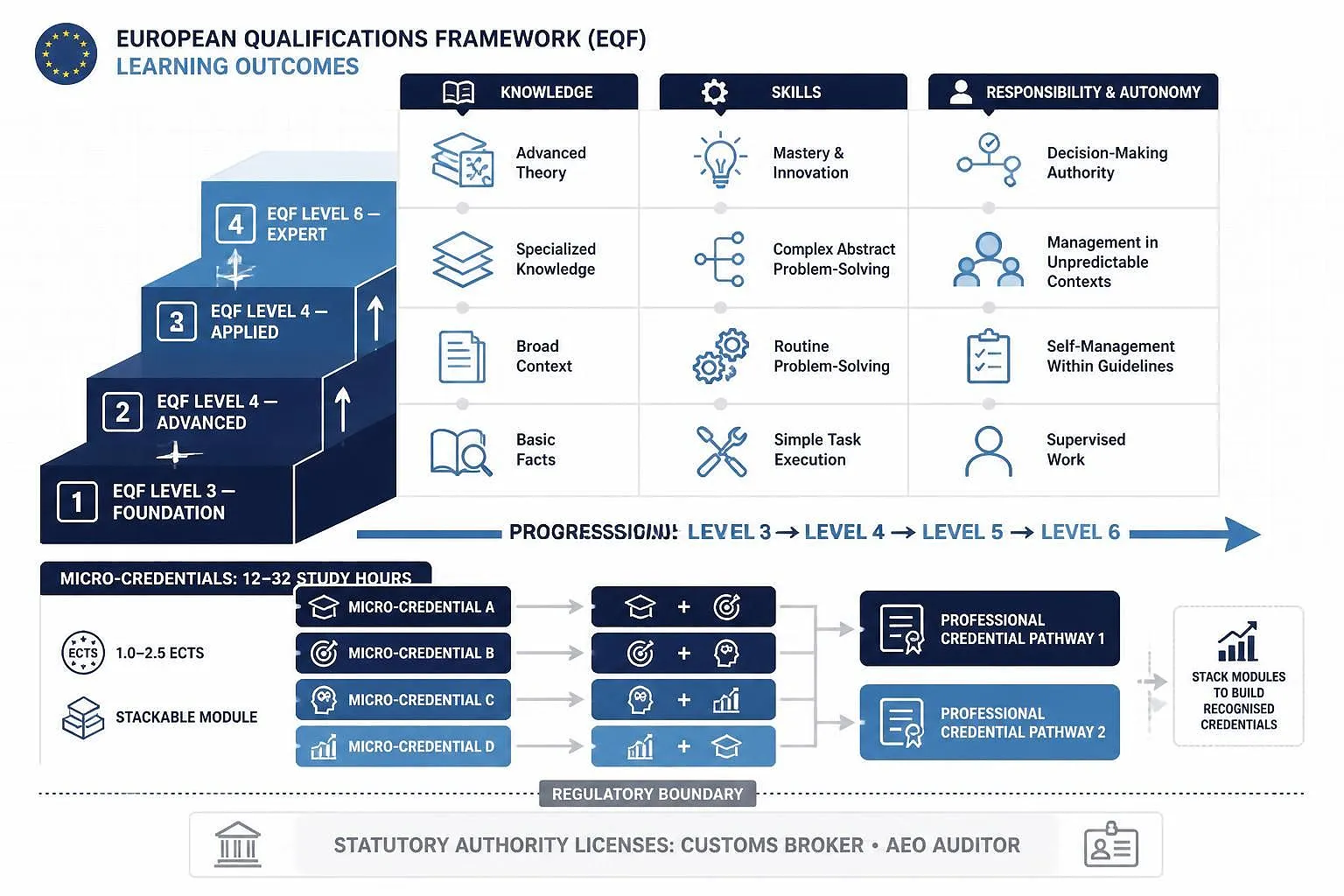
EQF Level Descriptors for VET Tiers
| EQF LEVEL | KNOWLEDGE DESCRIPTOR | RESPONSIBILITY & AUTONOMY |
|---|---|---|
| Level 3 (Found.) | Knowledge of basic facts, principles, & terminology in digital trade. | Take responsibility for completion of tasks in work under structured supervision. |
| Level 4 (Applied) | Factual & theoretical knowledge of broad trade workflows & customs codes. | Exercise self-management within guidelines; supervise routine operational trade tasks. |
| Level 5–6 (Advanced) | Advanced, specialized knowledge of complex UCC law & BTI dossiers. | Exercise management & decision-making in unpredictable trade & compliance contexts. |
2.2.1 Understanding EQF Level Descriptors
The EQF framework defines qualifications strictly through three dimensions of learning outcomes [2]:
- Knowledge: Described as theoretical and/or factual understanding of a field of work or study.
- EQF Level 3 (Foundation): Knowledge of basic facts, terminology, key concepts, and introductory principles of European digital trade [2].
- EQF Level 4 (Foundation/Applied): Factual and theoretical knowledge in broad contexts within digital trade documentation, basic customs concepts, and transport logistics [2].
- EQF Level 5 (Applied/Advanced): Comprehensive, specialized, factual and theoretical knowledge within trade compliance, tariff classification mechanics, and supply chain management [2].
- EQF Level 6 (Advanced): Advanced knowledge of a field of work, involving a critical understanding of theories, complex regulations (such as UCC Implementing Rules, CBAM calculations, or NIS2 cyber compliance), and legal principles [2].
- Skills: Described as cognitive (logical, intuitive, and creative thinking) and practical (involving manual dexterity and the use of methods, materials, tools, and instruments) performance capacity.
- EQF Level 3: Basic cognitive and practical skills required to use relevant information and basic digital tools to carry out tasks and solve routine problems [2].
- EQF Level 4: A range of cognitive and practical skills required to generate solutions to specific problems in a field of work (e.g., identifying packing list discrepancies or selecting standard Incoterms rules) [2].
- EQF Level 5: A comprehensive range of cognitive and practical skills required to develop creative solutions to abstract problems (e.g., performing complex Regional Value Content origin calculations or configuring B2B data schemas) [2].
- EQF Level 6: Advanced skills, demonstrating mastery and innovation, required to solve complex and unpredictable problems in a specialized field of work (e.g., formulating defensible Binding Tariff Information dossiers or managing customs audit appeals) [2].
- Responsibility and Autonomy: Described as the learner’s ability to apply knowledge and skills independently and responsibly under varying degrees of supervision.
- EQF Level 3: Taking responsibility for completion of tasks in work or study; adapting own behavior to circumstances in solving problems under structured supervision [2].
- EQF Level 4: Exercising self-management within the guidelines of work or study contexts that are usually predictable, but are subject to change; supervising the routine work of others [2].
- EQF Level 5: Exercising management and supervision in contexts of work or study activities where there is unpredictable change; reviewing and developing performance of self and others [2].
- EQF Level 6: Managing complex technical or professional activities or projects; taking responsibility for decision-making in unpredictable work or study contexts [2].
2.2.2 European Principles for Short Micro-Credentials
In accordance with the Council Recommendation of 16 June 2022 on a European approach to micro-credentials for lifelong learning and employability, short online professional courses are designed as modular, stackable learning units [22]. To maintain total regulatory integrity:
- Micro-Credential Definition: A micro-credential is the certified record of learning outcomes achieved by a learner following a small volume of learning (typically 12 to 32 study hours; 1.0 to 2.5 ECTS credit equivalents) [22].
- Stackability: Individual micro-credentials can be combined into broader Professional Credential Pathways (e.g., stacking Foundation, Applied, and Advanced modules plus a Capstone project) to build comprehensive workplace qualifications [5, 22].
- Statutory Non-Automation Boundary: Short professional micro-credentials provide certified workplace skills and VET micro-qualification badges. However, they do NOT independently confer university degrees (such as a 180 ECTS Bachelor’s or 120 ECTS Master’s degree under EHEA rules) nor do they automatically grant statutory authority licenses (such as a licensed customs broker status or AEO auditor certification) without formal evaluation by competent national authorities (such as the Portuguese Tax and Customs Authority or national accreditation bodies) [5, 23].
2.3 The Digital Competence Framework 3.0 (DigComp 3.0)
The European Digital Competence Framework for Citizens (DigComp 3.0), developed by the European Commission’s Joint Research Centre (JRC), serves as the official EU reference tool to measure, evaluate, and develop digital competencies across European populations and workforces [3]. As cross-border trade transitions rapidly from physical document exchanges to cloud-based logistics data platforms, electronic customs single windows, and automated compliance tools, digital literacy is no longer an optional skill—it is an absolute operational prerequisite [24].
DigComp 3.0 provides a structured, multi-dimensional framework that structures digital proficiency across 5 core thematic areas, encompassing 21 specific competences and 4 primary proficiency levels (Foundation, Intermediate, Advanced, Highly Specialised) [3]. Within professional digital trade training, every instructional lesson and practical toolkit is explicitly mapped to specific DigComp 3.0 competence statements, enabling enterprise managers to conduct objective digital skills gap analyses across their workforce [3, 25].

2.3.1 The Five Thematic Areas of DigComp 3.0 in Digital Trade Context
The DigComp 3.0 framework organizes digital capabilities across five primary domains [3]:
DigComp 3.0 Thematic Areas in Digital Trade
| DIGCOMP THEMATIC AREA | DIGITAL TRADE OPERATIONAL TASK |
|---|---|
| Area 1: Information & Data Literacy | Querying EU TARIC databases & verifying customs TARIC codes. |
| Area 2: Communication & Collaboration | Transmitting B2B/B2A eFTI data & issuing electronic eFBLs. |
| Area 3: Digital Content Creation | Generating e-invoices (PEPPOL) & filling e-customs declarations. |
| Area 4: Safety & Security | Maintaining NIS2 cyber hygiene & handling eIDAS 2.0 signatures. |
| Area 5: Problem Solving | Resolving portal submission errors & API data discrepancies. |
- Area 1: Information and Data Literacy:
-
- Framework Definition: Browsing, searching, filtering, evaluating, managing, and storing digital data, information, and content [3].
- Digital Trade Operational Mapping: Searching national customs databases (such as the Portuguese Tax and Customs Authority ACE Portal), filtering 10-digit TARIC commodity codes, extracting Binding Tariff Information (BTI) rulings, and verifying preferential rules of origin criteria [3, 14].
- Area 2: Communication and Collaboration:
-
- Framework Definition: Interacting, sharing, engaging, and collaborating through digital technologies while managing digital identity and netiquette [3].
- Digital Trade Operational Mapping: Executing electronic data exchanges between exporting SMEs, freight forwarders, and port community systems (such as the Janela Única Logística – JUL at the Port of Sines or Leixões), sharing electronic FIATA Bills of Lading (eFBL), and submitting regulatory data via eFTI platforms [3, 26].
- Area 3: Digital Content Creation:
-
- Framework Definition: Developing, editing, integrating, and re-elaborating digital content, understanding copyright, licenses, and automated programming logic [3].
- Digital Trade Operational Mapping: Assembling standardized structured trade files (e.g., XML/JSON Common Entry Module schemas), issuing structured electronic commercial invoices (EN 16931 / PEPPOL standards), and generating compliant packing list data schemas [3, 27].
- Area 4: Safety and Security:
-
- Framework Definition: Protecting digital devices, personal data, privacy, environment, and physical/psychological health in digital environments [3].
- Digital Trade Operational Mapping: Enforcing organizational cyber hygiene under the NIS2 Directive (Directive (EU) 2022/2555), applying GDPR data protection rules (Regulation (EU) 2016/679) to customer data, securing eIDAS 2.0 electronic seals, and safeguarding trade secrets against cyber-espionage [3, 28].
- Area 5: Problem Solving:
-
- Framework Definition: Identifying technical needs and problems, selecting appropriate digital tools, creatively using technology, and identifying digital competence gaps [3].
- Digital Trade Operational Mapping: Diagnosing customs portal data submission errors, selecting optimal enterprise resource planning (ERP) integration middleware, resolving API transport schema mismatches, and selecting targeted upskilling pathways to bridge internal operational skill gaps [3, 29].
2.4 ESG 2015 Standards as Internal Instructional Design Guidance
The Standards and Guidelines for Quality Assurance in the European Higher Education Area (ESG 2015) were adopted by the Ministers responsible for higher education in the EHEA to provide a common framework for quality assurance in higher education institutions [4]. While formal ESG accreditation mechanisms apply exclusively to higher education degree-awarding institutions (universities and polytechnics) [30], professional vocational education and training frameworks adapt Part 1 of the ESG 2015 (Internal Quality Assurance) as rigorous internal instructional design guidance [4, 5].
Utilizing ESG 2015 Part 1 principles ensures that professional adult courses maintain academic integrity, pedagogical structure, transparent assessment, and comprehensive learner support [4]. However, training providers must maintain a strict, unambiguous boundary between adopting ESG principles as internal instructional design guidelines and claiming formal university accreditation under national higher education agencies (such as A3ES in Portugal) [4, 30].
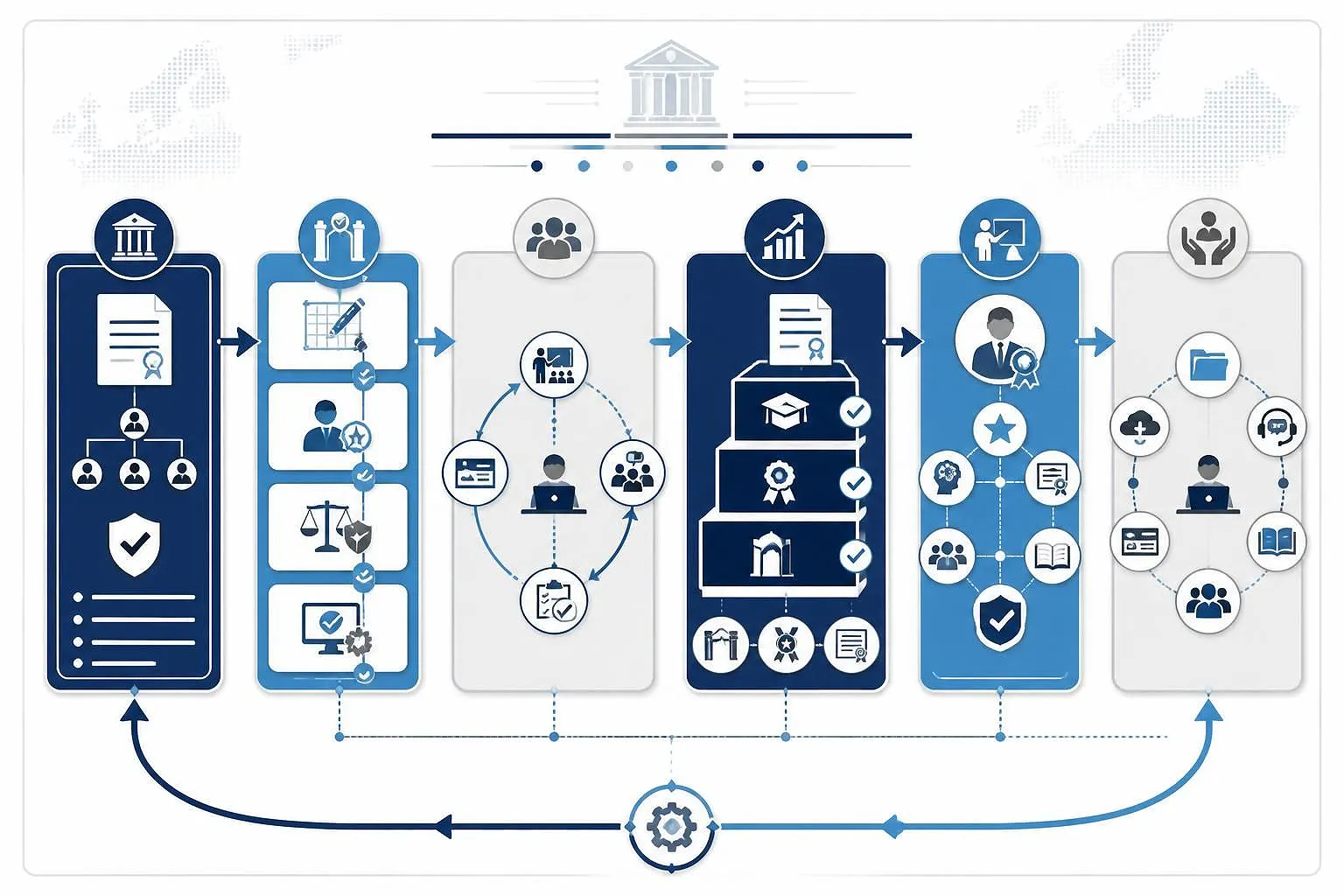
2.4.1 Key ESG 2015 Internal Design Standards Applied to VET
Professional adult course production incorporates six core internal standards from ESG 2015 Part 1 [4]:
- ESG Standard 1.1 (Policy for Quality Assurance): The course provider maintains a publicly available, formal quality assurance policy that details curriculum design standards, change control board procedures, and continuous improvement cycles [4].
- ESG Standard 1.2 (Design and Approval of Programmes): Courses are designed by qualified instructional architects and subject-matter experts using measurable learning outcomes. Programs undergo formal peer-review quality gates (Gate 1 Instructional Design, Gate 2 Subject-Matter Expertise, Gate 3 Statutory Legal Verification, Gate 4 LMS Functionality) prior to publication [4, 5].
- ESG Standard 1.3 (Student-Centred Learning, Teaching and Assessment): Instructional delivery encourages active learner engagement through real-world business scenarios, step-by-step practical workflows, and self-paced problem-solving. Assessment strategies evaluate outcome achievement through transparent criteria, non-spoiling diagnostic hints, and learner-friendly feedback [4].
- ESG Standard 1.4 (Student Admission, Progression, Recognition and Certification): Clear entry prerequisite guidance is provided to adult learners. Course progression criteria, quiz pass thresholds (60% Foundation, 70% Applied, 75% Advanced), and micro-credential completion criteria are defined transparently [4, 22].
- ESG Standard 1.5 (Teaching Staff Competence): Instructional authors, subject-matter experts, and review panel members possess documented domain expertise in European trade law, logistics engineering, and vocational pedagogy [4].
- ESG Standard 1.6 (Learning Resources and Student Support): Learners receive access to comprehensive downloadable toolkits (checklists, decision trees, calculation matrices), technical glossaries, clear platform navigation guides, and responsive technical helpdesk support [4].
3. Practical Workflow: Educational Quality Assurance & Audit Matrix
To operationalize European educational standards within an enterprise or training organization, training managers execute a standardized 5-step Educational Quality Assurance Audit Workflow. This workflow ensures that internal employee upskilling plans align strictly with EQAVET quality cycles, EQF level descriptors, DigComp 3.0 competence areas, and national VET certification requirements [1, 2, 3].
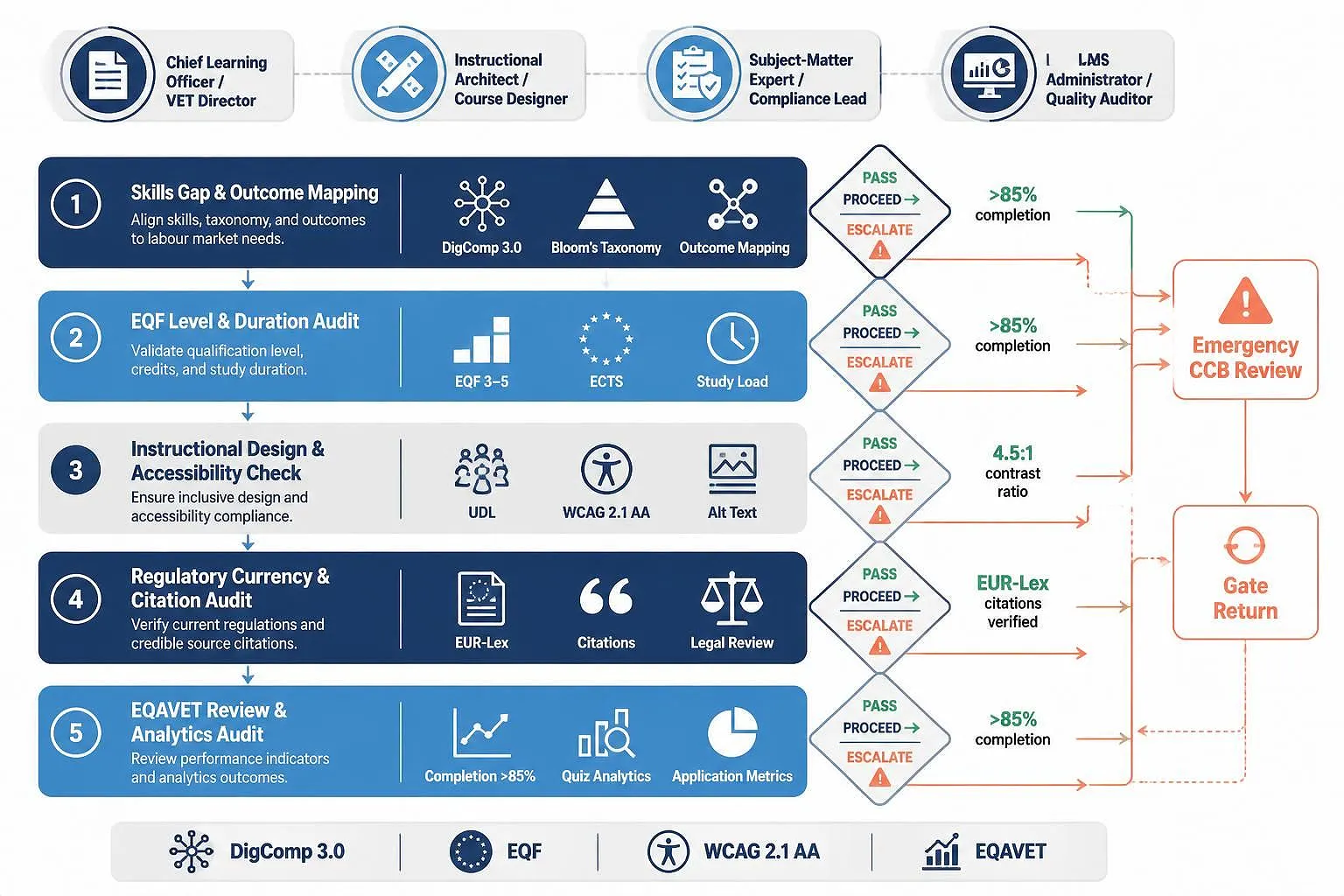
3.1 Role Responsibility Matrix for Educational QA
Executing educational quality assurance involves four key organizational roles [1, 4]:
- Chief Learning Officer / VET Director: Responsible for overall quality policy enforcement, EQAVET Indicator monitoring, and Change Control Board approvals.
- Instructional Architect / Course Designer: Responsible for formulating Bloom’s taxonomy learning outcomes, designing UDL-compliant lessons, and embedding DigComp 3.0 competence statements.
- Subject-Matter Expert (SME) / Compliance Lead: Responsible for verifying regulatory currency, legal citations, and practical accuracy against EU and national trade laws.
- LMS Administrator / Quality Auditor: Responsible for managing assessment analytics, tracking learner completion rates, and verifying technical functionality across the learning management system.
3.2 The 5-Step Educational Quality Audit Table
EQAVET Audit Framework – Quality Assurance Steps
| Step | Audit Stage | Required Tool / Standard | Operational Decision Point | Escalation Trigger |
|---|---|---|---|---|
| 1 | Skills Gap & Outcome Mapping | DigComp 3.0 Framework [3] & CEDEFOP Guidelines [5] | Are training objectives formulated using explicit Bloom’s verbs and mapped to DigComp competence statements? | If outcomes are vague or lack measurable Bloom’s verbs, return to instructional designer for revision. |
| 2 | EQF Level & Duration Audit | EQF Level Descriptors [2] & ECTS Credit Metric | Does the course study duration (12–32h) and autonomy expectation match the target EQF level (Level 3–5)? | If study volume is under 12 hours, classify as a micro-module rather than a full micro-credential. |
| 3 | Instructional Design & Accessibility Check | ESG 2015 Standard 1.3 [4] & WCAG 2.1 AA Checklist | Does lesson content include UDL features, structured toolkits, and WCAG 2.1 AA image alt-text? | If media lacks alt-text or contrast ratio is under 4.5:1, flag for immediate UI remediation. |
| 4 | Regulatory Currency & Citation Audit | Statutory EUR-Lex Directives [14] & National Rules [10] | Are all legal assertions grounded in current EU regulations with clean numeric footnotes and APA references? | If unverified external sources or raw database codes appear in learner text, reject at Gate 3. |
| 5 | EQAVET Review & Analytics Audit | EQAVET Indicators 3, 5, 6 [1] & LMS Quiz Analytics | Does the module achieve a >85% completion rate and a 60-day post-training workplace application score >80%? | If module quiz failure rate exceeds 30%, trigger an emergency CCB review of question difficulty. |
4. Realistic Enterprise Case Study
4.1 Enterprise Scenario Narrative
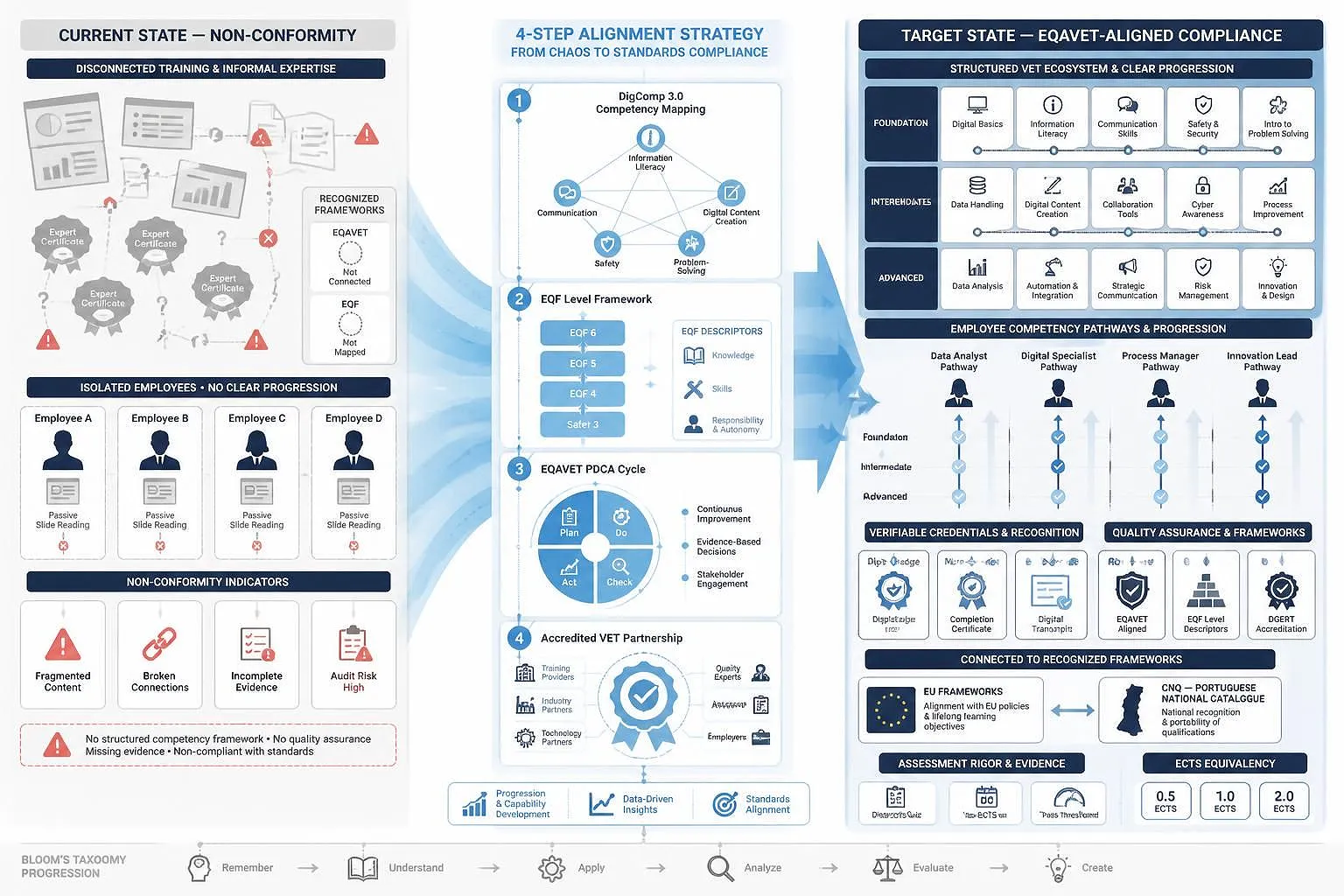
NorteLog Transportes e Logística S.A. is a regional freight forwarding and logistics enterprise headquartered in Maia, near Porto, Portugal. Operating an ocean-freight haulage fleet and bonded warehousing facilities near the Port of Leixões and the Port of Aveiro, the company employs 45 export coordinators, customs declarants, and warehouse supervisors.
Facing new digital mandates under the EU eFTI Regulation (Regulation (EU) 2020/1056), mandatory electronic invoicing, and updated Portuguese Tax and Customs Authority (ACE Portal) pre-lodgment schemas, NorteLog’s Human Resources and Training Manager was tasked with developing an internal workforce upskilling program. The HR Manager created a series of short internal training slides and issued internal “Digital Customs Expert Certificates” to staff upon reading the slides.
During a recent ISO 9001 and DGERT vocational quality audit, the external auditor issued a major non-conformity finding. The auditor noted that NorteLog’s internal training program lacked:
- Formulated learning outcomes mapped to recognized European frameworks (such as EQF or DigComp 3.0) [2, 3].
- Documented quality assurance processes matching the EQAVET Plan-Do-Check-Act cycle [1].
- Objective, verifiable assessment instruments with transparent pass thresholds [4].
- Clear distinction between internal orientation certificates and official national VET micro-credentials recognized on the Portuguese National Catalogue of Qualifications (CNQ) [10].
NorteLog’s Managing Director requested an immediate restructuring of the company’s workforce training framework to align strictly with European educational standards, eliminate audit non-conformities, and establish verifiable workforce competencies for digital trade execution [1].
4.2 4-Part Evaluation Key
Part 1: Primary Operational & Quality Diagnosis
NorteLog S.A. is suffering from informal, unaccredited corporate training design that fails to satisfy European VET quality assurance benchmarks [1]. Issuing internal certificates labeled “Expert” without defined EQF level descriptors, DigComp 3.0 competence mapping, or auditable assessment criteria exposes the enterprise to legal non-conformity during quality audits and provides no objective proof of operational competence [2, 3]. The company must transition from informal slide-reading sessions to a structured, EQAVET-aligned vocational micro-credential framework [1, 5].
Part 2: Recommended 4-Step Educational Alignment Strategy
- Adopt DigComp 3.0 Competency Mapping: Map all 45 employee job roles against DigComp 3.0 thematic areas [3]. For customs declarants, establish baseline targets in Area 1 (Information & Data Literacy – TARIC queries) and Area 3 (Digital Content Creation – XML customs filings) [3, 14].
- Restructure Curriculum under EQF Level Descriptors: Re-align internal training modules to match EQF Level 4 (Applied) operational parameters (12–24 study hours; 1.0–2.0 ECTS credit equivalents) with clear Bloom’s taxonomy learning outcomes (e.g., audit, verify, transmit) [2, 5].
- Implement the EQAVET PDCA Cycle: Establish a formal Quality Assurance Policy (ESG 1.1) [4]. Execute Phase 1 Planning via baseline skills assessments, Phase 2 Implementation via accessible e-learning portals, Phase 3 Evaluation via diagnostic quizzes and 60-day workplace audits, and Phase 4 Review via annual CCB updates [1].
- Partner with Accredited VET Providers / DGERT Certified Hubs: Enroll staff in recognized EDTC vocational micro-credential courses that issue verifiable digital badges registered under European micro-credential standards, ensuring full transparency for statutory audits [5, 10, 22].
Part 3: Alternative Acceptable Modular Approach
If budget constraints prevent immediate external enrollment for all 45 employees, NorteLog S.A. may implement a hybrid modular approach. Under this approach, the company enrolls 5 senior compliance leads in Advanced EDTC courses (EQF Level 5–6). These certified leads then act as internal mentors, delivering pre-approved, EQAVET-compliant micro-modules to junior staff using standardized EDTC downloadable toolkits and assessment banks [1, 5].
Part 4: Common Management & Learner Misconceptions
- Misconception 1: Assuming that reading a PDF document or slide deck constitutes a completed vocational course. Correction: VET standards require active student-centred learning, verifiable learning outcomes, structured practice, and rigorous diagnostic assessment [4].
- Misconception 2: Believing that short online micro-credentials confer academic university degree titles. Correction: Micro-credentials confer targeted workplace skill badges (EQF Levels 3–6) and ECTS credit equivalencies for lifelong learning, but do not replace higher education degree titles [2, 5, 22].
5. Governance, Educational Limitations & Glossary
5.1 Key Takeaways
- EQAVET Continuous QA Baseline: Quality assurance in European vocational education relies on the Plan-Do-Check-Act (PDCA) cycle to continuously align training outcomes with dynamic trade regulations [1].
- EQF Micro-Credential Hierarchy: Short vocational courses (12–32 study hours; 1.0–2.5 ECTS equivalents) correspond to EQF Levels 3–6 micro-credentials, evaluating Knowledge, Skills, and Autonomy [2, 5].
- DigComp 3.0 Competency Standards: Workforce digital readiness is evaluated across 5 thematic areas and 21 competences, establishing standardized proficiency benchmarks for digital trade tasks [3].
- ESG 2015 Design Integrity: Part 1 of ESG 2015 provides essential internal instructional design guidance (student-centred learning, transparent assessment) without replacing university degree accreditation [4].
5.2 Educational Limitations & Non-Automation Disclaimer
This instructional unit provides general guidance regarding European educational quality frameworks, qualification standards, and digital competency frameworks. Completion of this unit confirms vocational awareness and skill development under EQF Levels 3–4 parameters. It does NOT constitute formal academic university degree conferral, statutory customs broker licensing, or direct accreditation by national qualification agencies. Enterprise training managers must verify specific national VET registration requirements with competent national bodies (such as DGERT and ANQEP in Portugal).
5.3 Technical Glossary
- EQAVET (European Quality Assurance in Vocational Education and Training): European reference framework establishing a continuous PDCA quality cycle and 10 systemic indicators for VET provision [1].
- EQF (European Qualifications Framework / QEQ): 8-level translation grid defining qualifications through learning outcomes across Knowledge, Skills, and Autonomy [2].
- DigComp 3.0: The EU Digital Competence Framework defining 21 competences across 5 thematic areas for digital workforce assessment [3].
- Micro-Credential (Microcredencial): Certified record of learning outcomes achieved through a focused, short volume of learning (12–32h; 1.0–2.5 ECTS) [22].
- ESG 2015: Standards and Guidelines for Quality Assurance in the European Higher Education Area, used in VET as internal design guidance [4].
- PDCA Cycle (Ciclo PDCA): Continuous quality management model consisting of Plan, Do, Check, and Act [1].
6. References & Source Material
- European Parliament & Council of the European Union. (2009). Recommendation of the European Parliament and of the Council of 18 June 2009 on the establishment of a European Quality Assurance Reference Framework for Vocational Education and Training (EQAVET) (Text with EEA relevance, 2009/C 155/01). Official Journal of the European Union, C 155, 1–10.
- Council of the European Union. (2017). Council Recommendation of 22 May 2017 on the European Qualifications Framework for lifelong learning and repealing the recommendation of the European Parliament and of the Council of 23 April 2008 on the establishment of the European Qualifications Framework for lifelong learning (2017/C 189/03). Official Journal of the European Union, C 189, 15–28.
- Joint Research Centre (European Commission). (2022). DigComp 2.2 / 3.0: The Digital Competence Framework for Citizens – With new examples of knowledge, skills and attitudes (EUR 31006 EN). Publications Office of the European Union. https://data.europa.eu/doi/10.2760/115370
- European Association for Quality Assurance in Higher Education, European Students’ Union, European University Association, & European Association of Institutions in Higher Education. (2015). Standards and Guidelines for Quality Assurance in the European Higher Education Area (ESG 2015). ENQA. https://www.enqa.eu/wp-content/uploads/2015/11/ESG_2015.pdf
- European Centre for the Development of Vocational Training (CEDEFOP). (2022). European guidelines for the development and writing of short, learning-outcomes-based descriptions of qualifications. CEDEFOP Reference Series, No. 122. Publications Office of the European Union. https://data.europa.eu/doi/10.2801/835721
- European Commission. (2021). Communication from the Commission to the European Parliament, the Council, the European Economic and Social Committee and the Committee of the Regions: 2030 Digital Compass: the European way for the Digital Decade (COM(2021) 118 final). European Commission.
- CEDEFOP. (2020). Vocational education and training in Europe, 1995-2035: Scenarios for European VET development. CEDEFOP Research Paper, No. 78. Publications Office of the European Union.
- World Customs Organization. (2023). WCO Framework of Standards on Cross-Border E-Commerce. WCO Publications.
- European Parliament & Council of the European Union. (2020). Council Recommendation of 24 November 2020 on vocational education and training (VET) for sustainable competitiveness, social fairness and resilience (2020/C 417/01). Official Journal of the European Union, C 417, 1–16.
- Agência Nacional para a Qualificação e o Ensino Profissional & Direção-Geral do Emprego e das Relações de Trabalho. (2023). Guia de Alinhamento das Qualificações Vocacionais com o Catálogo Nacional de Qualificações (CNQ). Ministério do Trabalho, Solidariedade e Segurança Social de Portugal.
- European Commission. (2023). Customs Reform: A modern Customs Union for a seamless Single Market (COM(2023) 257 final). European Commission.
- EQAVET Secretariat. (2021). EQAVET Building Blocks: Quality Assurance Principles for VET Providers. European Quality Assurance in Vocational Education and Training.
- European Training Foundation. (2021). Quality Assurance in Vocational Education and Training: Standardisation and Development in EU Partner Countries. ETF Publications.
- European Parliament & Council of the European Union. (2013). Regulation (EU) No 952/2013 of the European Parliament and of the Council of 9 October 2013 laying down the Union Customs Code. Official Journal of the European Union, L 269, 1–101.
- EQAVET Secretariat. (2020). EQAVET Indicator Framework and Guidelines for VET Systems and Providers. European Commission.
- World Wide Web Consortium. (2018). Web Content Accessibility Guidelines (WCAG) 2.1 (W3C Recommendation 05 June 2018). W3C. https://www.w3.org/TR/WCAG21/
- CEDEFOP. (2021). The application of learning outcomes in European VET systems: Assessment methods and quality metrics. Publications Office of the European Union.
- European Parliament & Council of the European Union. (2020). Regulation (EU) 2020/1056 of the European Parliament and of the Council of 15 July 2020 on electronic freight transport information (eFTI). Official Journal of the European Union, L 249, 33–43.
- European Commission. (2022). Proposal for a Council Recommendation on European learning passports and micro-credentials for lifelong learning and employability (COM(2021) 770 final). European Commission.
- International Labour Organization. (2022). Digitalization and Skills Anticipation in Global Supply Chains. ILO Publishing.
- CEDEFOP. (2019). National qualifications framework developments in Europe 2019. Publications Office of the European Union.
- Council of the European Union. (2022). Council Recommendation of 16 June 2022 on a European approach to micro-credentials for lifelong learning and employability (2022/C 243/02). Official Journal of the European Union, C 243, 10–25.
- Autoridade Tributária e Aduaneira. (2024). Manual de Qualificação e Certificação de Operadores Económicos Autorizados (AEO). Ministério das Finanças de Portugal.
- European Parliament & Council of the European Union. (2021). Regulation (EU) 2021/694 of the European Parliament and of the Council of 29 April 2021 establishing the Digital Europe Programme. Official Journal of the European Union, L 166, 1–34.
- European Training Foundation. (2023). Digital Skills and Competence Frameworks in VET: A Comparative European Study. ETF Publications.
- International Federation of Freight Forwarders Associations. (2023). FIATA Digital Bill of Lading (eFBL) Technical Standards and Data Schema. FIATA Publishing.
- European Multi-Stakeholder Forum on e-Invoicing. (2021). e-Invoicing Architecture and Compliance under European Standard EN 16931. European Commission.
- European Parliament & Council of the European Union. (2022). Directive (EU) 2022/2555 of the European Parliament and of the Council of 14 December 2022 on measures for a high common level of cybersecurity across the Union (NIS2 Directive). Official Journal of the European Union, L 333, 80–152.
- Presidência do Conselho de Ministros. (2020). Resolução do Conselho de Ministros n.º 30/2020: Aprova o Plano de Ação para a Transição Digital de Portugal. Diário da República, 1.ª série, N.º 78, 2–21.
- Agência de Avaliação e Acreditação do Ensino Superior (A3ES). (2022). Manual de Avaliação Externa e Acreditação de Ciclos de Estudos. A3ES Editorial.