


















Overview
Curriculum
Certificates
Instructor
Trade Finance Fundamentals – Foundation is an introductory course that explains how businesses finance, structure, secure, and manage international trade transactions.
The course gives learners a practical overview of the financial relationship between exporters, importers, banks, insurers, payment service providers, freight forwarders, and other trade participants. It explains how payment terms affect risk, cash flow, working capital, and commercial relationships.
Learners will examine the main methods of payment used in international trade:
- Cash in advance
- Letters of credit
- Documentary collections
- Open-account terms
- Consignment
These methods distribute payment risk differently between the exporter and the importer. Cash in advance generally protects the exporter most strongly, while open-account terms are usually more favorable to the buyer but create greater payment exposure for the seller. The appropriate method depends on factors such as the relationship between the parties, country risk, creditworthiness, transaction value, competition, and the nature of the goods or services.
The course also introduces export and import finance, working capital, factoring, receivables finance, supply chain finance, foreign-exchange risk, trade credit insurance, cargo insurance, bank guarantees, and digital trade finance.
Learners will develop the ability to compare financing options and identify the questions that should be addressed before agreeing to payment terms. They will also learn why accurate and consistent documentation is essential, especially when a transaction uses a letter of credit. A letter of credit generally requires the exporter to present documents that comply with the terms specified by the issuing bank; discrepancies can delay payment or result in additional costs.
Documentary collections are also covered as a lower-cost alternative to letters of credit. Banks facilitate the exchange of documents and payment instructions, but they generally do not provide the same payment guarantee or document-verification function associated with a letter of credit. For this reason, documentary collections are commonly considered more suitable for established trading relationships and relatively stable markets.
The course uses examples relevant to European and international trade, including Portuguese SMEs, exporters, importers, freight forwarders, manufacturers, distributors, logistics companies, and service providers. It is suitable for learners who need a clear foundation before progressing to export finance, import finance, factoring, supply chain finance, structured trade finance, or international trade negotiation.
This is an educational foundation course. Completion does not constitute financial, banking, accounting, insurance, legal, customs, or regulatory certification. The course does not provide individualized financial advice or guarantee that a particular financing method is suitable for a specific transaction.
Course metadata
| Field | Course information |
|---|---|
| Pillar | Pillar 5: Trade Finance, Payments & Insurance |
| Categories | Trade Finance Fundamentals; Payments and Foreign Exchange; Trade Credit and Cargo Insurance |
| Course level | Foundation |
| Difficulty | Beginner |
| Estimated study time | 4–5 hours |
| Format | Text-first lessons, micro-video summaries, quizzes, scenarios, and practical worksheets |
| Language | American English |
| Market relevance | European Union, Portugal, and international trade |
| Prerequisites | None |
| Assessment | Knowledge checks and final payment-method comparison exercise |
| Certificate | EDTC Certificate of Completion – Foundation |
| Version | 1.0 |
| Regulatory and standards review | September 20, 2026 |
| Recommended review cycle | Every 6 months, or sooner when relevant rules, banking practices, or trade standards change |
Learning outcomes
By the end of the course, learners should be able to:
- Define trade finance and explain its role in international commerce.
- Identify the main parties involved in a trade finance transaction.
- Compare cash in advance, letters of credit, documentary collections, open-account terms, and consignment.
- Explain how payment terms affect exporter and importer risk.
- Describe the basic structure and workflow of a letter of credit.
- Recognize common documentary discrepancies that may delay payment.
- Explain the basic purpose of documentary collections.
- Distinguish between pre-shipment and post-shipment finance.
- Explain how working capital affects import and export transactions.
- Identify the basic purposes of factoring, receivables finance, and supply chain finance.
- Recognize foreign-exchange, credit, country, political, and commercial risks.
- Explain the role of trade credit insurance and cargo insurance.
- Identify common questions to ask a bank, insurer, or financial provider.
- Build a basic trade finance decision matrix for a sample transaction.
Lessons
| Lesson | Title | Main focus |
|---|---|---|
| 1 | What Is Trade Finance? | Purpose, scope, participants, and the relationship between trade and finance |
| 2 | Payment Risk in International Trade | Exporter and importer risk, credit risk, country risk, political risk, and commercial risk |
| 3 | Choosing International Payment Methods | Cash in advance, letters of credit, documentary collections, open account, and consignment |
| 4 | Letters of Credit: Structure and Workflow | Applicants, beneficiaries, issuing banks, advising banks, documents, conditions, and payment |
| 5 | Documentary Collections and Bank Guarantees | Documentary payment, acceptance, bank roles, guarantees, and limitations |
| 6 | Working Capital for Importers and Exporters | Pre-shipment finance, post-shipment finance, cash conversion, and liquidity planning |
| 7 | Factoring, Receivables Finance and Supply Chain Finance | Managing receivables, supplier finance, approved payables, and working-capital options |
| 8 | Foreign Exchange, Payments and Transaction Costs | Currency exposure, payment channels, fees, settlement timing, and basic risk management |
| 9 | Trade Credit and Cargo Insurance | Credit insurance, marine cargo insurance, claims, exclusions, and risk transfer |
| 10 | Building a Trade Finance Decision Plan | Comparing options, documenting assumptions, selecting next steps, and communicating with financial providers |
Included practical resources
- International Payment Method Comparison Matrix
- Letter of Credit Workflow
- Letter of Credit Document Checklist
- Documentary Collection Workflow
- Export Payment-Risk Assessment
- Import Finance Questions Checklist
- Working-Capital Planning Worksheet
- Foreign-Exchange Exposure Checklist
- Trade Credit Insurance Questions Checklist
- Basic Trade Finance Decision Template
- Sample Transaction-Financing Scenario
Primary learner profile
The primary learner is an SME owner, trade administrator, exporter, importer, or finance professional who needs to understand how international payment and financing options affect risk, liquidity, customer relationships, and transaction execution.
The course is particularly useful for learners who:
- Are preparing for their first export or import transaction.
- Need to compare payment terms offered by a foreign buyer or supplier.
- Want to understand how letters of credit work.
- Need to discuss working capital with a bank.
- Want to reduce exposure to delayed or nonpayment.
- Need to understand the difference between banking, insurance, and financing products.
- Are preparing for an EDTC trade finance or international trade learning pathway.
Recommended next courses
After completing this course, learners can progress to:
- Export Finance
- Import Finance
- Factoring and Receivables Finance
- Supply Chain Finance
- Structured Trade Finance
- International Trade Fundamentals
- Trade Documentation
- EU Customs and Import/Export Compliance
- Strategic Negotiation and Procurement
Regulatory and standards status box
| Item | Course status |
|---|---|
| Main subject areas | International payment methods, trade finance products, banking processes, insurance, working capital, and foreign exchange |
| Relevant rules and standards | Applicable banking rules, documentary-credit rules, collection rules, financial regulations, insurance requirements, and local contractual terms |
| Geographic scope | European Union, Portugal, and international transactions |
| Regulatory status | Introductory awareness; not a legal or financial compliance course |
| Operational relevance | Helps learners identify payment risks, financing options, documentation needs, and questions for qualified providers |
| Last content review | September 20, 2026 |
| Next planned review | March 20, 2027 |
| Content owner | EDTC Trade Finance Subject-Matter Owner |
| Change log | Initial course version |
| Important limitation | Course completion does not qualify a learner to approve credit, provide financial advice, issue banking instruments, underwrite insurance, or determine regulatory compliance |
Certificate
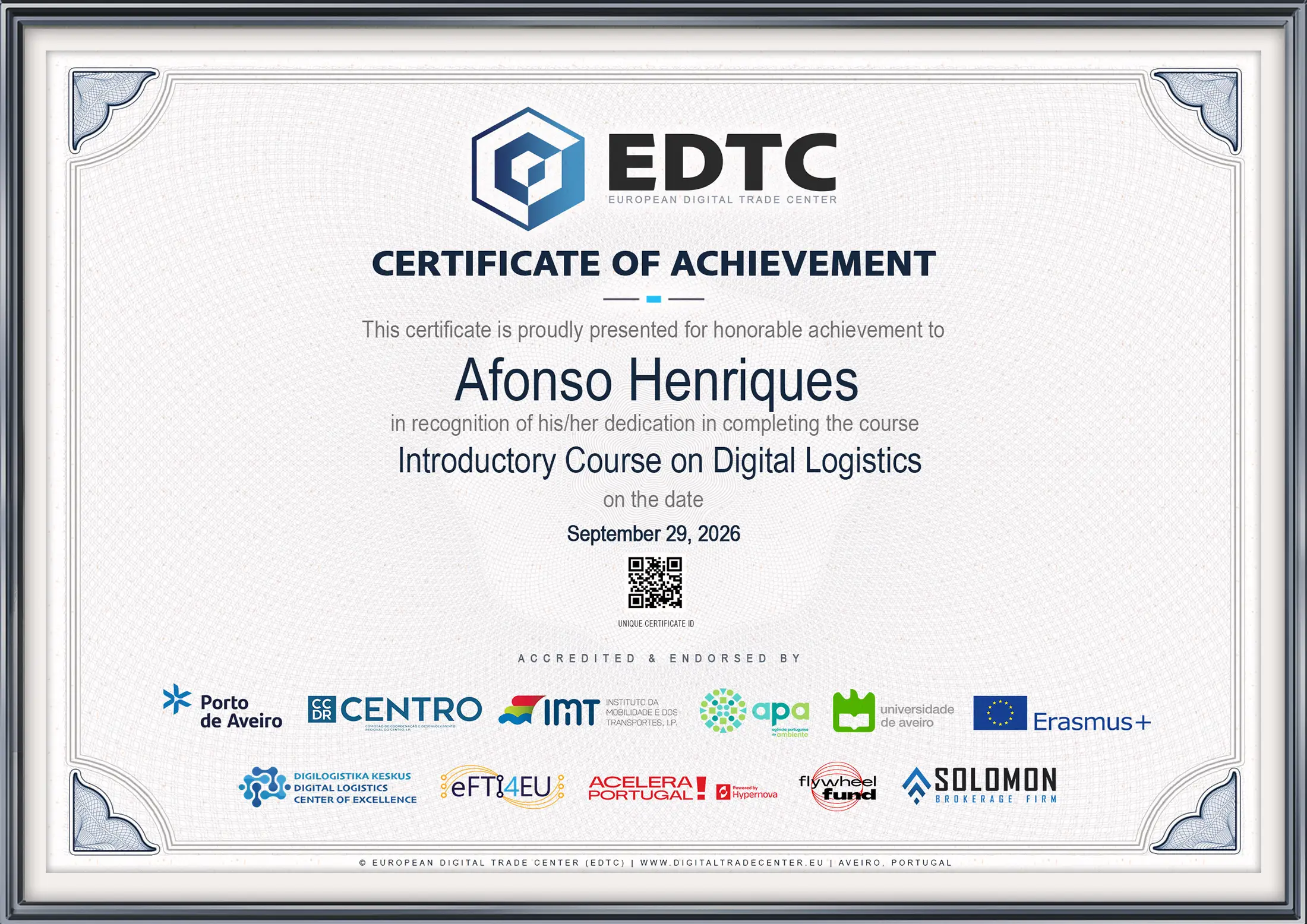
Earn a Certificate & Showcase Your Skills
Complete this course and earn a verified certificate to showcase your new skills. Share it on LinkedIn, add it to your resume, or download it for your records.

Instructor
European Digital Trade Center (EDTC)
2552 Students10 Courses
The European Digital Trade Center (EDTC) helps businesses and professionals participate in sustainable, technology-enabled international trade. Through its membership-based platform, EDTC offers practical training, assessments, and certifications in digital trade, logistics, transportation, trade finance, and compliance. Qualified members can access a digital brokerage marketplace to connect with relevant buyers and sellers, while organizations can receive support in implementing eLogistics, paperless trade, and digital transportation solutions.
Reviews